Build a Sourcing Workflow Before You Buy Anything
Sourcing consistent heritage fixtures starts long before you open a supplier catalogue, it starts with a survey. Restoration Station has spent more than 35 years helping owners of heritage-listed, Colonial and Federation-style homes match new hardware to original features, and the pattern is always the same: projects that stall bought first and measured later.
A heritage fixture is any fitting, handle, hinge, stay or light that matches the age and style of a historic property. Get the survey right and everything after it gets easier.
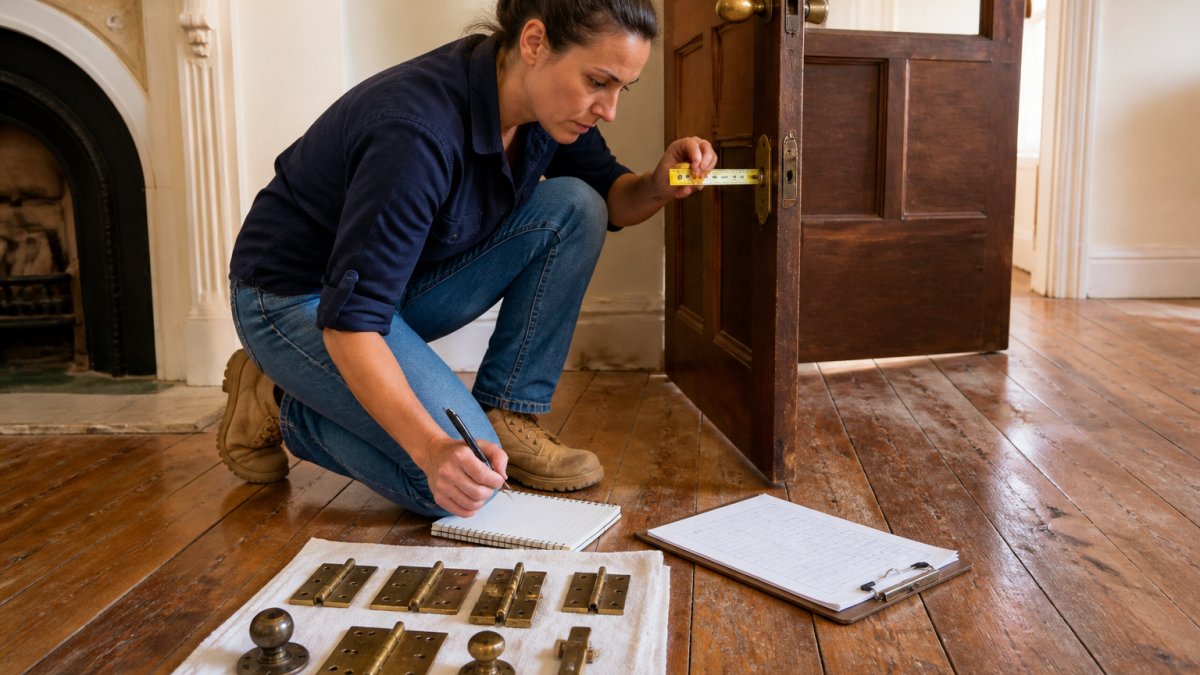
Survey each room and record existing fixtures
Walk every room with a notepad and record what is there: door handles, hinges, window stays, sash lifts and light fittings, plus finish and approximate age. Photograph each next to a ruler for scale.
Mark which items are original, which have been replaced, and which are missing entirely. That list becomes your shopping brief.
Set your specification and budget before requesting quotes
Write down what you need before requesting a price. A clear spec stops you ordering the wrong item twice.
- The style and era you are matching
- The finish (brass, bronze, iron, nickel)
- The size and fixing centres of each item
- How many of each you need
Send the same spec to every supplier. Quotes are only comparable when the brief is identical.
Heritage Door Hardware: Choosing Period-Correct Knobs, Handles and Hinges
Heritage door hardware is the fastest way to make a period home feel right, or wrong.
Match the style to the era. Federation homes suit round knobs and decorative backplates.
Material matters too. Solid brass ages well and develops a natural patina. Cast iron suits heavier doors and outbuildings.
Check three things on every door:
- The backset (distance from the door edge to the handle centre)
- The door thickness
- The existing latch or mortice cut-out
Get these wrong and even a perfect-looking handle will not fit.
Heritage Window Hardware: Stays, Fasteners and Sash Lifts
Heritage window hardware keeps sash windows working and looking correct.
Window stays hold a casement open, fasteners lock it shut, and sash lifts raise a heavy double-hung window without straining the frame.
Weigh the sash before ordering a lift: a heavy original sash needs a sturdier lift than a modern replacement.
Finish consistency matters here: if your door hardware is aged brass, your window hardware should match.
Door Hardware Measurements: What to Record Before You Order
Door hardware measurements decide whether your order fits or fails. Record five numbers for every door before buying.
| Measurement | What to Record | Why It Matters |
|---|---|---|
| Backset | Edge of door to handle centre | Wrong backset means the handle will not line up |
| Door thickness | Full thickness in millimetres | Determines which latch and spindle fit |
| Fixing centres | Distance between screw holes | Old holes must match the new plate |
| Handle height | Height from floor to centre | Keeps handles level across a room |
| Latch type | Mortice, tubular or rim | Sets the cut-out you need |
Measure in millimetres and record everything in one place, a single spreadsheet or notebook beats scraps of paper.
How to Vet Suppliers for Consistent Heritage Fixtures
Supplier vetting separates a smooth multi-room project from a mess of mismatched parts. A good supplier can tell you the era a piece suits, its material, and whether they can repeat the order in six months; a weak one sells you a single handle and disappears when you need forty more.
Most competitors stop at "ask about lead times", not enough for a project-scale order. Use the checklist below before committing a full-house budget.
The supplier vetting checklist
Work through each item and get the answer in writing, email is fine, a verbal promise is not.
- Stock reliability. Do they hold the item in stock, or is every piece made to order? Made-to-order is fine for bespoke work, but it means every top-up order restarts the clock.
- Lead times. Ask for the lead time on a first order and, separately, on a repeat order. Repeat orders are usually faster, but not always, some suppliers only run a finish when they have enough volume.
- Batch consistency. Ask how they control finish variation between production runs. A supplier who understands heritage work will have an answer; one who does not will look puzzled.
- Replacement availability. If a handle breaks two years after install, can they supply a matching one? Ask how long they keep a line in production.
Continuity checks for multi-room and multi-order projects
For a whole-house job, place one large order rather than several small ones: one order means one production batch and one consistent finish, the most effective way to avoid mismatched brass across a hallway.
- Get the batch or run number in writing
- Photograph the finish of your first delivery
- Compare the second delivery against that photo before you install
- Keep one spare of each item in case of breakage or a late change
Projects often need a top-up order partway through, a door added, a window replaced, a fitting damaged on site. Suppliers who understand this flag finish variation before you order, not after.
Red flags to walk away from
Some answers should end the conversation:
- No batch or run number available on request
- No written confirmation of finish or specification
- Lead times quoted only verbally, with no follow-up in writing
- No process for repeat orders or replacements
- A finish that cannot be matched to a sample you already hold
If a supplier cannot answer these questions, they are unlikely to support a multi-room heritage project from survey to install. Better to find out now than halfway through a build.
Build a Hardware Schedule for Renovation Projects
A hardware schedule for renovation projects is one document listing every fitting you need, room by room.
Build it in a simple table with these columns:
- Room
- Item (handle, hinge, stay, lift)
- Style and era
- Finish
- Quantity
Update it as you order and tick off deliveries. Missing items show at a glance instead of surfacing on install day.
It also protects your budget: you see total cost per room before committing, and can spot where a cheaper finish saves money without hurting the look.
Authenticity, Approvals and Heritage Constraints
Authenticity and approvals can stop a project in its tracks. Many older properties sit under a heritage overlay, a planning control that limits what you can change.
Before ordering anything, check with your local council about what applies.
Preserve original features where you can, repairing an original brass handle usually beats replacing it. When you must replace, choose a reproduction matching the original in style, size and finish.
Budgeting and Procurement Risk for Heritage Fixtures
Budgeting for heritage fixtures is less about sticker price than risk. Hard-to-find items take longer to source, and a slow delivery can hold up the whole build. Most guides quote a unit price and stop; a project budget must cover everything between quote and installed fitting.
Build a total installed cost, not a unit price
A handle's per-piece price is not its cost on the door. Add these layers before comparing suppliers:
- Unit price. The catalogue figure, usually ex-tax.
- Freight. Weight and distance drive this. Cast iron and glass are heavy and fragile, so freight can be a meaningful share of a large order. Get a quote before you commit.
- Minimum order quantities. Some suppliers only sell in packs, which inflates the cost of a one-off replacement.
- Substitutions. If an item is discontinued mid-project, a substitute may not match the finish, size or fixing centres you have already installed.
- Labour. Fitting, adjusting and re-drilling old doors takes time. A cheaper handle that needs extra labour can cost more than a dearer one that fits first time.
Add these per room for a total installed cost you can budget against, and to make supplier quotes comparable on the same scope.
Procurement risks to plan for
- Lead times. Rare pieces may take weeks to arrive. Order early, and order the long-lead items first so they are not the last thing holding up the build.
- Price drift. Metal prices move, so lock in quotes where you can and confirm how long a quote is valid.
- Discontinued lines. Ask how long a line will stay in production. If it is near the end of its run, buy your full quantity now rather than topping up later.
- Breakages. Order one spare of any fragile item, such as cast iron or glass. A spare is cheaper than a second freight charge for a single piece.
- Mismatches. Keep a sample of each finish so a later order can be checked against it before installation.
Staging the order to protect the budget
If the budget is tight, stage the order by room rather than by item: finish one room completely before starting the next.
Keep your hardware schedule updated with each line's actual cost as ordered. When the total creeps past budget, you will see which room is responsible and can change finish, reduce quantity, or accept the overrun deliberately rather than discovering it at the end.
Frequently Asked Questions
How do you identify period-correct door and window hardware?
Start with the building's construction era and style. Federation homes (roughly 1890-1915) typically used brass or bronze hardware with decorative backplates, while Colonial-era properties often had simpler wrought iron or cast brass fittings. Check existing doors and windows for maker's marks, screw spacing and finish patina. Photograph each item and note its dimensions. If you are unsure, a supplier with restoration experience, such as Restoration Station, can help match your home's era to the right heritage door hardware and heritage window hardware.
What details should you record before sourcing replacement fixtures?
Record the door thickness, backset, bore hole diameter, hinge size and screw hole spacing for every door. For windows, note the stay length, fastener type and sash weight. Also document the existing finish (polished brass, aged bronze, nickel) and any maker's marks. These door hardware measurements prevent ordering items that look right in photos but will not fit. Keep everything in a hardware schedule for renovation so your builder, supplier and joiner all work from the same specification.
How can you match new heritage fixtures to existing hardware?
Order physical samples or finish swatches before committing to a full run. Compare the new item's finish, weight and profile against your original pieces in natural light. Ask the supplier whether the finish is living (ages over time) or lacquered (stays fixed), because mixing the two across a room creates visible inconsistency. For multi-room projects, place one bulk order rather than several small ones, since plating batches can vary slightly between production runs. A supplier that holds consistent stock, like Restoration Station, reduces this risk.
What should a hardware schedule include for a restoration project?
A hardware schedule should list every door and window by room, with the item type, finish, quantity, dimensions and supplier reference. Include the door hardware measurements (backset, bore, hinge size) and note any heritage overlay conditions that restrict what can be installed. Add a column for approval status if the property is heritage-listed. This document becomes your single source of truth for ordering, installation and future maintenance, and it helps you spot gaps or mismatches before you place a bulk order.