Table of Contents
- Antique Style Ceiling Lights for Old Homes: What Actually Suits Your Era
- Vintage Ceiling Lights: Styles That Define Each Decade
- Traditional Ceiling Lights: Pendants, Chandeliers and Hanging Fixtures
- Ceiling Lights With Ceiling Roses: Getting the Pairing Right
- Ceiling Lights for Heritage Homes: Sizing, Height and Placement
- Finishes and Materials: Antique Brass, Aged Bronze and Aged Metal
- Authentic Antiques vs Reproductions: What to Buy and How to Maintain It
- Conclusion
- Frequently Asked Questions
Last Updated: October 9, 2026
Antique Style Ceiling Lights for Old Homes: What Actually Suits Your Era
Antique style ceiling lights for old homes work best when the fixture matches the era the house was built in, not the era a catalogue was styled for. At Restoration Station, we have spent 35 years helping owners of Colonial and Federation properties get this pairing right: the right fixture disappears into the room, while the wrong one fights it forever.
Most buyers get this backwards. They shop for a look, then try to make the ceiling cooperate.
Below, we break down which fixtures belong to which decades, how to size them for high ceilings, and how to tell a genuine antique from a reproduction.
Vintage Ceiling Lights: Styles That Define Each Decade
Vintage ceiling lights are best understood as a timeline, because each era produced a distinct silhouette. Once you can read those silhouettes, choosing becomes a process of elimination rather than guesswork.
Victorian and Edwardian Fixtures
Victorian and Edwardian fixtures are the most ornate period styles, and the two are often confused. Victorian designs lean heavier: intricate cast detailing, multiple arms, and dark finishes meant to hide soot from gas and early electric lamps.
Edwardian fittings are lighter and more restrained: where a Victorian pendant might carry six arms, an Edwardian one often carries three or four with slimmer profiles.
Retro and Mid-Century Nostalgia
The 1930s through the 1950s produced a different vocabulary: simplified metal fixtures, opaline glass shades, and simpler geometry. These suit later additions such as a 1950s extension or renovated kitchen.
Retro design works well confined to one room: a single mid-century pendant in a modernised kitchen reads as intentional, but the same fixture in a formal Victorian front hall reads as an oversight.
Traditional Ceiling Lights: Pendants, Chandeliers and Hanging Fixtures
Traditional ceiling lights fall into two broad families: pendants and chandeliers. Knowing which family suits a room matters more than the specific model.
Pendants and Hanging Fixtures
Pendants and hanging fixtures are the workhorses of period lighting, suiting hallways, kitchens, bedrooms, and any room where a single central light source is enough.
For old homes, look for pendants with a visible stem or chain rather than a flush mount: the drop is part of the period look and lets you control how low the fixture sits in a tall room.
Chandeliers and Decorative Ceiling Fixtures
Chandeliers and decorative ceiling fixtures belong in rooms with the height to carry them: formal living rooms, dining rooms, and wide entry halls. A chandelier in a low room is the most common period-lighting mistake we see, and it is avoidable with a tape measure.
Decorative fixtures carry more visual weight, so they work best as the single statement piece in a room. Pairing a chandelier with a second ornate fixture in the same sightline usually muddies both.
Ceiling Lights With Ceiling Roses: Getting the Pairing Right
Ceiling lights with ceiling roses need the rose and fixture sized to each other, or the result looks unbalanced from the floor. The rose should be visibly wider than the fixture's base, by a clear margin on each side, so the fitting sits within the rose rather than perching on top of it.
A few practical rules we give customers:
- Match the rose style to the fixture era, not just the room
- Keep the rose proportionate to the ceiling height, not the floor area
- Choose a rose with a centre hole sized for your wiring and stem
- If you are restoring an original rose, repair it rather than replace it
On a heritage-listed property, replacing an original rose with a modern equivalent can affect the room's character assessment. Where original plasterwork survives, restoration is almost always the better path.
Ceiling Lights for Heritage Homes: Sizing, Height and Placement
Ceiling lights for heritage homes live or die on sizing: too small vanishes against a high ceiling, too large crowds the room no matter how beautiful it is. Here is the maths.
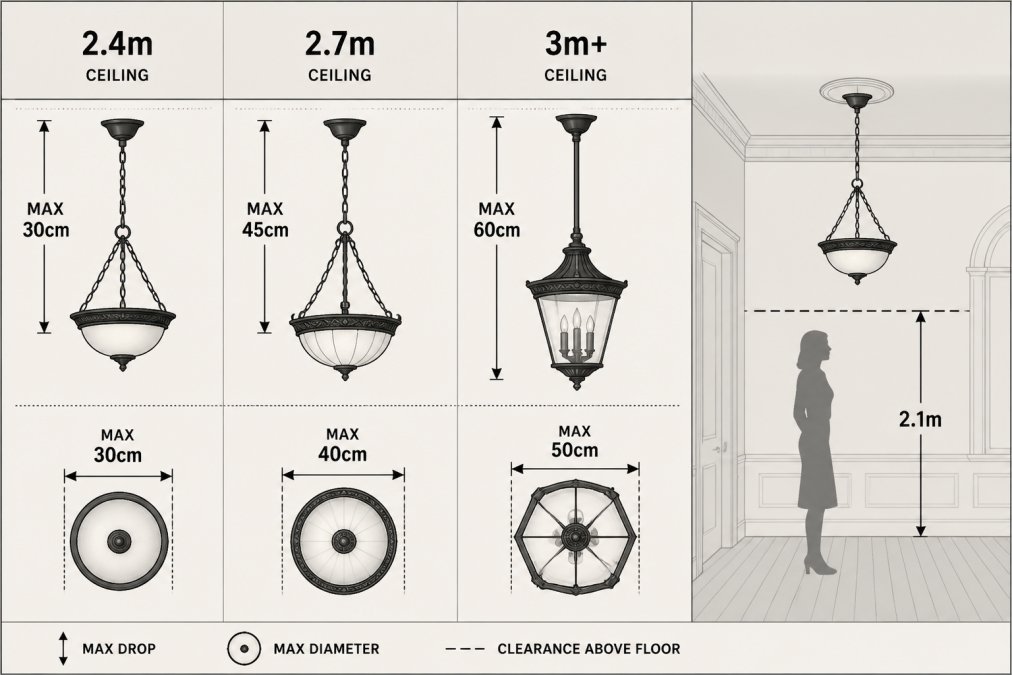
The two numbers that matter
Every fixture decision comes down to drop (how far it hangs below the ceiling) and diameter (how wide it is). Get both right and the room reads as correct.
Drop. Work from the floor up, not the ceiling down.
From there, subtract.
Diameter. A useful starting ratio is to keep the fixture's diameter between one-fifth and one-quarter of the room's shortest wall measurement.
Placement rules that hold up
- Dining rooms: centre the fixture over the table, not the room. If the table is off-centre, so is the light.
- Hallways: centre it on the sightline from the front door, so it reads as a deliberate axis rather than an afterthought.
- Bedrooms: centre over the bed if there is no ceiling fan, and keep the drop high enough that a standing adult clears it.
- Living rooms: if the room has a defined seating zone, centre over that zone rather than the geometric middle of the ceiling.
When the ceiling itself is the problem
Old homes rarely have a flat, level ceiling. Lath-and-plaster ceilings sag, and a fixture hung from a true plumb line can look visibly crooked against a bowed surface.
Finally, weigh the fixture before you buy it. Cast brass and multi-arm chandeliers can be surprisingly heavy, and an old ceiling may not have a fixing point rated for the load. If in doubt, have a licensed electrician or builder confirm the ceiling structure can carry the fixture before installation.
Finishes and Materials: Antique Brass, Aged Bronze and Aged Metal
Antique finishes separate a period-appropriate fixture from a modern one wearing a costume. Antique brass and aged bronze both develop character over time, exactly what you want in an old home.
Metal fixtures in a living finish darken and patina with age, a feature, not a fault.
Materials to prioritise:
- Solid brass for longevity and repairability
- Aged bronze for a warmer, darker tone
- Cast metal components over stamped ones for weight and detail
- Glass shades in opaline or simple pressed patterns
Recycled materials and pre-owned lighting also have a place here. An original fitting that has already aged fifty years will match your home better than anything new, provided the wiring is sound.
Authentic Antiques vs Reproductions: What to Buy and How to Maintain It
Authentic antiques carry history and hold value, but come with condition risks and often need rewiring. Reproductions are safer, easier to match across rooms, and available in consistent finishes. Neither is automatically better, the decision gets easier once you know what to inspect and expect.
Authentic antiques: what you are actually buying
An original fixture is a one-off. That is the appeal and the problem. Before you commit, inspect for the following:
- Wiring and insulation. Old fabric-covered or rubber-insulated flex is a fire risk and will almost certainly need replacing. Assume any pre-1970s fixture needs rewiring unless it has documented recent work.
- Earthing. Older fixtures may predate modern earthing requirements. A metal-bodied fixture that is not properly earthed is a shock hazard, particularly in wet areas.
- Lampholder condition. Cracked or brittle Bakelite and ceramic holders are common and should be replaced, not patched.
- Metal fatigue and repairs. Look for hairline cracks at arm joints, soldered repairs, and mismatched replacement parts. A sympathetic repair is fine; a structural bodge is not.
Buy authentic when the fixture is a single statement piece, when you can inspect it in person or from detailed photographs, and when you have budgeted for rewiring and restoration on top of the purchase price. A restored original in a formal room is hard to beat.
Reproductions: where they win
Buy a reproduction when you need several matching fixtures, when the fitting is in a hard-wearing room such as a kitchen or bathroom, or when the original is unavailable in the quantity you need.
The trade-off is character. A good reproduction in a living finish will age, but it will not carry the same depth of patina as a fixture that has spent a century in a room.
Maintenance by material
- Antique brass: clean gently with a soft cloth and leave the patina alone. Abrasive polishes strip the surface and remove the very character you paid for.
- Aged bronze: little beyond a dry cloth. Oily residues from hands are the main enemy.
- Painted or japanned finishes: dust only. Solvents will lift the finish.
- Glass shades: handle by the fitter, not the rim, and wash in lukewarm water. Thermal shock from hot water on cold glass is a common cause of cracking.
Safety and installation in older homes
This is the part most buying guides skip. In an old home, the ceiling rose or mounting point may not be rated for a chandelier's weight, and the existing wiring may not meet current requirements. Before installation:
- Have a licensed electrician check the circuit, the earthing, and the switch wiring.
- Confirm the ceiling structure can carry the fixture's weight, particularly for cast-metal and multi-arm designs.
- Ensure any metal-bodied fixture is properly earthed.
- If you are adding a dimmer, confirm both the dimmer and the lamp are compatible, older dimmers and modern LED lamps frequently are not.
For larger projects, consistency across orders matters as much as the individual fixture. A single supplier who can hold a finish across multiple rooms saves months of mismatched sourcing and makes future replacement far simpler if a shade or finial is damaged.
Conclusion
Matching antique style ceiling lights for old homes to the era of the building is the difference between a restoration and a renovation. Get the period right, size the fixture to the ceiling, and the room will feel correct without anyone being able to say exactly why.
Restoration Station has spent 35 years sourcing period lighting, cast iron fireplaces, and architectural hardware for heritage, Colonial, and Federation homes, with expert guidance on complex projects and shipping across Australia and internationally.
Frequently Asked Questions
What type of ceiling light suits an old home?
It depends on the era. Victorian and Edwardian homes suit decorative pendants, chandeliers and antique ceiling lights with intricate metalwork. Federation-era homes often pair well with simpler traditional pendants and ceiling roses. Mid-century rooms take retro-inspired fixtures with cleaner lines. Match the fixture to the room's original architecture rather than a single style across the whole house, and check the ceiling rose already in place before choosing a shape.
Are antique-style lights suitable for heritage homes?
Yes, provided the fixture suits the building's period and the wiring is sound. In heritage-listed properties, changes to fixtures can fall under local council or heritage authority approval, so check requirements before installing. Reproduction antique ceiling lights are often the practical choice because they meet current electrical standards while matching original designs. Confirm the fitting suits your ceiling height and that any existing rose is structurally sound before hanging a heavier chandelier.
Can you install modern LED bulbs in vintage ceiling lights?
Usually, yes. Most reproduction and restored vintage ceiling lights use standard bayonet or Edison screw fittings, which accept LED bulbs. Choose dimmable LEDs if you want to keep a dimmer, and check the dimmer is LED-compatible, since older dimmers often cause flickering or buzzing. LED bulbs also run cooler, which suits enclosed glass shades and fabric-covered flex that can discolour with heat from incandescent globes.
What should I consider before replacing a light fitting in an older home?
Check three things first: the ceiling structure, the wiring, and the fixture weight. Old ceilings may need a stronger mounting point for chandeliers or heavy pendants. Wiring in older homes may lack an earth connection, which a licensed electrician must verify before installation. Also measure ceiling height and room size so the fixture drop and diameter suit the space. In heritage-listed homes, confirm whether approval is needed before any change.