Table of Contents
- Traditional Outdoor Wall Lights: What Actually Suits a Period Home
- Matching Fixtures to Architectural Period and Room
- Heritage Outdoor Wall Lights: Styles from Victorian to Mid-Century
- Outdoor Wall Lanterns: Materials and Finishes That Last
- Weatherproof Outdoor Wall Lights: What to Check Before You Buy
- Outdoor Wall Light Placement: Height, Spacing and Balance
- Authentic Antiques vs Reproductions: Which Way to Go
- Installation, LED and Dimmer Compatibility in Older Homes
- Frequently Asked Questions
Last Updated: October 10, 2026
Traditional Outdoor Wall Lights: What Actually Suits a Period Home
Choosing traditional outdoor wall lights in Australia comes down to one principle: match the fixture to the era of the house, not to whatever is trending on a display wall. At Restoration Station, we have spent more than 35 years helping owners of heritage-listed, Colonial and Federation-style homes find fittings that look like they have always been there. Get the period right and the house looks settled. Get it wrong and even an expensive lantern reads as an afterthought.
A traditional outdoor wall light is a wall-mounted exterior fixture styled after historical designs, typically built from solid brass, copper or cast aluminium with a heritage finish. These fittings are chosen for character first and function second, though modern versions are fully weather-rated.
Most buyers start with the fixture and work backwards. That is the mistake: the house should choose the light. Below, we break down the styles, materials and placement rules that matter, plus the safety and compatibility checks most guides skip.
Matching Fixtures to Architectural Period and Room
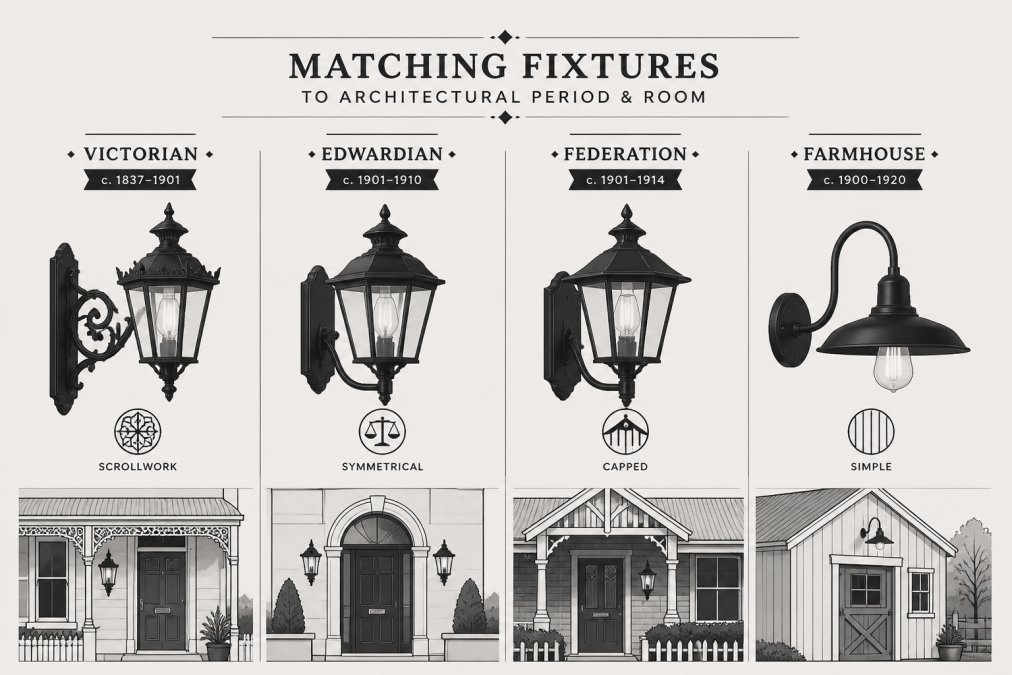
Start with the period, then the room's role. A front entry lantern and a side-path light do different jobs, and a Federation-era home should not carry a lantern designed for a 1970s brick veneer. Period homes fall into recognisable eras, each with a fixture language of its own.
- Victorian and Edwardian: ornate brackets, scrollwork, clear or seeded glass
- Federation: symmetrical, slightly heavier proportions, often with decorative caps
- Interwar and mid-century: simpler lines, less ornament, functional shapes
- Farmhouse and rustic: barn-style shades, exposed fixings, matte finishes
Room by room, the logic holds. Entrances suit a statement lantern. Verandahs and alfresco areas suit pendants or flush fittings. Side paths and utility walls suit smaller, unassuming fixtures that light the way without competing with the front facade.
Heritage Outdoor Wall Lights: Styles from Victorian to Mid-Century
Heritage outdoor wall lights are exterior fixtures designed to match the detailing of a specific historical era, right down to the bracket profile and glass type. The detail is the point. A Victorian lantern without its characteristic scroll bracket looks like a generic wall light wearing a costume.
Victorian, Edwardian and Federation-Era Fixtures
These three eras dominate the heritage market, and they are not interchangeable. Victorian designs lean ornate, with decorative scrolls and often a single clear glass panel. Edwardian fixtures favour cleaner symmetry, while Federation fixtures sit heavier again with capped tops and sturdier brackets.
If you own a Federation home and are unsure what belongs, a specialist's eye helps. Restoration Station stocks period lighting alongside cast iron fireplaces and architectural details, so you can match a lantern to the rest of the house rather than guessing from a photo.
Retro, Farmhouse and Rustic Touches for Later Homes
Not every old home is Victorian. Plenty of 1930s and post-war houses have their own character, and forcing ornate heritage fittings onto them looks as wrong as the reverse. Barn lights, simple gooseneck brackets and matte-finish shades fit these homes without pretending to be something older.
Outdoor Wall Lanterns: Materials and Finishes That Last
Material choice decides how a lantern ages, and in coastal or high-rainfall areas that matters more than styling. The base metal and the finish are two separate decisions, and confusing them is how buyers end up disappointed.
Solid brass is the traditional choice for heritage exteriors. It is naturally corrosion-resistant because the copper and zinc in the alloy form a protective surface layer rather than flaking away.
Copper behaves similarly but weathers faster and darker, moving through a brown stage before reaching the familiar green-grey verdigris in exposed positions.
Cast aluminium is the practical budget option. It does not rust and takes a powder coat well, but the coating is the weak point: once it chips at a bracket joint or screw fixing, moisture gets underneath and the finish lifts.
Aged bronze and antique brass finishes are surface treatments applied to a modern substrate, usually brass or aluminium. Done well, they use a chemical patination followed by a clear protective coat and look convincing for years.
| Material | Ages how | Best suited to | Watch for |
|---|---|---|---|
| Solid brass | Patinas to a warm, uneven tone | Heritage, Colonial, Federation | Lacquer clouding in strong sun |
| Copper | Darkens, then verdigris in exposed sites | Victorian, Edwardian, coastal | Uneven weathering if partly sheltered |
| Cast aluminium | Holds finish until coating chips | Inland, sheltered, budget builds | Coating failure at fixings |
| Aged bronze / antique brass finish | Wears at high-touch points | Modern substrate, heritage look | Thin plating wearing through |
Glass matters too. Clear glass shows the lamp and bracket detail; seeded or textured glass softens the light and hides dust and insect build-up, which is why it appears so often on period reproductions. Beveled or leaded panels suit grander facades but collect more grime in the joints.
A simple test when comparing fixtures: check the weight and the thickness of the metal at the bracket. A lantern that feels light for its size is usually thin-walled, and thin walls flex, crack coatings and let water in at the seams.
Weatherproof Outdoor Wall Lights: What to Check Before You Buy
Weatherproof outdoor wall lights carry an IP rating, which tells you how much moisture and dust the fixture tolerates. For most exterior walls, IP44 is the practical minimum; exposed coastal positions warrant IP65.
| Check | What to Look For | Why It Matters |
|---|---|---|
| IP rating | IP44 minimum, IP65 for exposed sites | Prevents water ingress and corrosion |
| Base material | Brass, copper or coated aluminium | Determines lifespan outdoors |
| Seals and gaskets | Replaceable, well-fitted | Stops moisture reaching wiring |
| Drainage | No water traps in the housing | Standing water shortens life |
Buying on looks alone is how people end up replacing fixtures every few years. The Australian Building Codes Board sets the broader building standards that exterior installations must respect, and electrical work itself is governed separately.
Outdoor Wall Light Placement: Height, Spacing and Balance
Outdoor wall light placement follows a few dependable measurements. Mount entry lanterns roughly 1.7 to 1.8 metres above ground, flank a door at about 2.4 to 3 metres apart, and space facade lights along a wall at 1.5 to 2 metres.
The 1.7 to 1.8 metre mounting height is set by the human eye line and the door itself.
Spacing between a pair of entry lanterns is driven by the door width, not a fixed figure.
Along a facade or verandah, 1.5 to 2 metres between fixtures gives even wash without hot spots.
Scale is the part most guides skip. As a rule of thumb, the lantern's height should be roughly one-quarter to one-third the height of the door it flanks, so a 2 metre door suits a lantern around 500 to 650 millimetres tall.
A few worked examples make the logic concrete:
- Single front door, 900 mm wide, 2.1 m tall: two lanterns at 1.75 m, spaced about 2.6 m apart, each around 550 mm tall.
- Double entry door, 1.8 m wide, 2.4 m tall: two lanterns at 1.9 m, spaced about 3.2 m apart, each around 650 mm tall.
- Long verandah, 8 m wide: four fixtures at roughly 2 m centres, aligned to the posts rather than the mid-points between them.
- Side path, narrow wall: a single smaller fixture at 1.7 m, sized to light the path rather than the facade.
Balance matters as much as numbers. A single oversized lantern beside a narrow door looks unbalanced; two smaller fixtures often read better. On long facades, symmetry beats even spacing, because the eye forgives a wider gap more than a crooked line.
Finally, check what the light is actually for.
Authentic Antiques vs Reproductions: Which Way to Go
This is the question we hear most, and the honest answer is that both have a place. Authentic antiques carry genuine history, but they can arrive with worn wiring, mismatched glass and no guarantee of a matching pair. Reproductions offer consistency, modern safety compliance and the ability to order six identical fixtures for a large facade.
For a single feature light on a heritage home, an antique can be worth the hunt. For a full exterior scheme, or a heritage builder needing reliable repeat orders, reproductions usually win on practicality.
Installation, LED and Dimmer Compatibility in Older Homes
Older homes bring older wiring, and that shapes what you can install. Modern LED and dimmer compatibility is usually achievable, but not automatically. LED lamps draw far less current than the incandescent bulbs these houses were wired for, and some dimmer switches simply will not behave with them.
- Confirm the fixture accepts LED lamps before buying
- Check your dimmer is rated for LED loads, not just incandescent
- Have a licensed electrician assess older circuits before adding load
- Choose warm colour temperatures (around 2700K) to suit period architecture
Electrical installation in Australia must be carried out by a licensed electrician and comply with Standards Australia's AS/NZS 3000 wiring rules. For heritage-listed properties, exterior changes may also need approval, so check with your local council before drilling into a protected facade. Guidance on heritage property obligations is worth reading before any exterior alteration.
Period-appropriate outdoor lighting is one of the few upgrades that makes an old house look more like itself rather than less. The challenge is sourcing fixtures genuinely right for the era, in materials that survive the weather, from a supplier who understands the difference. Restoration Station has spent 35 years doing exactly that, offering period lighting, cast iron fireplaces and architectural hardware in one place, with expert advice for heritage, Colonial and Federation-style projects. Contact us with your project details and we will help you match the right fixtures to your home.
Frequently Asked Questions
What styles of traditional outdoor wall lights suit a period home?
The right style depends on your home's era. Victorian and Edwardian properties typically suit decorative brackets, scrollwork and lantern-style fixtures with antique brass or aged bronze finishes. Federation homes work well with simpler, symmetrical designs. For 1930s and later homes, look at cleaner retro or farmhouse-inspired pieces. Matching the fixture's level of detail to your facade's existing trim and joinery keeps the look coherent rather than pasted on.
What material is best for outdoor wall lanterns in exposed coastal areas?
Salt spray and constant moisture are hard on any finish. Solid brass, copper and marine-grade stainless steel cope best because they resist corrosion rather than just coating the surface. Powder-coated finishes over steel can work inland but tend to fail faster near the coast. Check the warranty terms carefully, since many manufacturers exclude coastal exposure, and plan to rinse and inspect fixtures more often.
How do I choose weatherproof outdoor wall lights for a heritage-listed property?
Start with the practical requirements: an IP rating of at least IP44 for sheltered positions and IP65 for fully exposed walls, plus a fixture sized to your ceiling height and facade proportions. Then match the design to the building's period details. If your property has heritage listing, check whether external alterations need approval before you buy, and keep original mounting points where possible to avoid new holes in historic masonry.
Are traditional outdoor wall lights compatible with modern LED bulbs and dimmers?
Most traditional fittings accept standard LED bulbs, but check the cap type (commonly B22 or E27) and the maximum wattage the fixture allows. For dimming, use dimmable LED bulbs paired with a dimmer rated for LED loads, since older dimmers designed for incandescent bulbs often cause flickering or buzzing. If your wiring is original, have a licensed electrician confirm the circuit can handle the new fittings before installation.