Table of Contents
- Start With the Room, Not the Surround
- Measure the Opening Before You Choose a Fireplace Surround
- Materials and Finishes for a Federation Fireplace Surround
- Cast Iron Fireplace Inserts Australia Buyers Should Recognise
- Restore or Replace? Heritage Home Fireplace Restoration Tips
- Safety, Clearances and Compliance Before You Install
- A Checklist for Evaluating Fireplace Surround Options
- Conclusion
- Frequently Asked Questions
Last Updated: October 10, 2026
Start With the Room, Not the Surround
Choosing a fireplace surround for a Federation home starts with the room, not the product page. The most common mistake is falling for a surround online, then discovering it fights the cornices, skirting and ceiling height already in the room.
A fireplace surround is the decorative frame around the fireplace opening. It includes the mantel, legs and often a hearth. In a Federation home, it is one of the few features that ties the whole room together.
Federation Features That Set the Rules
Federation homes (1890-1915) follow design rules that affect surround choice:
- Tall ceilings (3m+) suit taller mantels
- Picture rails and deep cornices draw the eye upward
- Timber skirting boards, often 150mm or deeper
- Symmetrical layouts with the fireplace as focal point
The National Trust of Australia heritage guidance notes that original interior details carry much of a listed property's significance. That matters when you are choosing what to keep and what to swap.
Measure the Opening Before You Choose a Fireplace Surround
Measure the fireplace opening before you shop. You need these measurements in millimetres:
What to Record on Your Measuring Sheet
- Opening width and height (widest point, hearth to top)
- Surround width and height (full mantel width, floor to shelf)
- Hearth depth and width
- Distance to nearby walls or windows
- Skirting height
Check the opening is square by measuring at the top, middle and bottom; a 5mm difference is common in older homes.
Materials and Finishes for a Federation Fireplace Surround
Timber, cast iron, marble, slate and tiles are the five materials used in Federation homes, each with different durability and maintenance needs.
Timber: The Default Choice
Timber was the most common surround material, usually blackwood, cedar or kauri. It takes stain and polish well and is easiest to repair. The trade-off is movement: timber expands and contracts with humidity, joints open over decades, and leg bases rot first. Polished finishes show every scratch; painted finishes hide them but lose the grain.
Suitable finishes: French polish or shellac for formal rooms; oil and wax for softer, easy-to-repair looks; painted off-white or cream for bedrooms and kitchens.
Cast iron: Detail and Heat
Cast iron offers fine ornament (scrollwork, acanthus leaves) and is non-combustible, making it ideal with inserts. It is heavy and can crack if over-fired. In Federation rooms, choose simple, restrained patterns rather than heavy Gothic revival styles.
Marble and Slate: Formal and Cool
Marble is formal and heavy, used in front rooms and hallways in white or cream. Slate was the cheaper alternative for hallways and utility rooms. Both stain and are cold to touch. Marble needs sealing and careful cleaning; slate is more forgiving but can delaminate if wet repeatedly.
Tiles: Colour and Pattern
Tiled surrounds (timber or masonry frame with tiles set in) were popular in kitchens, bedrooms and bathrooms. Tiles crack and grout discolours, making repairs difficult. The upside is colour and pattern, which were central to Federation interiors.
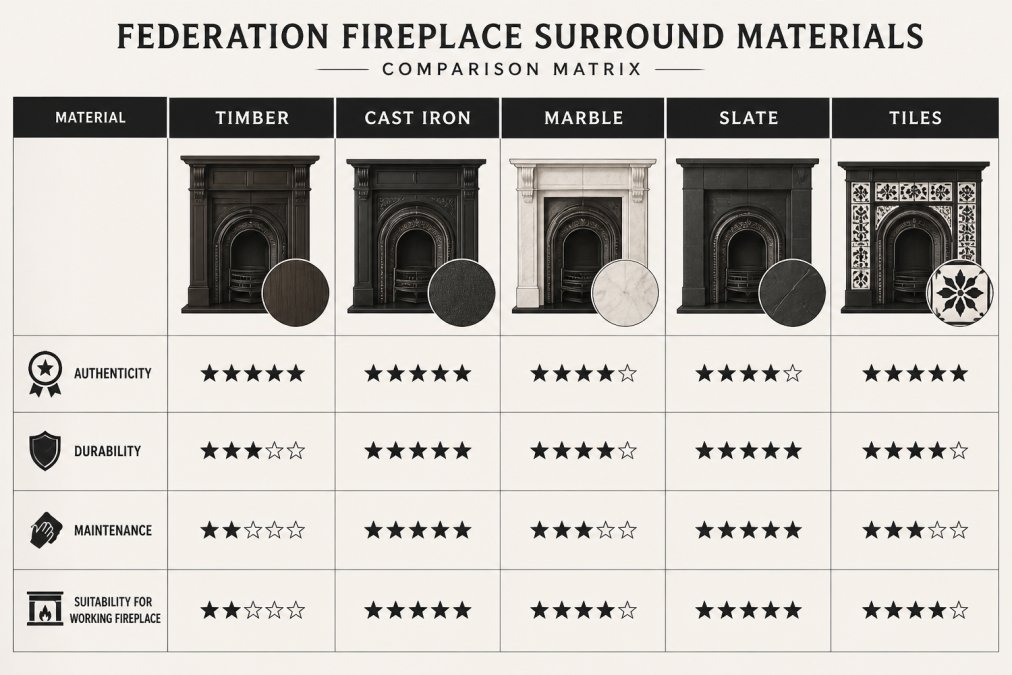
Timber, Cast Iron, Marble, Slate and Tiles Compared
| Material | Authenticity | Upkeep | Best For | Main Risk |
|---|---|---|---|---|
| Timber | High | Repolish every few years | Painted or polished rooms | Rot at leg bases |
| Cast iron | High, but pattern must suit Federation | Low, dust and wipe | Working fireplaces | Cracking if over-fired |
| Marble | High | Sealing, careful cleaning | Formal front rooms | Etching and staining |
| Slate | High | Occasional resealing | Hallways and utility rooms | Delamination if wet |
| Tiles | Medium to high | Regrouting over time | Kitchens and bedrooms | Cracked or missing tiles |
Proportions: The Rule Most Owners Miss
A fireplace surround should be roughly one-third the wall height (in a 3m room, mantel shelf around 1-1.2m from floor). The mantel shelf should be 150mm wider than the opening on each side, with legs clear of skirting or set forward on a plinth block.
Which Material Suits Which Room
- Front parlour or drawing room: timber (polished) or marble
- Dining room: timber with tiled or cast iron insert
- Main bedroom: timber (painted) or tiled
- Kitchen or servant area: painted timber or tiled
- Hallway: slate or painted timber
For restoration, use the original material. For modern living, choose what suits your use, but keep proportions period-correct so the room reads as Federation.
Cast Iron Fireplace Inserts Australia Buyers Should Recognise
Cast iron fireplace inserts sit inside the opening, throw heat and hide damaged fireboxes. Look for: solid, unwarped body with no corner cracks; intact fireback; original or matched decorative panels; level grate that lifts for cleaning; freely moving damper or air control.
Many inserts are reproductions made to period patterns, that is fine. What matters is that the pattern suits Federation rather than Victorian or Edwardian homes.
Restore or Replace? Heritage Home Fireplace Restoration Tips
Restoring the original surround is almost always better if timber is sound. Check for: rot at leg bases; split or lifting veneer; open joints; hearth cracks and loose tiles; missing mouldings or details.
If the damage is surface-level, a repair and repolish will bring it back. If the legs have rotted through or the mantel has warped, replacement may be cheaper than a full rebuild.
Keep any original pieces you remove. Even a damaged section can be copied by a joiner. The Heritage Council of Victoria guidance on restoring heritage places recommends retaining original fabric wherever possible, and that advice holds for fireplace surrounds too.
Safety, Clearances and Compliance Before You Install
Safety and clearances come before style. A surround too close to a heat source is a fire risk. Federation homes differ from modern ones because the firebox, chimney and hearth were built to different assumptions.
Clearances You Need to Confirm
Clearance figures depend on the appliance, fuel and installation. Refer to the appliance manufacturer's instructions and relevant Australian Standards (AS/NZS 2918 for solid fuel; AS 5601 for gas). A licensed installer or local council can confirm what applies to your specific firebox.
General principles: combustible materials must be kept the required distance from the firebox opening; a non-combustible hearth must extend in front and to the sides; minimum clearance above the opening to any combustible mantel; chimney and flue must be sound, clear and correctly sized; existing flues should be inspected for cracks, blockages and failed mortar.
The Hearth Matters More Than the Surround
In a Federation home, the original hearth is often the weakest link. Tiles lift, mortar crumbles, and the hearth may not extend far enough forward for a modern appliance. If you are keeping the original hearth, check that it is non-combustible, intact and large enough for the appliance you plan to install. If it is not, a new hearth can be laid over or beside the original without destroying it.
Heritage Listing and Approval
If the property is heritage-listed, or sits in a heritage overlay, you may need approval before you alter, remove or replace a fireplace surround. The pathway depends on the listing:
- State or territory heritage register: approval through the relevant state heritage authority
- Local heritage overlay: approval through your local council's planning department
- National Trust classified property: the Trust's advice is not a statutory approval, but it is influential and worth seeking early
A common pattern is that internal alterations which affect significant fabric need a permit, while like-for-like repairs do not. The only way to know which applies to you is to ask your council before you start. This is especially important for Federation homes, because the fireplace surround is often one of the original features that gives the property its significance.
When to Call a Professional
Call a licensed installer or builder before you commit to a surround if any of the following apply:
- The chimney has not been used for years
- There is any sign of smoke staining on the wall above the opening
- The firebox is cracked or the fireback is missing
- You are changing fuel type, for example from wood to gas
- The property is heritage-listed or in a heritage overlay
- The surround you want is heavier than the existing one, for example marble replacing timber
A Practical Order of Operations
- Confirm the property's heritage status and any approval requirements
- Have the chimney and flue inspected
- Confirm the appliance and its clearance requirements
- Measure the opening and the hearth
- Choose the surround material and proportions
- Have a licensed installer fit the surround and appliance
- Keep the approval paperwork with the house records
Getting this order right saves rework. Getting it wrong can mean removing a surround you have already fitted, or worse, creating a fire risk that is not obvious until the first cold night.
A Checklist for Evaluating Fireplace Surround Options
Use this checklist before you commit to any surround. It covers the points that cause the most problems later.
- Does the surround height suit the ceiling and cornice line?
- Does the width match the wall and leave room for skirting?
- Does the material suit the room's existing timber and trim?
- Is the style correct for Federation, not Victorian or Edwardian?
- Does it fit the measured opening in millimetres?
- Is the finish right, painted, polished or natural?
- Have you confirmed clearances and hearth requirements?
- Have you checked whether the property is heritage-listed?
- Can the supplier advise on period accuracy, or are you guessing?
That last point matters more than people expect. A supplier who knows Federation homes will save you from an expensive mistake.
Conclusion
Choosing a fireplace surround for a Federation home comes down to reading the room before you read the catalogue. Get the measurements, the material and the style right, and the surround will look like it has always been there.
At Restoration Station, we have spent 35 years sourcing period lighting, cast iron fireplaces and architectural details for heritage homes. We offer an extensive range of traditional fittings and expert advice for complex restoration projects. Contact us for a quick enquiry and let our team help you find the right surround for your Federation home.
Frequently Asked Questions
What are the key design features of a Federation-style fireplace?
Federation fireplaces typically pair a timber or tiled surround with a cast iron insert, finished with decorative tiles on the cheeks and hearth. Common details include moulded shelf profiles, arched or rectangular openings, and a mantel proportioned to the ceiling height of the room. Symmetry matters: the surround should sit centred on the chimney breast, with the shelf depth matching the room's scale rather than dominating it.
Should I choose timber or cast iron for a period fireplace surround?
Timber suits rooms where the joinery, skirting and architraves are already painted or stained timber, and it is easier to repair or recoat later. Cast iron suits a more formal look and pairs well with tiled cheeks and a cast insert. Many Federation homes combine both: a timber mantel with a cast iron insert and tile panels. Choose based on the existing room, not on which material looks better in isolation.
How do I measure my existing fireplace opening for a new surround?
Measure the opening width and height at the narrowest point, the depth of the fireplace box, the width of the chimney breast, and the distance from the floor to the underside of any existing shelf. Also note the hearth depth and the clearance to nearby timber. Take these measurements to a supplier before ordering, because surrounds are sized to the opening, not to the room.
Are there specific heritage regulations for fireplace restoration?
Rules vary by state, territory and local council, and many heritage-listed properties require approval before external or structural changes. Internal cosmetic work is often exempt, but altering a chimney, flue or original fabric may need consent. Check with your local council's heritage adviser before you order, and keep records of what was original so any change can be justified later.