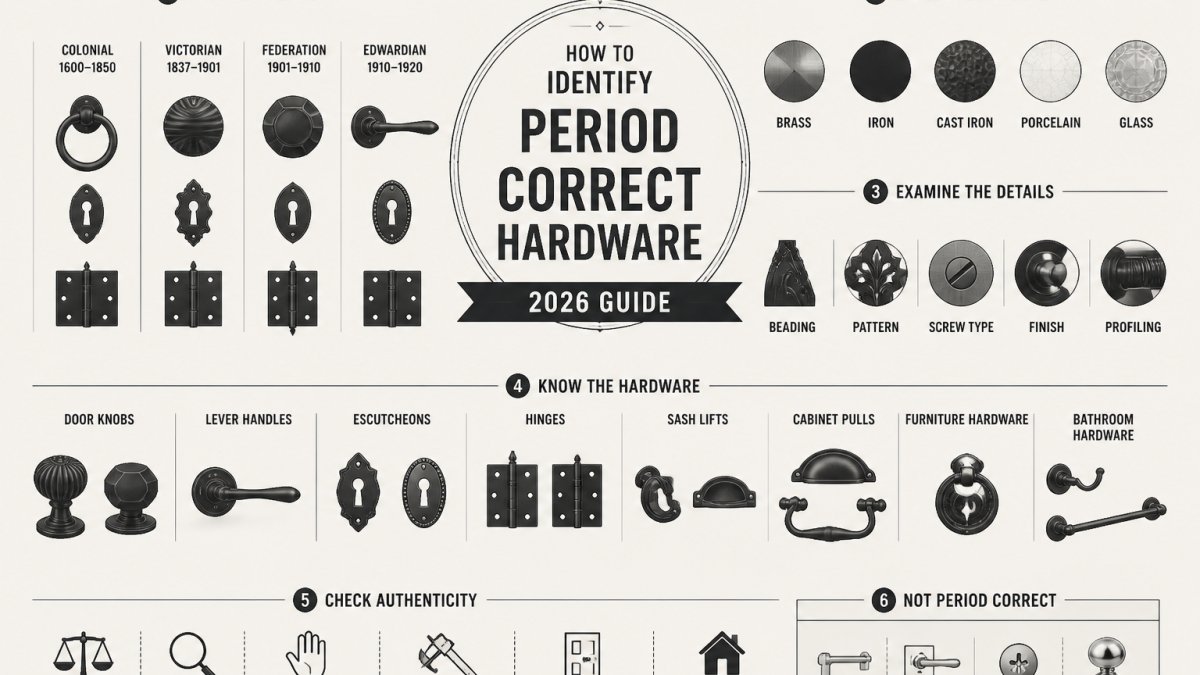
Table of Contents
- Start With the Architecture, Not the Hardware
- Period Door Hardware Styles by Era
- An Antique Door Hardware Identification Guide: Materials, Fixings and Patina
- How to Match Door Hardware to a Period Home
- Reproduction Versus Original Architectural Hardware
- Measurements, Compatibility and Replacement Fit
- Hardware Beyond Door Knobs: Windows, Cabinetry and Fireplaces
- Care, Conservation and Safe Restoration
- Frequently Asked Questions
Last Updated: October 12, 2026
Start With the Architecture, Not the Hardware
Identifying period correct hardware starts with the building, not the fittings. At Restoration Station, we've spent 35 years helping owners of heritage-listed, Colonial and Federation homes work out what belongs on their doors, and the pattern is always the same: the architecture decides, the hardware follows.
Period correct hardware is door and window furniture that matches the era, construction method and decorative style of the building it sits on, knobs, handles, hinges, latches, locks, escutcheons and window fittings made in the materials and profiles common when the house was built.
Below, we'll show you how to date a house, read unknown hardware, and match the two.
A Practical Identification Checklist for Unknown Hardware
Work through these questions before you buy anything. Each one narrows the field fast.
- What year was the house built, or what decade does the original section date to?
- Is the door solid timber, and how thick is it? Thicker doors suit heavier furniture.
- Are the screws slotted or Phillips? Slotted screws point to earlier manufacture; Phillips screws generally indicate later or reproduction work.
That last point matters most: old screw holes and faded outlines tell you what was there originally, and they are the cheapest research you will ever do.
Period Door Hardware Styles by Era
Dating hardware by era is the fastest way to sort authentic stock from everything else. Materials shifted with manufacturing and decoration shifted with taste, so the two together usually place a piece within a decade or two.
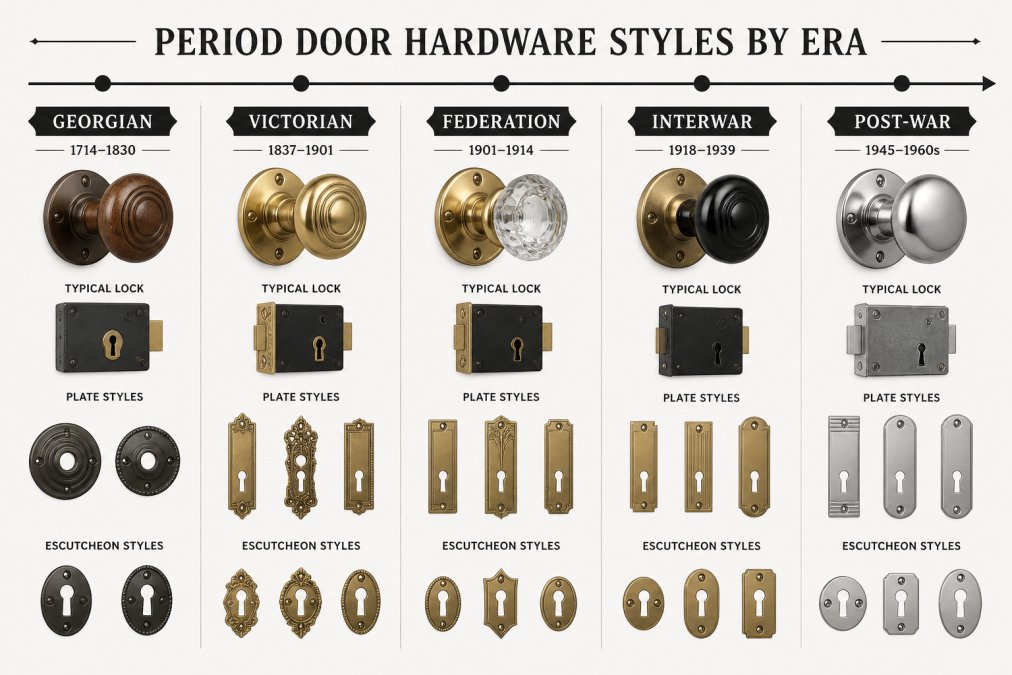
Georgian and Colonial (roughly 1788 to 1840)
Early Australian buildings used what was available and what the British pattern books specified. Door furniture was restrained: small round or oval brass knobs on iron or brass rim locks, simple escutcheons, little ornament. Wooden knobs on iron spindles appear on service doors and outbuildings. Screws are slotted, threads hand-cut, and plate edges often show file marks rather than a machined finish.
Victorian (roughly 1840 to 1890)
Industrial manufacturing changed everything. Brass knobs became heavier and more sculpted, backplates grew larger and carried cast decoration, scrollwork, acanthus leaves, beaded edges, and keyhole surrounds became elaborate. Mortise locks displaced rim locks on better doors, changing the spindle and escutcheon arrangement too. Black japanned iron and nickel plating appear alongside brass. A Victorian backplate is usually noticeably thicker and heavier than anything made later.
Federation and Edwardian (roughly 1890 to 1915)
Decoration lightened and turned to nature. Faceted glass knobs set on brass shanks are the signature, often paired with slimmer brass backplates carrying floral or geometric motifs. Pressed metal became common, so plates are thinner and more uniform than Victorian castings, and copper and bronze finishes appear. This period is the easiest to misdate, because reproduction faceted glass knobs are widely made today, check the metal shank and screw heads, not the glass.
Interwar (roughly 1915 to 1940)
Design simplified sharply: plain round or slightly stepped brass knobs, simple rectangular or oval plates, and a move away from cast ornament. Bakelite and early plastics appear on cupboards and interior doors, chrome and nickel plating on later interwar work, and spindles are usually square and standardised, making replacement easier than on earlier doors.
Post-war (roughly 1945 onward)
Pressed metal, plated finishes and eventually aluminium and chrome dominate. Knobs become smaller and lighter, plates thin and stamped, and Phillips screws gradually replace slotted ones. Bakelite and plastic knobs are common on interior doors and cabinetry. Anything with a Phillips screw, a sprayed antique finish or a perfectly uniform reverse is almost certainly post-war or a modern reproduction.
How to use this timeline
Start with the house, then narrow the piece. A Victorian cast backplate is wrong on a Federation building even if genuinely old; a faceted glass knob is wrong on an Interwar one even if beautiful. The era sets the boundary; material, fixings and wear patterns confirm whether a piece sits inside it.
An Antique Door Hardware Identification Guide: Materials, Fixings and Patina
Materials and fixings separate original, antique and reproduction pieces better than any visual style test.
Solid brass develops a warm, uneven patina, with wear concentrated where hands touch. Plated finishes wear through at edges and high points, revealing the base metal.
Then look at the fixings. Slotted screws, hand-cut threads and slightly irregular spacing point older. Uniform Phillips screws, machine-perfect alignment and modern coatings point newer.
How to Match Door Hardware to a Period Home
Matching hardware to a period home comes down to three variables: door style, door thickness and the level of decoration already in the room.
Start with the door. A four-panel Victorian door with deep mouldings carries a heavier, more ornate knob and backplate than a simple ledge-and-brace door.
Finally, respect the room: a formal front door can carry more ornament than a service door or bedroom.
| Variable | What to Check | Why It Matters |
|---|---|---|
| Door style | Panel count and moulding depth | Heavier ornament suits deeper mouldings |
| Door thickness | Measure the door, not the old fitting | Spindle and latch length must suit the door |
| Room formality | Front door versus service areas | Decoration level should match use |
| Existing fittings | Plates, escutcheons, hinges | Consistency across a house reads as original |
Reproduction Versus Original Architectural Hardware
Reproduction hardware is not the enemy. Original pieces are scarce, often damaged, and rarely available in the quantities a full restoration needs.
What separates good reproduction from poor is fidelity to the original pattern, correct material and correct finish.
Where original pieces survive, keep them, original hardware carries the wear patterns of the house itself, and that patina cannot be manufactured.
Measurements, Compatibility and Replacement Fit
Replacement fit is where most restoration projects stall: a knob that looks right in a photograph can arrive and not fit the door, spindle or existing mortise.
Measure before you order:
- Backset: the distance from the door edge to the centre of the spindle or keyhole
- Spindle size: square or threaded, and its length
- Plate dimensions: height, width and screw hole spacing
Where an original mortise is sound, keeping it and fitting new furniture around it is simpler than cutting a new cavity. Where the door has been modified, expect to fill old holes and drill fresh ones, treat that as normal, not a failure.
Hardware Beyond Door Knobs: Windows, Cabinetry and Fireplaces
Door knobs get all the attention, but period character lives in the smaller fittings too. Window hardware, cupboard latches, hinges, locks and fireplace furniture carry the same era signals, and mismatching them undermines an otherwise careful restoration.
Hinges
Hinges are the most reliable dating clue on a door because they are rarely replaced unless they fail. Look at the material, the pin arrangement and the screw holes.
- Butt hinges in cast brass or iron with slotted screws and hand-cut threads point earlier. Steel butt hinges with Phillips screws point later.
- Loose-pin versus fixed-pin: loose-pin hinges are easier to remove and became more common as doors became heavier and more standardised.
- Rising butt hinges, which lift the door as it opens, appear on some Victorian and Edwardian doors and are a strong period signal.
Locks and Latches
Rim locks sit on the face of the door; mortise locks sit inside a cavity cut into the door edge. Rim locks point earlier, mortise locks later, and the transition happened at different times in different building types. A simple round or oval keyhole suits an earlier lock; a complex escutcheon with a separate keyhole insert points later.
Window Fittings
Window hardware should match the sash type, not just the room. Sash windows use sash lifts, sash locks and sometimes pulleys and cords; casement windows use stays, fasteners and peg stays. Brass and bronze dominate earlier work; plated steel and aluminium dominate later. A sash lift with a cast brass base and slotted screws is a different animal from a pressed steel lift with Phillips screws, a difference visible across the room once you know what to look for.
Cabinet and Cupboard Hardware
Cabinet hardware follows joinery style, not kitchen convention. Look at the hinge first: butt hinges on a cupboard door point earlier, concealed or overlay hinges later. Knobs and pulls should match the timber and door construction, small turned wooden knobs on a cedar cupboard, cast brass or pressed metal on later joinery. Cupboard locks with small brass escutcheons are a strong period signal, frequently missing on restored pieces.
Fireplace and Architectural Metalwork
Cast iron fireplaces and their surrounds are their own category, with register, hob and insert grates changing shape and ornament by era. Fireplace furniture should agree with the room's door and window hardware in material and finish, not fight it. Period lighting, door furniture and cast iron work together visually.
If you are unsure which fittings suit your property, our team can talk through the era and the room before you order.
Care, Conservation and Safe Restoration
Care is where good intentions cause the most damage.
Clean brass and cast iron gently with soft cloths and mild solutions. Avoid abrasive polishes, harsh acids and stripping agents, which remove surface history.
For heritage-listed properties, check any proposed external alteration against your local heritage requirements before work begins, and confirm what applies to your site with the relevant authority.
Getting period correct hardware right is a research problem before it is a shopping problem.
Frequently Asked Questions
How can I tell how old a door knob is?
Start with the material and the fixing. Early timber knobs were turned on a lathe and fitted with a simple spindle and grub screw. Brass knobs became more common from the late Victorian period onward, often with a separate backplate or rose. Faceted glass knobs belong to the Federation and Interwar years. Check the screw heads too: slotted screws suggest earlier manufacture, while Phillips screws generally point to the mid-20th century or later. Wear patterns, casting marks and the depth of the patina all help narrow the date.
What details help identify period-correct hardware?
Look at the whole assembly, not just the knob. The escutcheon shape, keyhole cover, hinge type and latch mechanism all carry date signals. Hand-forged ironwork has irregular hammer marks; cast brass has crisper, more uniform edges. Original period hardware usually sits on timber that has darkened and shrunk around it. Reproduction pieces tend to have perfectly even finishes, modern screw threads and a uniform colour that does not match the surrounding timber.
How do I match door hardware to the age and style of a house?
Identify the architectural period first, then work outward. A Georgian or early Colonial home suits simple round knobs, plain escutcheons and rim locks. Victorian properties take ornate brass or cast iron with decorative backplates. Federation homes often used faceted glass or brass knobs with floral motifs. Interwar homes lean toward simpler, streamlined designs. Match the finish to the era as well: aged brass, bronze or blackened iron rather than bright modern chrome.
How can I identify the age of window hardware?
Window fittings follow the same era logic as door hardware. Early sash windows used simple brass or iron sash lifts and quadrant stays. Federation windows often feature decorative brass sash lifts and more elaborate catches. Interwar homes introduced simpler, more utilitarian designs. Check whether the fitting is surface-mounted or mortised, and look at the screw heads and finish. Original window hardware usually shows consistent patina with the surrounding timber frame.
What is the difference between antique and reproduction hardware?
Antique hardware was made in the period it belongs to. It shows hand or early machine work, uneven wear, and a patina built up over decades. Reproduction hardware is newly made to look old. It may copy the shape accurately, but the casting is usually sharper, the finish more uniform, and the fixings modern. Reproduction is often the practical choice when originals are scarce or damaged, provided the style and finish match the property.
How do I check whether existing door hardware will fit a replacement?
Measure the backset (distance from the door edge to the centre of the spindle hole), the spindle diameter, the screw hole spacing on the backplate, and the door thickness. Photograph the existing hardware from the front, back and side, and note any maker's marks. Take these measurements with you when sourcing. If you are ordering online, compare them against the listed specifications before you buy to avoid returns.
Can old door hardware be restored and reused?
In most cases, yes. Brass and bronze can be cleaned gently with a soft cloth and a mild soap solution, avoiding abrasive polishes that strip the patina. Ironwork can be derusted and re-blacked. Worn springs and latches can sometimes be replaced without discarding the visible parts. If a piece is structurally sound, restoring it usually preserves the character of the property better than replacing it with new hardware.
What should I photograph or measure before sourcing replacement hardware?
Photograph the hardware in place, then remove it and photograph the front, back and any stamps or marks. Measure the backset, spindle diameter, screw hole centres, plate width and height, and door thickness. Note the finish and any decorative pattern. If you are matching multiple doors, record each one separately, as sizes and styles often vary within the same home. These records make it much easier to order the right replacement.