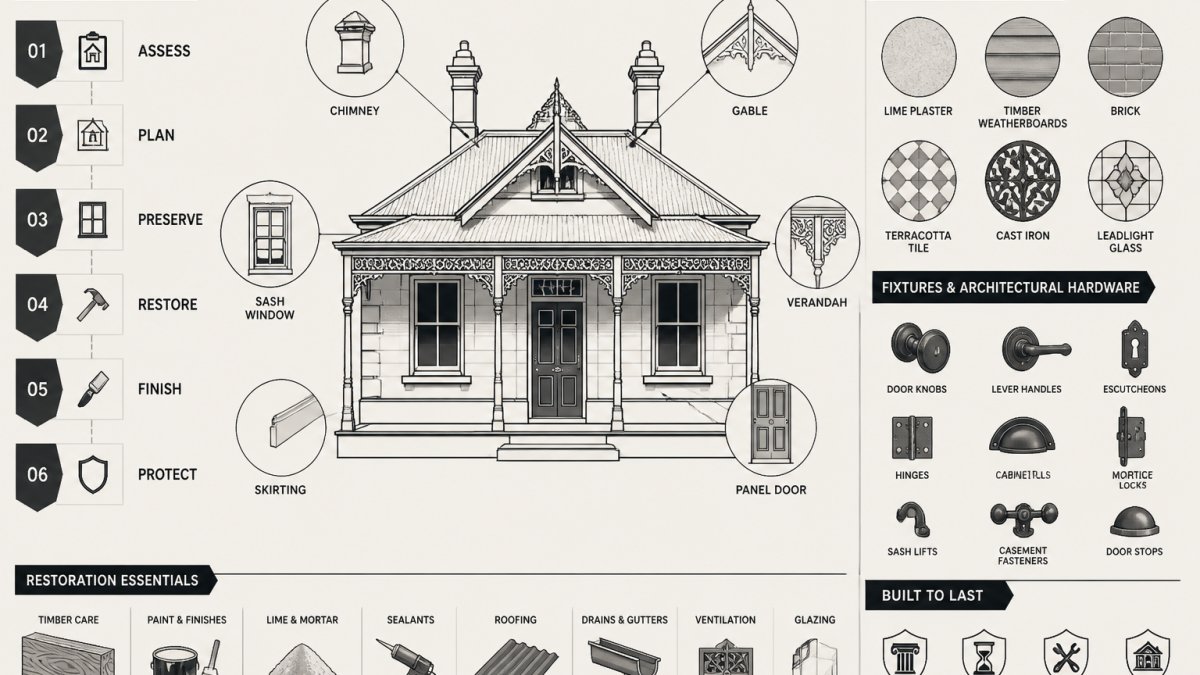
Table of Contents
- Why Expert Advice for Heritage Home Restoration Saves Money and Heartache
- Start With a Condition Assessment, Not a Mood Board
- A Step-by-Step Heritage Home Restoration Process
- Heritage Renovation Approvals: What Councils Actually Ask For
- Restoring Original Features in a Heritage Home Without Faking It
- Choosing Trades and Materials for Heritage Work
- A Heritage Home Maintenance Checklist for the First Year and Beyond
- Conclusion: Sequence Beats Speed in Heritage Restoration
- Frequently Asked Questions
Last Updated: October 12, 2026
Why Expert Advice for Heritage Home Restoration Saves Money and Heartache
Most heritage restoration projects go over budget because the scope was never properly understood.
At Restoration Station, we've spent over 35 years helping owners of heritage-listed, Colonial and Federation-style homes source the right fixtures and fittings.
That definition matters. According to the Heritage Council of New South Wales, works to a listed property generally need approval before they start.
Get the sequence right and the project runs smoothly. Get it wrong and you face delays, rework and council knockbacks.
Start With a Condition Assessment, Not a Mood Board
A condition assessment is a written report on the building's current state, prepared by a qualified professional, and it should come before any design work. Most owners start with Pinterest boards instead, then the builder finds rising damp and the budget collapses.
A proper assessment covers:
- Structural soundness of walls, floors and roof framing
- Moisture levels and evidence of rising damp
- Condition of mortar, render and masonry
Hidden Defects That Change the Whole Scope
Some problems stay invisible until walls open up, so don't budget only for what you can see:
- Salt damp in brickwork, which eats away mortar and plaster
- Rotten bearers and joists hidden behind intact flooring
- Failed flashings that have let water into wall cavities for years
A Step-by-Step Heritage Home Restoration Process
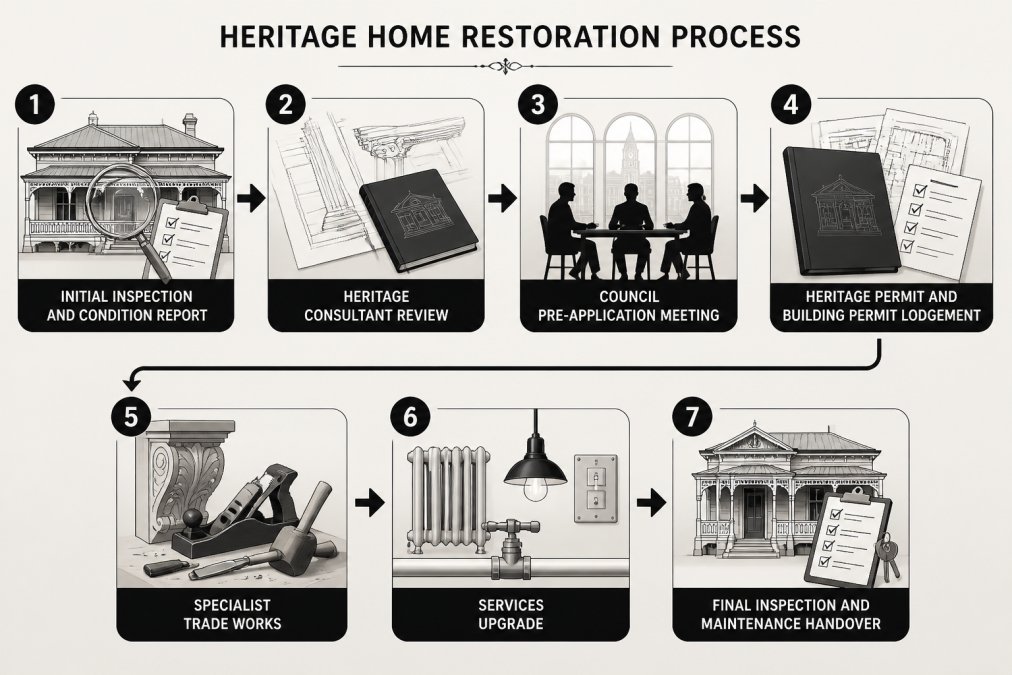
The heritage home restoration process follows a fixed order; skipping a step creates expensive problems.
Phase 1: Inspection and Documentation
- Engage a heritage consultant or architect for a site assessment.
- Commission a building condition report and a dilapidation survey.
- Photograph and measure every original feature you plan to keep.
- Check your property's heritage listing and any heritage overlay with your local council.
- Gather any old plans, photos or council records you can find.
Phase 2: Approvals, Trades and Sequencing
- Book a pre-application meeting with your council's heritage advisor.
- Lodge your heritage application and building permit together where possible.
- Wait for approval before ordering materials or booking trades.
- Sequence structural work first, then services, then finishes.
- Keep original fabric protected during the build.
Heritage Renovation Approvals: What Councils Actually Ask For
Heritage renovation approvals hinge on one question: does your proposal conserve the significance of the place? Councils assess impact, not just appearance, a sympathetic colour scheme does not offset the removal of original fabric. That means demonstrating in writing why each intervention is necessary, how it affects significance, and what alternatives you considered.
What a Heritage Impact Statement Actually Contains
A heritage impact statement is a structured argument, not a cover letter. A strong one follows a consistent shape:
- Statement of significance, what makes the place significant, drawn from the relevant heritage register or conservation management plan
- Description of proposed works, itemised, with drawings referenced
- Assessment of impact, how each work affects significance, graded as negligible, minor, moderate or major
A statement that skips the alternatives analysis is the most common reason an application is sent back for further information.
Documents That Speed Up a Heritage Application
A complete application moves faster. Missing documents are the most common cause of delays.
| Document | Purpose | Who Prepares It |
|---|---|---|
| Heritage impact statement | Explains how works affect significance | Heritage consultant |
| Conservation management plan | Sets long-term policy for significant places | Heritage consultant |
| Condition report | Records current state of the building | Building surveyor or architect |
| Architectural drawings | Shows existing and proposed works | Architect or draftsperson |
| Schedule of works | Lists every task in sequence | Builder or project manager |
| Material samples | Confirms traditional materials match | Supplier or specialist |
| Structural report | Confirms load paths and proposed interventions | Structural engineer |
| Photographic survey | Records existing fabric before works | Architect or heritage consultant |
Who Reviews the Application and How
The pathway depends on your property's listing and your council's delegation. A common pattern:
- Lodgement, council checks the application is complete and registers it.
- Referral, the file goes to the council's heritage advisor or a heritage panel for comment.
- Public notification, some applications are advertised to neighbours, which adds time.
- Assessment, a planning officer weighs the heritage advice against planning controls.
- Determination, approval with conditions, or refusal with reasons.
Where a property is listed on a state or territory register rather than only a local heritage overlay, the application may also be referred to the relevant state heritage body, adding a second reviewer and a second set of conditions. Navigating these regulatory layers often reveals that even minor structural adjustments, such as those involving listed property roofing, require meticulous documentation to satisfy both local and state oversight.
Realistic Timeframes and Delay Risks
Statutory timeframes vary by council and state, so check your council's published timeframes before planning a start date. The clock often stops when council requests further information, so completeness at lodgement is your biggest lever. Common delay triggers:
- An impact statement that does not address the relevant statement of significance
- Drawings that show proposed works but not existing conditions
- Missing structural justification for removing or altering load-bearing fabric
Conditions of Consent You Should Read Carefully
Approvals rarely come clean. Typical conditions:
- A requirement to protect retained fabric during construction, often with photographic recording before and after
- Specified mortar composition, pointing profile and joint finish
- Limits on the extent of demolition permitted
Read every condition before you sign a building contract, conditions not priced into the contract become variations, and that's where heritage budgets slip.
Restoring Original Features in a Heritage Home Without Faking It
Restoring original features in a heritage home means repairing what exists before replacing what's missing: repair, then match, then replace.
- Repair original timber joinery rather than ripping it out
- Match mortar composition to the original mix, not modern cement
- Source period-accurate light fittings and cast iron fireplaces
Where a feature is beyond saving, a faithful reproduction is the honest choice. That's where Restoration Station helps. We stock period lighting, cast iron fireplaces and architectural details suited to Colonial and Federation homes, and our team can talk you through what's right for your era.
Choosing Trades and Materials for Heritage Work
Specialist trades make or break a heritage project. A skilled general builder is not automatically a heritage builder, the difference shows up in how they handle the unexpected, which in heritage work is the norm.
The Trades a Heritage Project Typically Needs
Most projects draw on a mix of the following, each engaged before work starts:
- Heritage consultant or architect, sets the conservation approach and prepares the impact statement
- Structural engineer, assesses load paths and designs interventions that keep original fabric doing its job
- Bricklayer and renderer experienced in lime, repoints and repairs masonry without trapping moisture
Ask any tradesperson three questions before you hire:
- Have you worked on a listed property before, and can you describe what the approval conditions required?
- Can you show examples of matching traditional materials and profiles?
- How do you handle unexpected finds, do you stop, document and seek advice, or push on?
The third question matters most. A heritage-minded tradesperson stops and documents. A general builder who pushes on can destroy evidence and fabric that cannot be recovered.
Why Traditional Materials Behave Differently
Traditional construction manages moisture by moving it; modern construction keeps it out. Mixing the two is where most damage begins.
- Lime mortar is softer and more permeable than the bricks it beds. It allows moisture to evaporate and accommodates slight movement. Modern cement mortar is harder and less permeable, so moisture is driven into the brick instead, and soft heritage bricks spall and crumble over time.
- Lime render and limewash work the same way, they breathe and can be renewed without damaging the substrate.
- Traditional plaster on timber laths tolerates movement. Gypsum plaster over the same substrate cracks and can trap moisture against the lath.
A useful principle is reversibility. Where a repair or addition can be undone without damaging original fabric, it is generally preferred. Where it cannot, the case for it needs to be stronger.
Matching Profiles, Mixes and Finishes
Matching is a skill, not a purchase. Before specifying anything, record what is there:
- Photograph and measure mouldings, cornices, architraves and skirtings
- Note the mortar colour, aggregate size and joint profile
- Record paint colours and finishes, including any evidence of earlier schemes
Where a feature is beyond saving, a faithful reproduction is the honest choice. That's where Restoration Station helps. We stock period lighting, cast iron fireplaces and architectural details suited to Colonial and Federation homes, and our team can talk you through what's right for your era.
A Heritage Home Maintenance Checklist for the First Year and Beyond
A heritage home maintenance checklist protects your investment after the builders leave. Most damage comes from neglect, not age.
- Check gutters and downpipes every three months
- Inspect roof flashings before and after storm season
- Look for new cracks in render and masonry each season
The first year after restoration is when small issues appear. Catch them early and they stay small.
Conclusion: Sequence Beats Speed in Heritage Restoration
The hardest part of heritage restoration isn't the work itself. It's resisting the urge to rush. Owners who assess first, approve second and build third finish with fewer surprises and a home that holds its value.
Restoration Station has supported heritage projects for over 35 years, supplying period lighting, cast iron fireplaces and traditional architectural hardware, with expert guidance for complex restorations.
Get started with Restoration Station and source the right fittings for your heritage home restoration.
Frequently Asked Questions
Do you need approval to alter a heritage-listed property?
Yes, in most cases. A heritage listing or heritage overlay means external changes, and often some internal ones, need consent from your local council before work starts. You may need a heritage permit alongside a building permit, and the application usually requires drawings, a statement of heritage impact and photos of existing conditions. Minor like-for-like repairs are sometimes exempt, but confirm this with your council's heritage adviser in writing before you book a tradesperson, because unapproved work can lead to fines or orders to reverse the changes.
How do you choose tradespeople for heritage restoration work?
Look for a heritage builder or specialist trades who have completed comparable projects on listed properties, not just general renovations. Ask for addresses or portfolios of past work, references from owners of heritage homes, and evidence they understand traditional materials such as lime mortar, soft-fired bricks and cast iron. A heritage architect or conservation consultant can recommend trades and review their methods. Get a written scope that specifies materials and repair techniques, because the cheapest quote often means cement render or modern substitutes that damage original fabric.
What should you check before restoring a heritage home?
Commission a building condition assessment before you design anything. It should cover structural movement, rising damp, roof and gutter condition, timber pest activity, and the state of masonry, mortar and drainage. Check your title and planning certificate for heritage listing or overlay controls, and request any previous approvals from council. This early work sets your renovation scope, contingency and project timeline, and it stops you spending on finishes before fixing the defects that cause damp, cracked walls and failed repairs.
How can you improve a heritage home without losing its character?
Keep changes reversible and concentrate new work where it does least harm. Retain the original facade, verandah detail and front rooms, and place open-plan living, a new kitchen or bathroom, and services upgrades to the rear or within existing footprints. Match period details such as ceiling roses, cornices, door handles and light fittings to the era of the house, and use traditional materials for repairs. Energy efficiency upgrades like insulation, draught sealing and secondary glazing can improve comfort while leaving original fabric intact.