Table of Contents
- Introduction to Period Lighting for Federation Homes
- Federation Hallway Lighting Ideas That Welcome Guests
- Federation Pendant Lights: Styles and Placement
- Layered Lighting for Traditional Interiors: Ambient, Task, and Accent
- Lighting for High Ceilings in Period Homes: Scale and Suspension
- Australian Electrical Safety and Heritage Constraints
- Frequently Asked Questions
Last Updated: October 14, 2026
Introduction to Period Lighting for Federation Homes
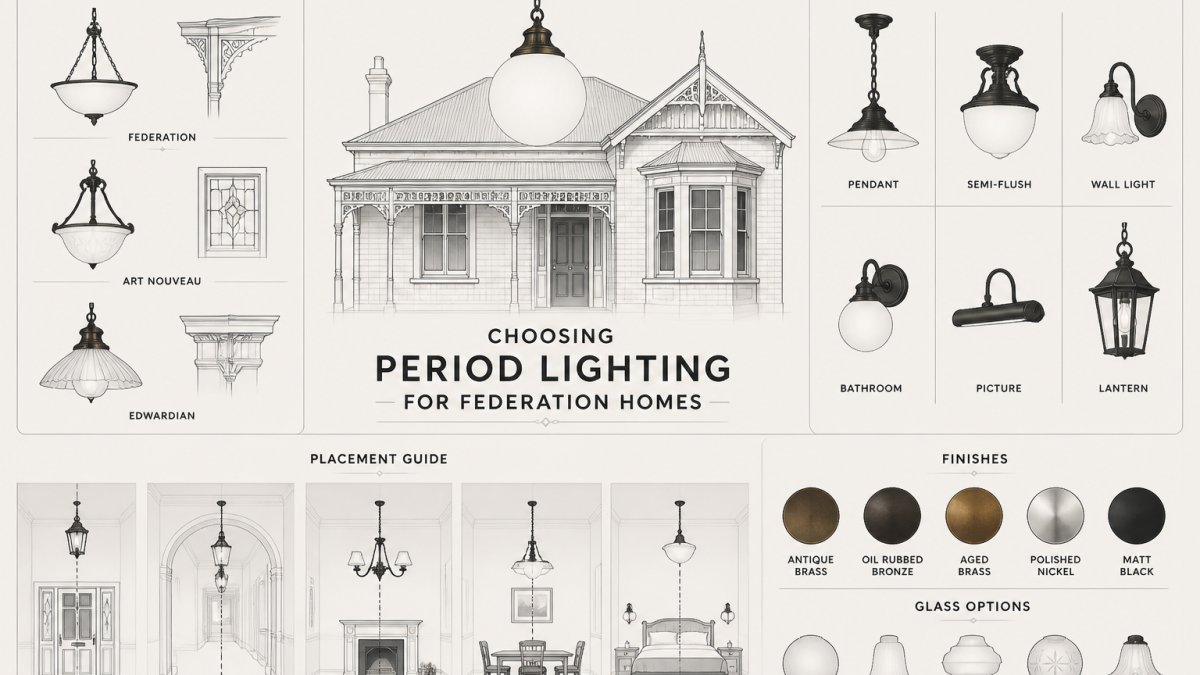
Period lighting means selecting light fittings that match the era, proportions and decorative language of a historic house, for Federation homes, styles in use roughly between 1890 and 1915.
Federation homes reward restraint. The era sat between Victorian excess and the cleaner interwar lines, so fittings are generous in scale but calmer in decoration, a middle ground renovators often miss, buying either too fussy or too plain.
Federation Hallway Lighting Ideas That Welcome Guests
A Federation hallway lighting plan starts with a single central fitting, then adds wall or floor layers so the entry works at night as well as in daylight.
For a typical 2.7 m wide hall, a pendant or rod pendant with a 350-450 mm shade diameter sits comfortably without crowding the walls.
Traditional finishes matter: polished brass, antiqued brass and dark bronze sit naturally against heritage colour schemes, while bright modern chrome fights the timber and plasterwork.
Federation Pendant Lights: Styles and Placement
Federation pendant lights fall into three families: rod pendants with a rigid stem, chain-hung pendants, and close-mounted ceiling fittings. The choice depends on ceiling height, the weight of the room's plasterwork, and how much visual weight the space can carry.
Rod pendants suit high rooms because the rigid stem holds a straight, deliberate line. Chain-hung fittings are more forgiving with decorative plaster, since the chain adjusts on site.
What is historically grounded, and where modern interpretation is fine
Separate the details that carry the era's character from those that are simply taste. These are well-established period features and safe choices in a Federation interior:
- A metal gallery or gallery ring holding an opal or clear glass shade
- Simple, restrained decoration rather than heavy scrollwork
- Brass, antiqued brass, dark bronze or blackened metal finishes
- A visible ceiling rose at the mounting point
You have more latitude in the shade material, the exact glass profile and the internal lamp. A schoolhouse-style shade with a simple opal or clear glass body and a metal gallery is among the most reliable choices, traditional without tipping into Victorian fussiness. A modern reproduction of the same silhouette in a cleaner profile usually sits comfortably alongside original cornices and architraves.
Lamp choice, LED compatibility and dimming
This is where most Federation lighting projects quietly go wrong: the fitting is only half the decision. The lamp inside determines the colour, the dimming behaviour and the running cost.
- Colour temperature. Warm white around 2700K flatters timber, brass and aged paintwork. Cooler 4000K lamps make period interiors look clinical and wash out heritage colour schemes.
- LED versus halogen or incandescent. Warm-white LED is now the default for period fittings: cooler running, longer lasting and far more efficient. The trade-off is that not every LED dims smoothly.
- Dimmer compatibility. A dimmer that worked with incandescent lamps can buzz, flicker or drop out with an LED. The fix is a dimmer rated for LED loads, matched to the lamp's driver. If keeping an older dimmer, check with your electrician first.
- Lamp shape and visibility. In a clear glass shade the lamp is part of the look, so a decorative filament-style LED is worth considering. In an opal shade the lamp is hidden and a standard warm-white LED is fine.
Placement
Placement follows the room's function, not the furniture layout. Centre the fitting on the main architectural axis, the ceiling rose, or the midpoint between the chimney breast and the opposite wall, rather than over a dining table that may later move.
- Dining room: hang the pendant so the bottom of the shade sits roughly 750-800 mm above the table surface, clear of seated diners' sightlines but close enough to feel intimate.
- Bedroom: mount higher, so the fitting stays clear of sightlines from the bed.
- Hallway or circulation route: keep the lowest point above about 2.1 m so tall visitors do not strike it.
Layered Lighting for Traditional Interiors: Ambient, Task, and Accent
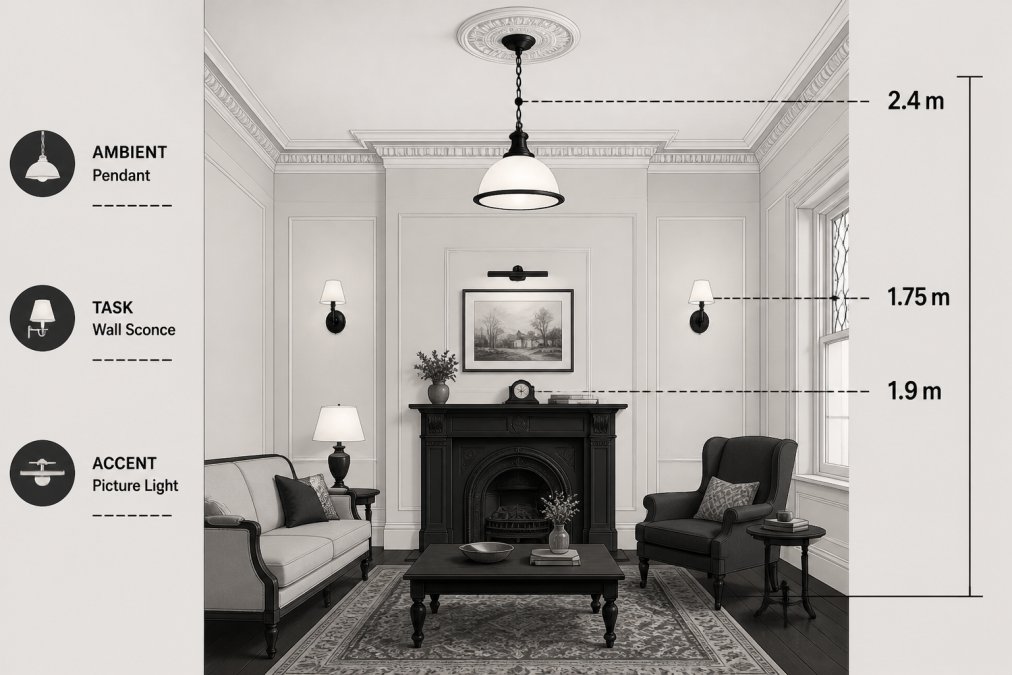
Layered lighting for traditional interiors splits light into three jobs: ambient for general brightness, task for specific activities, and accent to highlight architectural features. Federation rooms were designed around a single central light, which is why they can feel flat after dark.
What each layer does
- Ambient comes from the ceiling fitting and provides the room's base light, usually the central pendant or, in larger rooms, a pair of matching fittings.
- Task covers reading, cooking, dressing and working: wall sconces, a floor lamp beside an armchair, or a lamp on a sideboard or desk.
- Accent is the layer most renovators skip. A picture light over a mantel, a small uplight washing a cornice, or a floor lamp angled at a pressed-metal ceiling panel all add depth and draw the eye to the features worth restoring.
Planning the layout before you buy
The most useful exercise is to sketch the room in plan and mark where each layer sits:
- Mark the ceiling rose or the room's central axis, this is the ambient position.
- Mark the walls where task light is needed: beside the bed, over a kitchen bench, next to a reading chair.
- Mark the architectural features you want to draw out: a mantel, a cornice, a picture rail, a bay window.
Once the positions are on paper, you can see how many circuits the scheme needs and where switching should sit.
Switching zones and dimming
A Federation room with three layers on one switch is barely better than the original single pendant. Split the layers across separate switches or a multi-gang plate so ambient, task and accent work independently.
- Separate the layers. Ambient on one switch, task on another, accent on a third, so you can run a low ambient level in the evening without the task lights blazing.
- Dim the ambient layer at minimum. A dimmer on the main pendant is the single most useful upgrade in a period room, letting the ceiling light drop to a warm background level rather than dominating.
- Check dimmer and lamp compatibility. An LED dimmer rated for the load is usually needed for smooth, buzz-free dimming.
- Consider two-way switching in hallways and on stairs, where you want control from both ends.
Circuit capacity
Older homes often have lighting circuits that were never designed for the load of a multi-layer scheme. Adding sconces, accent lights and a dimmer may mean new circuits rather than new fittings on old wiring. This is also the point at which to confirm that any new work complies with the wiring rules set out in AS/NZS 3000, the Australian and New Zealand Wiring Rules.
Colour temperature ties the layers together
A warm 2700K light suits traditional interiors because it flatters timber, brass and aged paintwork and avoids the clinical feel of cooler globes. Keep colour temperature consistent across all three layers, a warm ambient pendant beside a cool task lamp is a common reason a layered scheme looks unresolved.
Lighting for High Ceilings in Period Homes: Scale and Suspension
Lighting for high ceilings in period homes comes down to two numbers: the drop and the diameter.
As a working rule, add the room's length and width in metres and treat the total as a rough guide to the fitting's diameter in centimetres: a 5 m by 4 m room points to a fitting around 450 mm across.
Suspension length also affects how the room reads: a long rod pendant draws the eye upward and makes the ceiling height feel intentional, while a short chain leaving dead space above the shade does the opposite.
| Ceiling Height | Suggested Drop Below Ceiling | Fitting Diameter Guide | Best Fitting Type |
|---|---|---|---|
| 2.7-3.0 m | 600-750 mm | 350-400 mm | Close-mounted or short rod pendant |
| 3.0-3.4 m | 750-1000 mm | 400-500 mm | Rod pendant or chain-hung pendant |
| 3.4 m and above | 1000-1400 mm | 500-600 mm | Long rod pendant or chandelier |
Australian Electrical Safety and Heritage Constraints
Any new light fitting must be installed by a licensed electrician and comply with the wiring rules set out in AS/NZS 3000, the Australian and New Zealand Wiring Rules.
Heritage overlays add a second layer.
If you are sourcing hard-to-find fittings for a listed property, Restoration Station stocks period lighting, cast iron fireplaces and architectural details for heritage, Colonial and Federation-style homes, with over 35 years of experience and expert advice on restoration, renovation and remodelling projects.
Federation lighting is a measurement problem before it is a style problem, and the houses that look best are the ones where someone did the arithmetic first.
Frequently Asked Questions
What should I consider when choosing lighting for a Federation home?
Focus on scale, style, and function. Federation homes often have high ceilings, so pendants and chandeliers need extra suspension. Match finishes like polished brass or aged iron to the era. Consider how each room is used and layer ambient, task, and accent lighting. Also check heritage overlay requirements before making changes.
What types of light fittings suit Federation-style homes?
Traditional pendants, rod pendants, schoolhouse glass shades, and crystal chandeliers are all appropriate. For hallways, consider lantern-style fixtures. Wall sconces and picture lights add period charm. Choose warm colour temperatures around 2700K and avoid overly modern designs unless you are deliberately mixing eras.
How do I choose lighting for a Federation hallway?
Hallways in Federation homes are often narrow and long. Use a central pendant or a series of small pendants to draw the eye. A rod pendant can lower the light source to a comfortable height. Add a wall sconce or two for ambient glow. Ensure the fixture does not obstruct traffic and complements existing archways or cornices.
How can I layer lighting in a period home?
Start with ambient lighting from a ceiling fixture, then add task lighting such as table lamps or under-cabinet lights, and finally accent lighting like picture lights or floor uplights. Use dimmers to control each layer. This approach lets you adjust the mood and function for different times of day without losing period character.
What is the three-lighting rule, and how can it work in a Federation home?
The three-lighting rule suggests using three sources of light in a room to avoid harsh shadows and create depth. In a Federation home, this could be a pendant, a pair of wall sconces, and a floor lamp. It works well in living rooms and bedrooms, helping to highlight architectural features while providing practical illumination.
How do I balance period-style lighting with modern everyday needs?
Choose fixtures that look period-appropriate but are compatible with modern bulbs, such as LED. Use dimmers and smart switches to adapt lighting for daily tasks. If you need more light, add hidden modern sources like LED strips behind cornices. The key is to keep visible fixtures traditional while upgrading performance behind the scenes.
How can I choose lighting for rooms with high ceilings?
High ceilings require larger fixtures and longer suspension. A pendant or chandelier should hang low enough to feel connected to the room, typically 2.1 to 2.4 metres from the floor. Use a rod pendant to adjust the drop. For very tall spaces, consider a two-tier chandelier. Ensure the fixture is proportional to the room's volume.
Should lighting in a Federation home match across every room?
Not necessarily. While a consistent style helps, you can vary fixtures by room function. For example, a formal dining room might have a crystal chandelier, while bedrooms use simpler pendants. Keep finishes and colour temperatures consistent for a cohesive look. Matching every room exactly can feel monotonous; aim for harmony rather than uniformity.