Table of Contents
- Why Matching Door Handles to Your Home Era Matters
- How to Identify Period Door Hardware for Your Home
- Edwardian Door Handles: Style, Finish, and Selection
- Matching Door Knobs for Old Houses: Finish and Coordination
- Mixing Door Handle Styles in a Period Home
- Common Mistakes to Avoid When Selecting Period Hardware
- Conclusion: Preserving Your Home's Character Through Authentic Hardware
- Frequently Asked Questions
Last Updated: October 16, 2026
Why Matching Door Handles to Your Home Era Matters
The character of a heritage home lives in its details. A door handle might seem like a small thing, but it's one of the first things people touch when they enter. When you match door handles home era correctly, everything clicks into place.
At Restoration Station, we've spent 35 years helping homeowners preserve their period properties. One pattern we see constantly: people choose handles based on what they like in isolation, not what actually belongs in their home's era.
Matching door handles to your home's architectural era isn't about rigid rules. It's about understanding what makes your home's character distinctive, then reinforcing it through thoughtful hardware choices.
This guide walks you through identifying your home's era, selecting handles that belong in that period, and mixing finishes smartly when you need variety. By the end, you'll know exactly what hardware works for your space and why.
How to Identify Period Door Hardware for Your Home
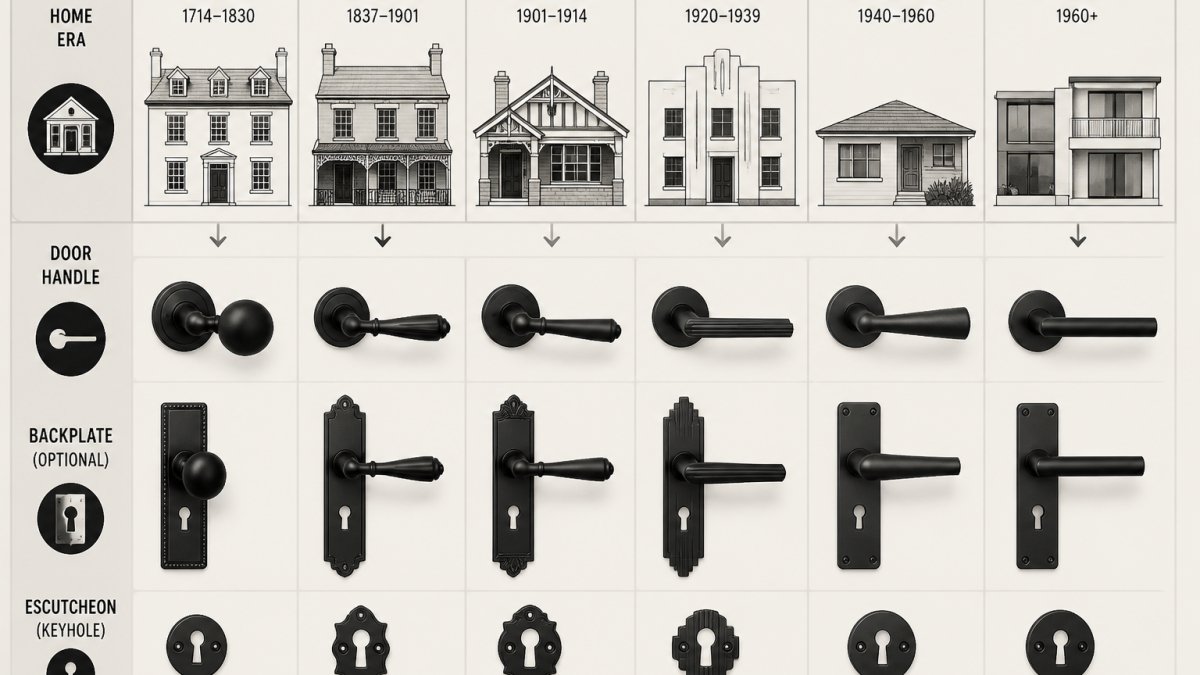
Before you can match door handles home era correctly, you need to know what era you're actually working with. Most Australian homes fall into a handful of distinct periods, each with recognisable architectural features.
Start with the obvious markers. Look at the roof pitch, the window style, the exterior cladding, and the overall proportions of the facade. A steep gable roof with decorative bargeboards screams Federation. A low-pitched roof and clean lines point to modern or contemporary.
Next, step inside. Look at the ceiling height (Victorian and Federation homes typically have higher ceilings). Check the skirting boards and architraves around doors and windows, are they simple or ornate? Examine the doors themselves. Panelled timber doors are common in older homes.
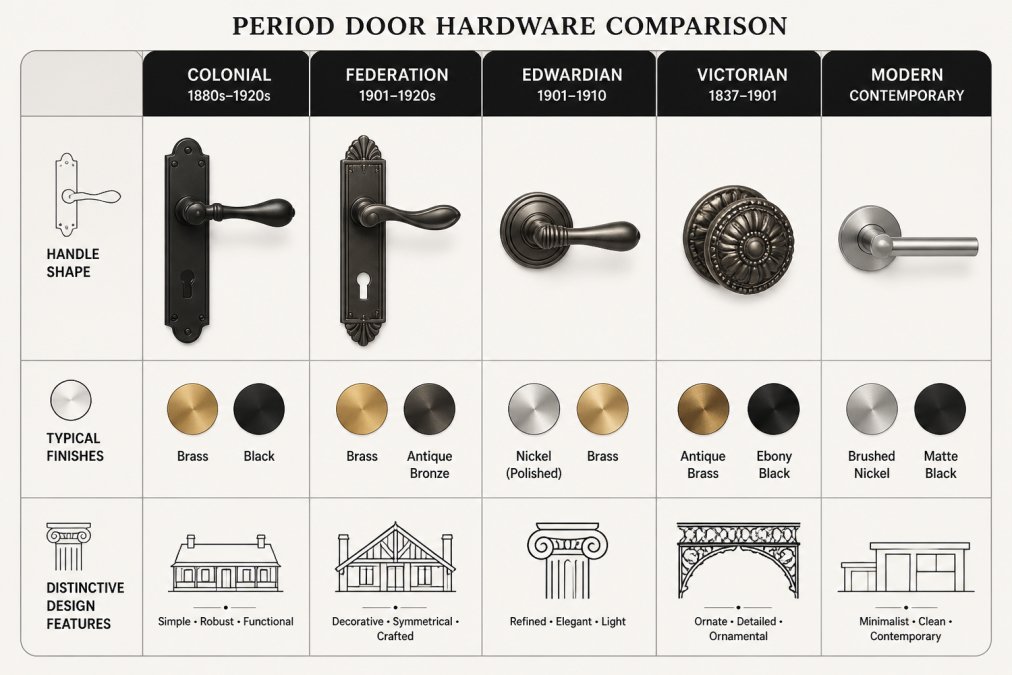
Colonial and Federation styles (1880s-1920s)
Colonial and Federation homes dominate the Australian residential landscape. These periods overlap slightly but have distinct characteristics.
Colonial homes feature simple, functional hardware. Door knobs tend to be round or slightly flattened, often cast from brass or iron. The aesthetic is practical rather than decorative. Federation style, which emerged in the early 1900s as Australian architecture developed its own identity, introduced more ornament. You'll see more elaborate door knobs and handles, often with decorative roses (the metal plate behind the handle). Brass becomes more common, sometimes with a patina finish.
When matching door handles to Federation homes, look for handles with some visual weight and detail. A simple pressed-brass knob works. So does a more ornate cast-brass handle with a decorative rose. The key is avoiding anything too minimal or too contemporary.
Edwardian era (1901-1910)
Edwardian door handles sit between Federation practicality and Victorian ornament. They're more refined than Colonial hardware but less fussy than pure Victorian pieces.
Edwardian door handles often feature elegant proportions and subtle decoration. You'll see brass handles with simple geometric patterns, or cast-iron knobs with understated detailing. The finish is typically polished brass or dark iron. Avoid shiny chrome or brushed stainless steel, these finishes didn't exist in the Edwardian period and will look anachronistic.
Victorian period (1837-1901)
Victorian homes, particularly those built in the latter half of the 1800s, showcase ornate hardware. Door knobs are often large, sometimes ceramic or porcelain with brass or iron mounts. Cast-brass handles with elaborate roses are common. The aesthetic celebrates ornamentation and craftsmanship.
If your home is genuinely Victorian, lean into that character. Ornate cast-brass handles, dark patina finishes, and decorative roses all belong. Simple, minimal hardware will undermine the home's visual language.
Modern and contemporary homes
Modern homes built from the mid-20th century onward favour clean lines and minimal ornamentation. Door handles tend to be simple, lever handles in chrome, stainless steel, or matte black. The focus is on function and sleek aesthetics.
Contemporary homes (built in the last 20-30 years) often push minimalism further. Recessed handles, invisible hardware, and monochromatic finishes are common. When matching door handles to a modern home, simplicity is your guide.
Edwardian Door Handles: Style, Finish, and Selection
Edwardian door handles occupy a sweet spot for many homeowners. They're elegant without being fussy. They work in homes that aren't strictly Edwardian because they bridge traditional and contemporary sensibilities.
An Edwardian door handle typically features a lever or knob with a decorative rose. The proportions are generous, neither too chunky nor too delicate. Common finishes include polished brass, dark patina brass, and cast iron with a matte or slightly weathered appearance.
When selecting Edwardian handles, consider the room's function. A formal entry might warrant a more ornate handle. A bedroom or service room can carry something simpler. The key is consistency: if you're using Edwardian handles throughout your home, they should feel like a coordinated set, even if individual pieces vary slightly in detail.
Look for handles with solid construction, cast brass rather than stamped, or quality cast iron. These materials age beautifully and develop character over decades. Avoid thin, lightweight handles that feel flimsy. Period hardware was built to last.
Matching Door Knobs for Old Houses: Finish and Coordination
The finish you choose matters as much as the handle style itself. A beautiful Victorian handle in shiny chrome looks wrong. The same handle in dark patina brass looks perfect.
Choosing the right metal finish
Polished brass reads as traditional and warm. It reflects light and develops a natural patina over time. Works beautifully in Victorian, Edwardian, and Federation homes.
Dark patina brass (sometimes called antique brass) has a muted, aged appearance. This finish suits older homes perfectly because it looks like it belongs there, like it's been on the door for decades.
Brushed or matte finishes work across multiple eras. A brushed brass handle suits Federation or contemporary homes. Brushed stainless steel belongs in modern spaces.
Black or dark iron evokes heritage and craftsmanship. Cast-iron handles with a matte black finish work in Victorian, Colonial, and Federation homes, and increasingly in contemporary spaces where black hardware is fashionable.
Chrome and polished stainless steel are modern finishes. They belong in contemporary homes and modern renovations. Avoid them in heritage homes, they'll look out of place.
Coordinating with interior and exterior design
Your front door hardware sets the tone for how visitors perceive your home. If your exterior is painted in a heritage colour (deep green, burgundy, charcoal), choose door hardware that complements it. A dark patina brass handle works beautifully on a charcoal door. Polished brass suits warmer tones.
Inside, think about the colour scheme of your entry hall or living space. Neutral interiors (whites, creams, soft greys) work with any traditional finish. If your interior leans warm (timber tones, warm whites), polished or dark patina brass feels right.
The hardware on your doors should also coordinate with other metalwork in the space. If your light fittings are brass, your door handles should match. If your tapware (kitchen and bathroom taps) is chrome, consider whether your door handles should echo that finish or provide intentional contrast.
Mixing Door Handle Styles in a Period Home
Many homeowners worry they need identical handles throughout their home. That's not necessary, and sometimes it's less interesting if you do.
A common approach: use your best, most ornate handles on the front entry and principal rooms. These are the spaces visitors see first. Use simpler handles on bedrooms, bathrooms, and service areas. This creates visual hierarchy without looking disjointed.
The unifying factor isn't identical handles, it's consistent finish and era. All your handles might be brass, but some ornate and some simple. Or all cast iron, with varying levels of detail. As long as the finish and period feel cohesive, the variation reads as intentional.
Another strategy: coordinate door handles with cabinetry hardware and tapware. If your kitchen cabinets have brass handles, your internal doors might carry matching brass hardware. This creates a thread of visual continuity that ties rooms together without requiring everything to be identical.
Consider the architecture of each room too. A high-ceilinged Victorian sitting room can carry an ornate handle. A modern ensuite with minimal detailing calls for something simpler. The handle should feel proportionate to its setting.
Common Mistakes to Avoid When Selecting Period Hardware
Mixing eras carelessly. Pairing a sleek contemporary lever handle with ornate Victorian hardware doesn't create eclectic charm, it looks like you couldn't decide.
Choosing handles based on what's available rather than what's right. Just because a handle is in stock doesn't mean it belongs on your door.
Ignoring the scale of the door. A tiny delicate handle looks lost on a large timber door. An oversized ornate handle overwhelms a modest bedroom door.
Assuming all brass is the same. Polished brass and dark patina brass are completely different aesthetically. One looks bright and new; the other looks aged and heritage.
Forgetting that hardware ages. Polished finishes will develop a patina over time, that's part of their charm. Dark patina finishes will stay relatively stable.
Installing modern hardware in heritage homes. Shiny chrome, brushed stainless steel, and minimalist lever handles belong in contemporary spaces.
Conclusion: Preserving Your Home's Character Through Authentic Hardware
Matching door handles to your home era is one of the most visible ways to preserve, or undermine, your property's character. The right handle reinforces the home's story. The wrong one contradicts it.
Start by identifying your home's architectural period. Look at the roof, windows, ceilings, and existing details. Then choose handles and finishes that belong in that era. Polished or dark patina brass for Victorian and Federation homes. Simpler cast handles for Colonial spaces.
Restoration Station has spent 35 years sourcing authentic period hardware for homeowners and heritage builders. Our range includes period lighting, cast iron fireplaces, and unique architectural details.
When you're ready to source hardware that genuinely belongs in your home, contact us for expert guidance.
Frequently Asked Questions
What did Edwardian door handles look like?
Edwardian door handles (1901-1910) typically featured elegant, elongated designs with refined proportions. Common styles included lever handles with slender, tapered profiles, often finished in brass or bronze. Many Edwardian handles incorporated subtle decorative elements such as floral motifs or geometric patterns near the base. The period favoured understated ornamentation compared to the heavier Victorian era, reflecting the era's emphasis on simplicity and functionality paired with refined aesthetics.
How do I identify the architectural era of my home?
Start by examining your home's external features: roof pitch, window style, wall materials, and decorative details. Federation homes (1890s-1920s) typically have steep roofs, ornate timber details, and leadlight windows. Victorian properties (1837-1901) feature ornamental ironwork, tall sash windows, and elaborate facades. Colonial homes show simpler lines, verandahs, and shutters. Check your property's title deeds, council records, or heritage listings for confirmation. If unsure, consult a heritage professional or your local council's heritage register.
Can I mix and match door handles in a period home?
Yes, thoughtful mixing is acceptable and often more authentic than identical hardware throughout. Period homes typically had hardware selected over time as replacements were needed. The key is creating visual harmony by maintaining consistency within zones: use matching handles on doors in the same room or hallway, then transition to different styles in other areas. Ensure all handles share the same finish family (brass with brass, black with black) and era aesthetic. This approach respects the home's evolution while preserving its character.
What finish should I choose for period door hardware?
Your finish should reflect your home's era and colour scheme. Brass and bronze finishes suit Victorian and Edwardian homes and complement warm, neutral interiors. Black finishes work well with contemporary colour schemes and modern period homes. Brushed or satin finishes offer a softer, more understated look suitable for Federation-era properties. Consider your home's existing metalwork, tapware, cabinetry hardware, light fittings, and select a finish that coordinates with these elements for overall visual harmony and consistency.