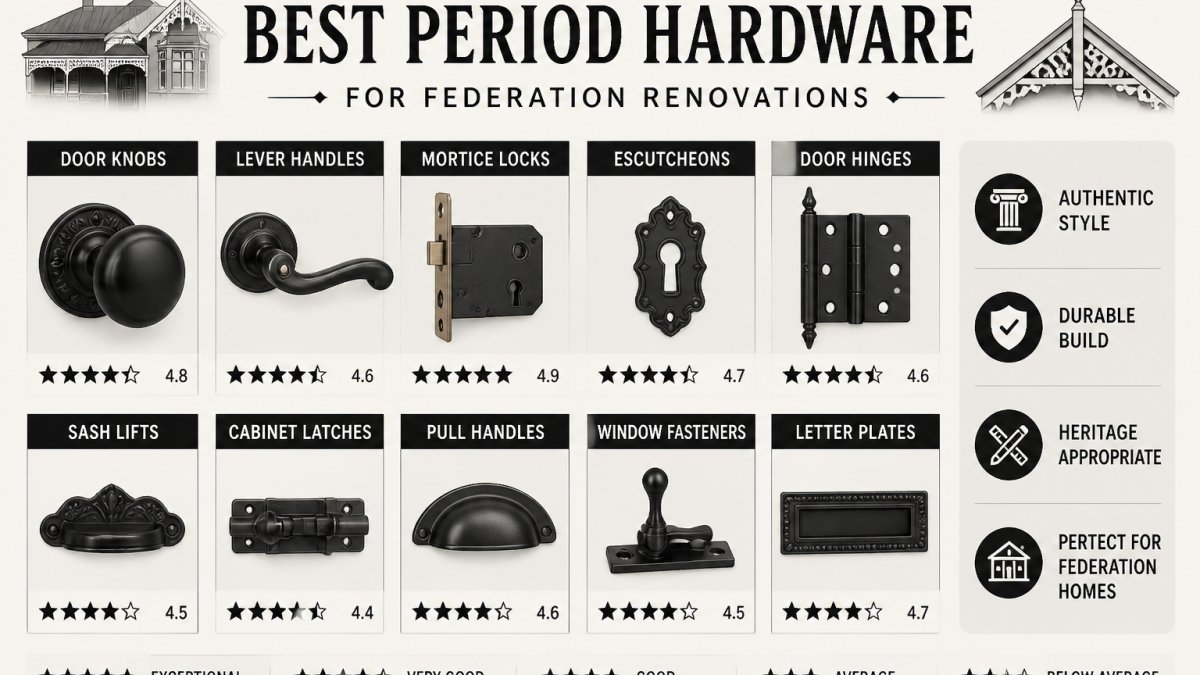
Table of Contents
- Why Period Hardware Makes or Breaks a Federation Renovation
- Reading Your Federation Home: Era Cues That Guide Hardware Choice
- Federation Door Hardware: Knobs, Handles, Locks and Latches
- Choosing Brassware for Federation Houses by Room and Function
- Traditional Window Hardware and Decorative Details
- Durable Exterior Door Hardware Finishes That Suit the Period
- Authenticity vs Sympathetic Reproduction: What to Buy and What to Skip
- Fitting, Maintenance and Compatibility With Existing Doors
- Frequently Asked Questions
Last Updated: October 18, 2026
Why Period Hardware Makes or Breaks a Federation Renovation
Walk into a beautifully restored Federation home and you can usually spot the fake within seconds. It's rarely the paint or plasterwork, it's the door furniture: a modern lever handle bolted onto a 1910 four-panel door, or a chrome tap set where aged brass belongs.
At Restoration Station, we've spent more than 35 years supplying traditional fixtures and fittings for heritage-listed, Colonial and Federation-style homes.
Below, we break down how to read your Federation home's era cues, choose brassware room by room, and balance authenticity against modern function.
Reading Your Federation Home: Era Cues That Guide Hardware Choice
The Federation era in Australia ran from about 1890 to 1915, and the design language shifted across those decades. Early homes leaned toward Queen Anne and Arts and Crafts influences; later examples moved toward Edwardian restraint. Your hardware should follow the same arc.
Look at three things before you buy anything:
- The door itself. Four-panel doors with moulded panels suggest an earlier Federation build. Simpler three-panel or flush designs point to later Edwardian work.
- Existing joinery. Skirting profiles, architraves and picture rails tell you how ornate the original fit-out was.
- Any surviving fittings. A single original brass knob or latch is your best reference point. Match it rather than guess.
Federation-Era Design Characteristics to Match
Federation design favours decorative detail: pressed metal ceilings, leadlight windows, turned timber posts and verandah fretwork. Hardware that suits the period carries the same decorative weight.
One insider observation: Federation hardware was often mismatched from new. Builders sourced from different suppliers, so a front door might carry a more ornate set than the bedrooms. Inconsistency in your home is likely original, not a renovation error.
Federation Door Hardware: Knobs, Handles, Locks and Latches
Federation door hardware covers the full set of fittings that make a door work: the knob or handle, the backplate or rose, the spindle, the latch mechanism and the lock. Getting all five right matters, because a beautiful knob on a cheap modern latch still feels wrong in the hand.
Here's how we'd approach the main pieces:
- Door knobs. Faceted glass or solid brass knobs with a decorative rose are the safest Federation choice. Glass suits bedrooms and internal doors; brass suits front and main living areas.
- Backplates. Floral or pressed-motif backplates anchor a knob visually. Long plates suit front doors; smaller roses suit interior doors.
- Rim locks. Many Federation homes used rim locks on the front door. A traditional rim lock in polished or aged brass is period-appropriate and still works well.
- Mortice locks. Where a mortice lock was fitted, keep the existing body if it's sound and replace only the furniture.
- Latches. A traditional latch with a solid brass snib or turn is more authentic than a modern tubular latch.
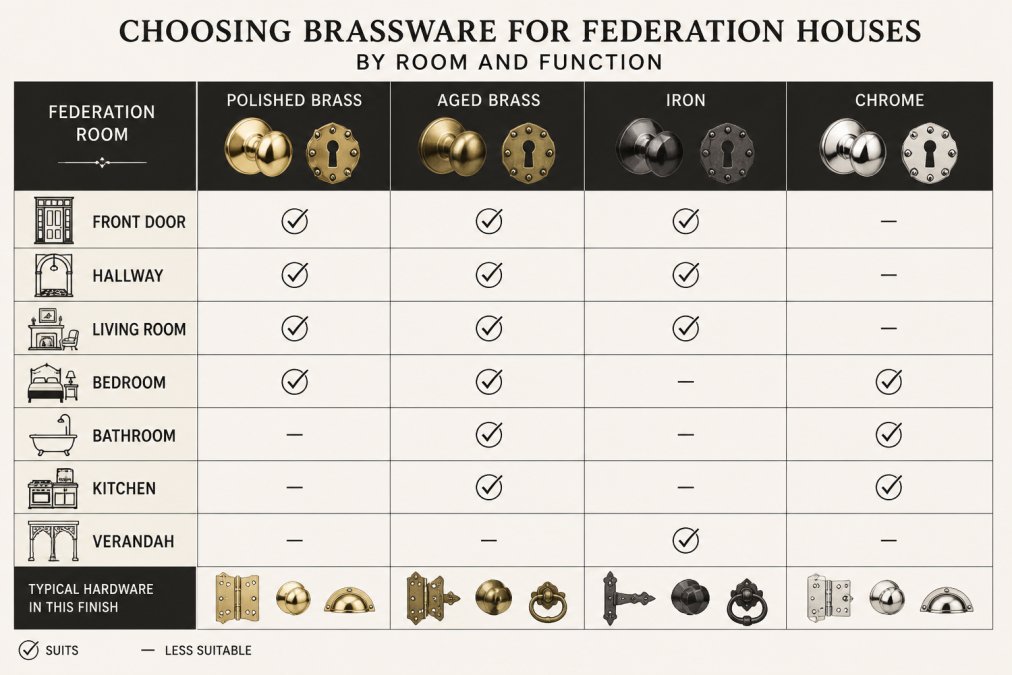
Choosing Brassware for Federation Houses by Room and Function
Brassware for Federation houses should follow the function of each room, not a single house-wide rule. A front door needs durability and presence, a bathroom needs finishes that tolerate moisture, and a bedroom can carry more delicate decorative detail. The table below maps rooms against recommended hardware, finishes and fitment checks.
| Room | Recommended hardware | Best finish | Fitment and function notes |
|---|---|---|---|
| Front door | Rim lock or mortice lock, long backplate, solid brass knob | Polished or aged brass | Check backset and door thickness; front doors are the highest-wear item, so prioritise solid construction over decorative detail |
| Hallway | Brass knobs, smaller roses | Polished brass | Match the front door pattern for visual continuity; confirm spindle diameter before ordering |
| Living room | Brass knobs, decorative backplates | Polished brass | Can carry more ornate detail; ensure backplate screw holes align with existing mortises |
| Bedroom | Faceted glass knobs, small roses | Glass with brass | Softer look suits private rooms; glass knobs need a sound spindle and a gentle latch action |
| Bathroom | Solid brass taps and fittings | Aged brass or chrome | Aged brass hides water marks; avoid plated finishes in damp areas where plating can lift |
| Kitchen | Brass cupboard latches and handles | Aged brass | Aged finish handles daily handling; check cabinet door thickness for latch clearance |
| Verandah | Iron or brass fittings, heritage lighting | Iron or aged brass | Exterior exposure favours iron; apply occasional protection against rust in coastal conditions |
A Room-by-Room Shortlist
For a Federation home, we would shortlist:
- Front door: solid brass knob, long floral backplate, traditional rim lock. Confirm backset and spindle size against the existing lock body.
- Internal doors: faceted glass or brass knobs with small roses; check door thickness so roses sit flush.
- Bathroom: aged brass tapware that tolerates moisture. Avoid chrome if the rest of the house uses brass.
- Kitchen: aged brass cupboard latches and handles; test latch clearance before ordering a full set.
Matching Hardware to Door Function
Function should drive the specification as much as style.
Order the full set for a room together where possible. This avoids batch variation in finish and pattern, which is more noticeable when pieces sit side by side on the same door or cabinet run.
Traditional Window Hardware and Decorative Details
Traditional window hardware is the most overlooked part of a Federation fit-out. Homeowners spend hours on door knobs, forget the windows entirely, then wonder why a room still feels modern.
Period-appropriate window furniture includes:
- Sash lifts and pulls. Solid brass sash lifts suit double-hung windows and are far more authentic than modern finger pulls.
- Window latches. Brass or iron sash latches with a traditional snib match the period.
- Casement stays and fasteners. For casement windows, brass stays with a decorative finial suit Federation detailing.
- Decorative details. Pressed motifs, floral backplates and faceted glass carry through to window fittings for a consistent look.
The same logic applies to verandah fretwork, heritage lighting and pressed metal panels. Consistency across doors, windows and trim separates a sympathetic restoration from a patchy one.
Durable Exterior Door Hardware Finishes That Suit the Period
Durable exterior door hardware finishes need to survive sun, salt air and rain without losing their period look.
Solid brass is the standard for Federation exteriors.
Iron suits verandah and gate hardware where a darker, heavier look fits.
Chrome is a modern finish and rarely suits a Federation exterior.
A common mistake is choosing a plated "brass-look" finish to save money.
Authenticity vs Sympathetic Reproduction: What to Buy and What to Skip
Authenticity versus sympathetic reproduction is the central tension in any Federation renovation. Original hardware is scarce, often damaged, and not all reproduction is equal. The useful question is not "original or reproduction" but "which choice preserves the home's character while meeting current needs".
Here is a decision framework we use when advising on Federation renovations:
- Restore original where it survives and works. Sound, functional original brass knobs and backplates are worth restoring, they carry the home's history and usually match the door's existing mortise and spindle. Check for cracks, stripped threads and worn spindle holes first.
- Choose sympathetic reproduction where original is missing or unsafe. A reproduction rim lock matching the original pattern beats a modern lock that clashes. Look for solid construction, correct proportions and a finish that develops naturally rather than a painted-on patina.
- Skip anything that fakes age badly. Artificial "antique" finishes read as fake up close; aged brass with a genuine patina reads as authentic because it is.
- Skip modern lever handles on period doors. They break the period look fastest. If accessibility is a concern, choose a period-style lever or a knob with a sympathetic rose rather than a contemporary bar handle.
Criteria for Judging Reproduction Quality
The question we hear most is how to tell authentic from reproduction. The honest answer: good reproduction is honest about what it is. Use these criteria:
- Material: solid brass or iron, not plated base metal. Plated finishes can flake at high-touch points and expose the metal underneath.
- Construction: cast or machined components that feel solid in the hand. A lightweight knob on a thin spindle will rattle and wear quickly.
- Proportions: backplates and roses sized to the door, not oversized modern plates on a period door.
- Pattern accuracy: motifs that match known Federation patterns, such as floral backplates and faceted glass knobs, rather than generic Victorian or modern designs.
If a supplier can explain the pattern, material and construction, that's a good sign. If the description is vague about material or finish, treat it with caution.
When to Mix Original and Reproduction
Mixing original and reproduction is often the most practical approach. Keep original hardware on the front door and main living areas where it survives, and use sympathetic reproduction on secondary doors, windows and cupboards where originals are missing. The key is consistency of pattern and finish within sight of each other: a reproduction knob matching the original pattern on the same hallway run reads as part of the same fit-out; a mismatched modern handle will not.
Fitting, Maintenance and Compatibility With Existing Doors
Fitting period hardware to existing doors is where many renovations stall. Old doors have settled, spindle holes have worn, and lock bodies may not match modern standards.
On fitting and maintenance:
- Spindle and backset. Match the spindle diameter and backset to the existing lock body. If you're keeping the original lock, buy furniture that fits it.
- Door thickness. Federation doors are often thicker than modern ones. Check that backplates and roses sit flush.
- Maintenance. Solid brass needs occasional polishing; aged brass needs little beyond a wipe. Iron needs periodic protection against rust.
- Durability. Solid construction outlasts plated finishes every time. Prioritise it over decorative detail where the two conflict.
If you're working with a heritage builder across multiple orders, consistency of finish and pattern matters as much as individual pieces.
A Federation renovation asks a lot of the homeowner: patience, research and a willingness to get the details right. Hardware is where that effort shows most clearly.
Frequently Asked Questions
What door hardware suits a Federation home?
Federation homes typically suit solid brass door knobs, lever handles and backplates with pressed or floral motifs, paired with rim locks or mortice locks in a traditional style. Polished brass and aged brass are the most period-appropriate finishes, while darker iron works well on exterior and utility doors. Match the level of decoration to the room: ornate backplates and escutcheons for hallways and front doors, simpler knobs for bedrooms and service areas.
What is the most durable finish for exterior door hardware?
For exterior doors, aged brass and solid cast iron generally hold up best because they develop a protective patina rather than showing every scratch. Lacquered polished brass looks sharp when new but can flake in harsh weather, so unlacquered brass that patinas naturally is often the safer long-term choice. Whatever finish you pick, solid construction matters more than the coating: a heavy cast piece outlasts a thin plated one.
Should hardware be the same throughout a Federation house?
Consistency helps, but it does not mean every door needs an identical handle. Federation-era homes often used one finish family, usually brass, across the main rooms, with simpler or heavier fittings in service areas and on exterior doors. Keep the finish and general style consistent, then vary the decorative detail by room function. This balances historical accuracy with the practical needs of each space.
How do you choose hardware for a heritage renovation without getting it wrong?
Start by identifying your home's architectural era and existing fittings, then match materials, finishes and decorative motifs to that period rather than to current trends. Check compatibility with your existing doors and locks before ordering, since spindle sizes and lock backset vary. If you are unsure, ask a specialist for guidance rather than guessing from photos, and buy solid construction over lightweight reproductions.