Table of Contents
- What Makes a Cast Iron Fireplace Mantle Authentic
- Victorian Cast Iron Fireplace Styles and Characteristics
- Federation Fireplace Designs: Transitional and Simplified Aesthetics
- Cast Iron Fireplace Surround and Mantel Dimensions
- Cast Iron Fireplace Restoration and Ongoing Care
- Sourcing Authentic Cast Iron Fireplace Mantels
- Fireplace Accessories and Complementary Cast Iron Details
- Frequently Asked Questions
Last Updated: October 19, 2026
What Makes a Cast Iron Fireplace Mantle Authentic
Authentic cast iron fireplace mantels bear the marks of their era: casting seams, hand-finished details, and substantial weight. At Restoration Station, we help homeowners and heritage builders distinguish real antiques from convincing fakes.
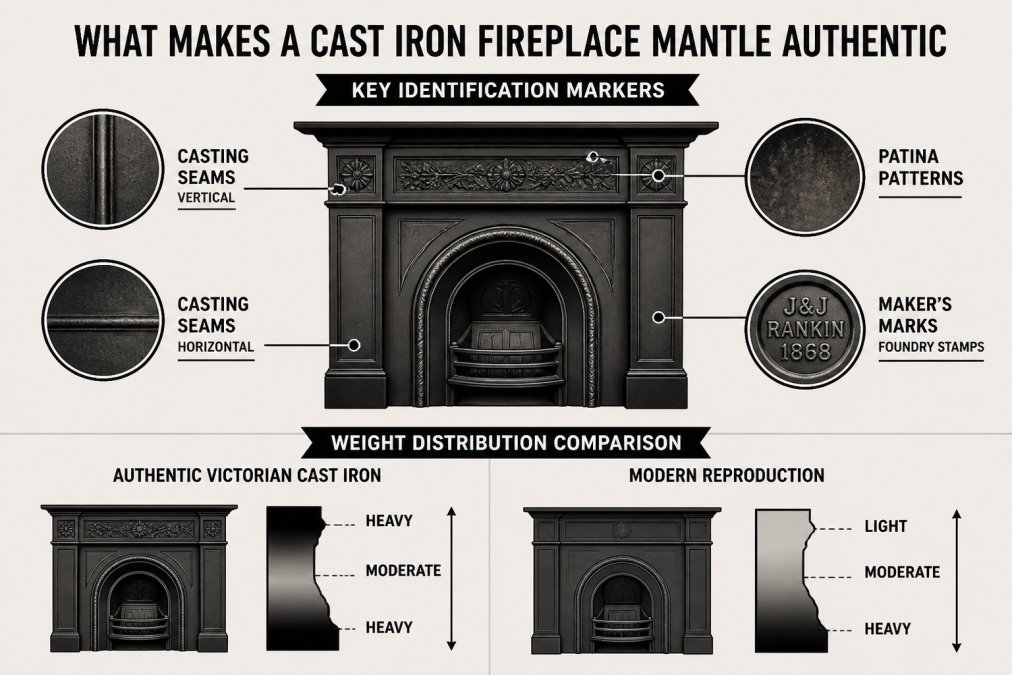
Genuine Victorian and Federation-era mantels were hand-poured into sand moulds, leaving casting marks, uneven wall thickness, surface irregularities, and patina developed over decades rather than months.
Identifying genuine antique cast iron versus reproduction pieces
Look for casting seams running vertically or horizontally across the piece, the natural result of joining mould halves; reproductions often sand these smooth.
Maker's marks and foundry stamps are another strong indicator. Many Victorian and Federation foundries stamped initials, names, or locations on the back or underside.
Authentic Victorian cast iron has a slightly rough, porous surface; Federation pieces are smoother but still show minor casting imperfections. Reproductions often have suspiciously uniform surfaces, artificially distressed to appear aged.
Materials, construction marks, and casting techniques
Sand casting, the dominant period technique, created natural air pockets and slight variations in thickness. Running your hand across an authentic piece reveals minor irregularities that modern casting rarely replicates.
Authentic cast iron fireplace mantels are genuinely heavy because casting required substantial material thickness for structural integrity. Reproductions sometimes use thinner walls or lighter alloys, feeling insubstantial by comparison.
The underside reveals construction secrets. Authentic pieces show rough patches, tool marks, and uneven surfaces where workers cleaned away excess material. Reproductions often have suspiciously clean, polished undersides.
Victorian Cast Iron Fireplace Styles and Characteristics
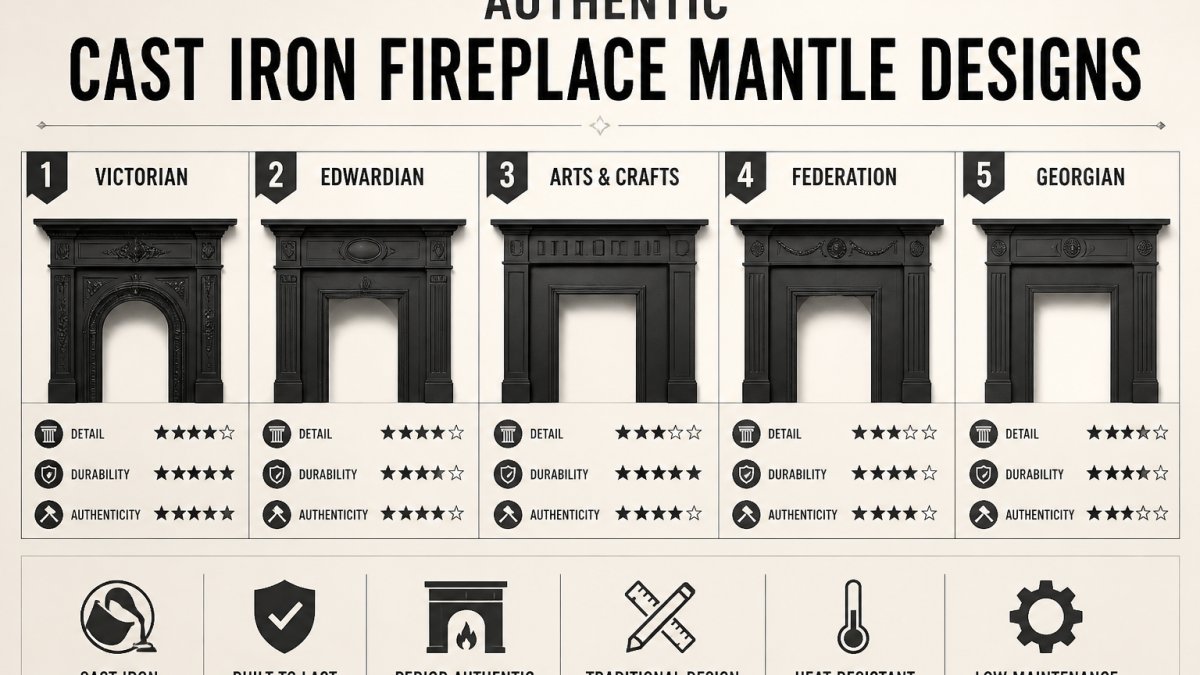
Victorian cast iron fireplace mantels represent peak ornamentation, with elaborate scrollwork, floral motifs, and architectural detailing reflecting wealth and taste. Recognising period-specific elements helps you match a mantel to your home's construction date.
Early Victorian mantels (1837-1860) tend toward heavy, geometric ornamentation. Mid-Victorian pieces (1860-1880) embrace naturalistic designs: acanthus leaves, roses, and scrolling vines. Late Victorian mantels (1880-1901) often show Art Nouveau influence with flowing lines and stylised plant forms.
Ornate detailing and period-specific design elements
Detailing followed predictable patterns by decade and foundry.
Tiling was integral to Victorian design. Original tiles, cast iron panels or ceramic inserts with geometric or figural designs, add significant authenticity value. Replacement tiles, even period-appropriate ones, indicate modification.
Finish and patina tell you about a mantel's history. Victorian pieces often show deep black paint beneath layers of rust and age. Some were originally polished to a high sheen.
How to match a Victorian mantle to your home's era
Match your mantel to your home's construction date. A Georgian home (pre-1837) shouldn't have a Victorian mantel, and a Federation bungalow (1901-1920) would look wrong with a heavily ornate Victorian piece.
Room proportions matter. Victorian parlours had higher ceilings and larger fireplaces than bedrooms, so a parlour-sized mantel would feel out of scale in a modest cottage bedroom. Assess fireplace opening and ceiling height before selecting.
Architectural details in your home, cornicing, skirting boards, door frames, should harmonise with your chosen mantel.
Federation Fireplace Designs: Transitional and Simplified Aesthetics
Federation-era mantels (1901-1920) mark a transition from Victorian excess toward modernist restraint. Geometric patterns replace naturalistic ornamentation, and vertical lines dominate horizontal ones, creating elegance without overwhelming detail.
Federation cast iron fireplace mantels often feature Art Deco influences: chevrons, sunburst patterns, and stylised geometric forms. Detailing is confined to specific zones, corbels, central panel, and mantel shelf edge, with large blank areas of smooth cast iron balancing the decorated sections.
Simplified ornamentation and geometric proportions
Geometric simplification defines Federation design. Where a Victorian mantel might feature a dozen motifs, a Federation piece typically uses two or three repeated geometric patterns, creating visual rhythm without chaos.
Colour and finish on Federation pieces often reflect their transitional nature. Some retain Victorian black paint; others show evidence of being polished or burnished to reveal the underlying cast iron.
Cast Iron Fireplace Surround and Mantel Dimensions
Measuring your fireplace opening accurately is essential before sourcing a cast iron fireplace mantle. A mantel that's too small looks lost; one that's too large overwhelms the room.
The height of your mantel above the hearth affects both aesthetics and safety. Standard clearance is 1.5 metres from the top of the mantel to any combustible material above (ceiling, timber beams, or cornicing), a non-negotiable building safety standard that protects your home from fire risk.
Measuring and assessing room-scale fit
Measure your fireplace opening width, height, and depth from the outer edge of the existing brickwork or stonework.
Measure the distance from the top of your fireplace opening to the ceiling. A mantel with a tall central panel might not fit if your ceiling is low.
Consider visual weight. In a small cottage bedroom, a cast iron fireplace mantle designed for a grand Victorian parlour will dominate the space; in a large, high-ceilinged living room, a modest mantel may appear undersized.
Installation considerations and safety clearances
Building codes in Australia require specific clearances for fireplace installations.
Securing a cast iron fireplace mantle requires proper fixings. Cast iron is brittle and can crack under uneven stress, so installation typically involves securing the mantel to the brickwork or stonework using specialist fixings that distribute load evenly.
Settlement in older homes can affect installation. Heritage properties often shift over decades, leaving the fireplace opening slightly out of square; a skilled installer will assess this and adjust so the mantel sits level and secure.
Cast Iron Fireplace Restoration and Ongoing Care
Restoring an authentic cast iron fireplace mantle requires patience. Preserve the piece's patina and character while removing damaging rust; aggressive cleaning such as sandblasting or wire brushing strips the aged surface that gives an antique its authenticity and value.
Begin with gentle cleaning. A soft brush and mild detergent remove surface dust and grime without damaging the patina. For stubborn dirt, use a soft cloth dampened with white vinegar, which helps dissolve corrosion without harming the underlying cast iron.
Cleaning, rust treatment, and protective finishing
Light surface rust can be managed with gentle abrasion using fine steel wool or a soft brass brush.
For deeper rust, a rust converter (which transforms iron oxide into a stable compound) is gentler than mechanical removal. Apply per instructions, cure fully, then seal to maintain the aged appearance while halting rust progression.
Protective finishing prevents future rust without creating a plastic-like surface. Traditional approaches used beeswax or linseed oil, which penetrate the cast iron and provide modest protection.
When to seek professional restoration services
Complex restoration, deep corrosion, structural cracks, or pieces of significant historical value warrant professional attention. A heritage specialist has the equipment and knowledge of period-appropriate techniques that preserve authenticity.
If your cast iron fireplace mantle has broken sections, missing details, or extensive damage, specialist foundries can sometimes cast replacement corbels, panels, or decorative details to match originals, work beyond homeowner maintenance.
Restoration Station can connect you with heritage specialists who understand the complexities of authentic cast iron restoration.
Sourcing Authentic Cast Iron Fireplace Mantels
Finding a genuine cast iron fireplace mantle requires patience and knowledge. Salvage yards, heritage specialists, and online marketplaces all stock period pieces, but quality and authenticity vary widely. Knowing what to verify before purchasing protects you from expensive mistakes.
Request detailed photographs before purchasing: front, back, underside, maker's marks, and close-ups of casting seams, patina, and damage. Reputable sellers provide comprehensive documentation; resistance to detailed photography is a warning sign.
What to verify before purchasing salvaged or reclaimed pieces
Inspect in person if possible: run your hands across the surface, feel the weight, check for cracks or warping.
Ask about the piece's provenance. Where was it salvaged? From which era does it date? What condition was it in when removed?
Verify the dimensions match your needs. Confirm the width, depth, and height. Ask about weight, authentic cast iron should feel substantial. Request information about any damage, repairs, or modifications. Honesty about a piece's condition builds confidence in the seller's credibility.
Working with heritage specialists and restoration suppliers
Heritage specialists bring expertise that general salvage yards lack. They understand period design, can authenticate pieces, and often provide guidance on installation and restoration.
When working with specialists, ask about their sourcing practices. Do they have relationships with salvage operations? Do they authenticate pieces before resale? Do they stand behind their inventory?
Documentation adds value and authenticity. A cast iron fireplace mantle with clear provenance, salvaged from a specific heritage property, documented with photographs from its original installation, commands higher prices and provides confidence about its authenticity.
Fireplace Accessories and Complementary Cast Iron Details
Authentic cast iron fireplace mantels pair beautifully with period-appropriate accessories. Andirons, fenders, fire baskets, and grates serve practical functions, holding logs and preventing embers from escaping, while adding visual interest and authenticity.
Andirons are decorative supports that hold logs in the fireplace. Period andirons feature cast iron construction with ornamental detailing matching the mantel era. Victorian andirons often have elaborate scrollwork and finials. Federation-era pieces show simpler geometric forms. Matching andirons to your mantel creates visual harmony.
Andirons, fenders, fire baskets, and grates
Fire baskets (also called fire grates) hold burning logs and allow air circulation underneath for proper combustion. Authentic period baskets are cast iron, often with decorative bars and supports.
Fenders are protective barriers that prevent hot embers or logs from rolling onto the hearth. Period fenders are typically cast iron, sometimes with brass or steel trim, serving a genuine safety function while adding decorative detail.
Fireplace tools, pokers, shovels, tongs, and brushes, complete the picture.
Coordinating accessories with your mantle style
Matching accessories to your mantel requires attention to design language. If your mantel features ornate Victorian scrollwork, choose accessories with similarly elaborate detailing.
Material consistency matters. An ornate cast iron mantel paired with sleek stainless-steel accessories creates visual discord.
Scale and proportion guide accessory selection. Large, bold accessories suit spacious fireplaces in high-ceilinged rooms; delicate, refined accessories work better in modest fireplaces.
Preserving your home's period character requires authentic cast iron fireplace mantels that reflect its architectural heritage.
Frequently Asked Questions
How can you tell if a cast iron fireplace is antique?
Authentic antique cast iron fireplaces show specific hallmarks: visible seam lines from the casting moulds, uneven patina indicating age, maker's marks or foundry stamps on the back or underside, and a distinctive weight that reproduductions rarely match. Examine the surface texture closely, genuine pieces display natural wear patterns, not uniform aging. Check underneath for construction details; authentic mantels often have reinforcing brackets or registration marks from the original casting process. If you're unsure, consult a heritage specialist who can assess the piece's provenance and construction methods.
What styles of cast iron fireplace mantles are authentic?
Authentic styles span several periods: Victorian mantles feature elaborate ornamental detailing, scrollwork, and classical motifs; Federation-era designs show streamlined proportions with restrained decoration; and earlier Colonial pieces display simpler, more functional designs. Each era has distinct characteristics, Victorian pieces are typically heavier and more ornate, while Federation designs favour geometric simplicity. Authentic pieces reflect the craftsmanship and aesthetic values of their time. Reproduction mantles often lack the subtle variations and imperfections that characterise genuine castings. Match your mantle's style to your home's architectural period for historical accuracy.
Can a cast iron fireplace be restored?
Yes, cast iron fireplaces respond well to restoration. Surface rust can be treated with wire brushing or chemical rust converters, then sealed with appropriate protective finishes. Structural cracks require professional assessment, minor surface cracks may be acceptable, but deep fractures affecting the firebox need expert evaluation. Cleaning should use gentle methods to preserve original patina; avoid aggressive grinding that removes character. Repainting or refinishing should use period-appropriate products. For complex restoration involving refractory lining, firebox repairs, or structural concerns, engage a specialist experienced with heritage fireplaces. Proper care extends the life and authenticity of your mantle significantly.
Which cast iron fireplace designs suit Victorian homes?
Victorian cast iron fireplaces feature ornate, heavily detailed designs that reflect the era's aesthetic. Look for pieces with elaborate scrollwork, classical motifs, floral or geometric relief patterns, and substantial proportions. Victorian mantles typically incorporate decorative brackets, corbels, and tiered shelving. Authentic pieces often display maker's marks and show variations in casting depth that add visual richness. The fireplace surround should complement the mantle's ornamentation through coordinating tilework or painted finishes. Victorian designs work best in homes with high ceilings and period architectural details. Ensure the mantle's scale matches your room proportions, oversized pieces can overwhelm smaller spaces.