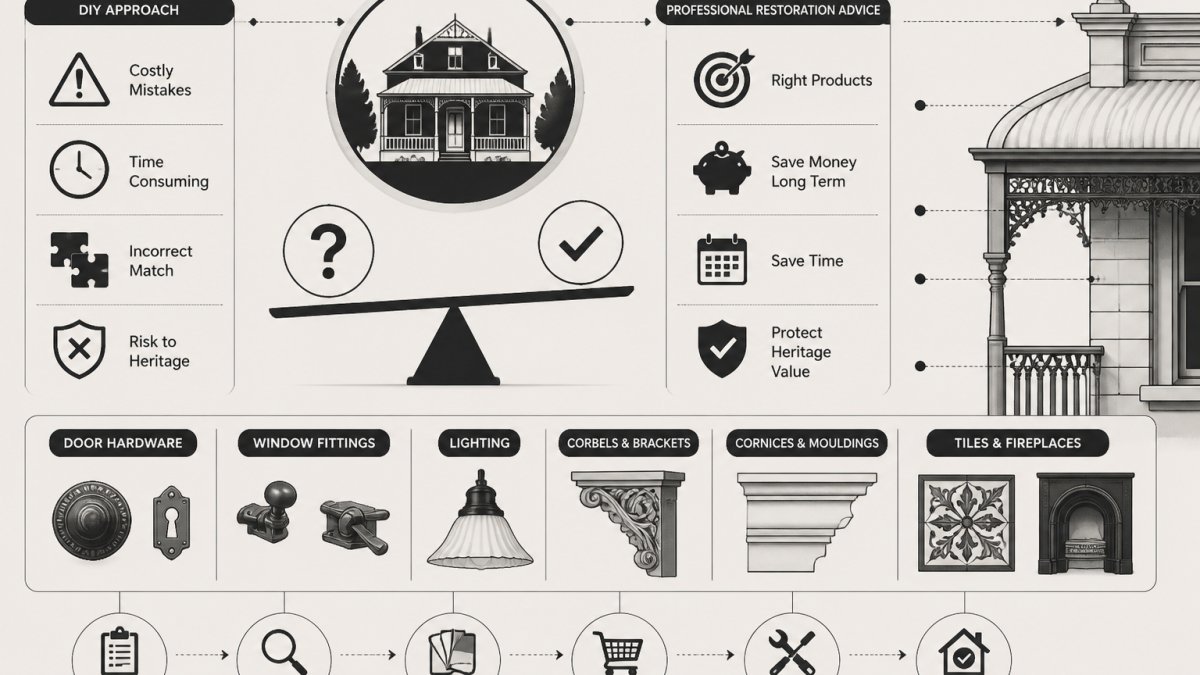
Table of Contents
- When DIY Restoration Advice Falls Short
- Types of Property Damage That Need Professional Assessment
- A Practical Decision Tree for Hiring a Restoration Professional
- Choosing a Heritage Restoration Professional: Questions to Ask
- Restoring Original Features in a Heritage Home
- Your Heritage Home Renovation Checklist
- Conclusion: Weighing the Value of Professional Restoration Advice
- Frequently Asked Questions
Last Updated: October 21, 2026
When DIY Restoration Advice Falls Short
Professional restoration advice is guidance from a qualified restoration professional on how to repair, conserve or reinstate a damaged property, based on an on-site damage assessment rather than a general assumption.
At Restoration Station, we have spent 35 years supplying period fixtures and hardware to owners of heritage-listed, Colonial and Federation-style homes. That work keeps us in constant contact with restoration professionals, and it has taught us one thing: the gap between DIY and professional restoration rarely shows up in the first week.
DIY restoration advice falls short in four specific situations:
- The damage is hidden. Water and smoke travel inside wall cavities and under floors, well out of sight.
- The building is protected. Heritage-listed properties carry approval requirements that vary by state and council.
- The work is structural. Load-bearing walls, footings and roof framing are not DIY territory.
- The risk is to health. Mould, asbestos and lead paint all demand controlled handling.
Below, we break down exactly where to draw the line, and the questions to ask before you hire anyone.
Types of Property Damage That Need Professional Assessment
Professional assessment is a documented inspection of damage extent, cause and risk, carried out before any repair work starts. Most damage that looks simple on the surface has a second layer underneath that only an inspection finds. The categories below most often justify professional help.
- Fire and smoke damage affecting structure, surfaces and air quality
- Water damage from flooding, burst pipes, roof leaks or storm ingress
- Mould growth following unresolved moisture
- Structural damage to walls, footings, floors or roof framing
- Impact and storm damage to roofs, windows and masonry
A common mistake is treating visible staining as the full extent of the problem; the visible mark is usually the smallest part of it.
Fire, Smoke and Water Damage Risks
Fire damage rarely stops at the burnt area. Smoke residue is acidic and settles into porous surfaces such as plaster, timber and brickwork, corroding them and holding odour long after the flames are out.
Water damage works the same way, more quietly. Moisture wicks into timber framing, plaster and insulation and stays there; household fans dry the surface, not the cavity.
Both categories need a professional assessment because the real damage sits behind the finish. A restoration professional uses moisture meters and thermal imaging to map where water or smoke has travelled.
Hidden Mould and Structural Damage
Mould is a symptom, not the problem. It appears wherever moisture has been left unresolved, often inside wall cavities, under flooring and above ceiling linings where nobody looks.
The health risks are real: spores affect indoor air quality, and disturbing a colony without containment spreads it further.
Structural damage follows the same pattern of concealment. Sagging floors, cracked cornices, sticking doors and stepped brick cracks all signal that something below or behind the surface has moved.
Impact and Storm Damage
Impact and storm damage is the category most often misjudged as cosmetic. A cracked roof tile or dented gutter is minor on its own, but the same event often breaches flashing or pushes water into a wall cavity that shows no sign for weeks.
Neither mould nor structural movement resolves with a surface fix. Both need a professional assessment before anyone picks up a tool, and both are far cheaper to diagnose early than to correct after a cosmetic repair has failed. Preventing these systemic failures requires a similar commitment to expert insight, much like the foresight applied when consulting professional styling guides to ensure long-term aesthetic and functional harmony.
A Practical Decision Tree for Hiring a Restoration Professional
Hiring a restoration professional is the right call when damage is severe, hidden, health-related or covered by heritage controls. Most DIY-versus-professional advice stops at that sentence; what you need is a way to sort your situation into an action, so the decision tree below is written to be used rather than admired.
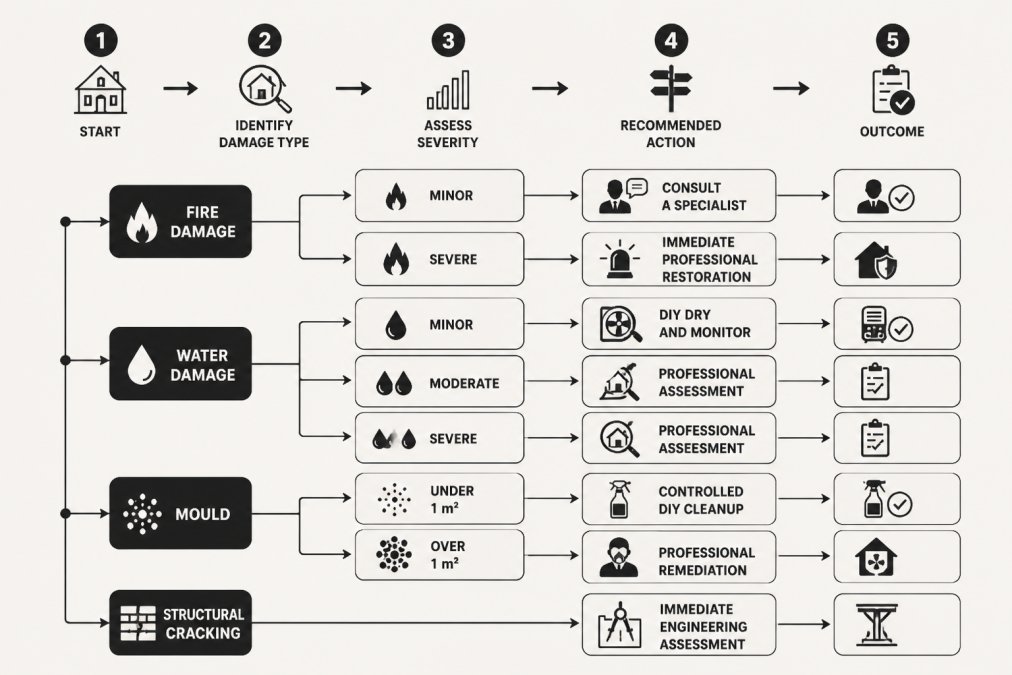
Work through it in this order, and write your answers down. The written record matters later if you claim on insurance or need heritage approval.
- Identify the damage type. Fire and smoke, water, mould, structural, or impact and storm. If more than one applies, treat the most severe as the lead category.
- Rate the severity against a threshold, not a feeling. Minor means cosmetic, contained and dry. Moderate means it reaches behind a finish, has been wet for more than about 48 hours, or covers an area larger than a single sheet of plasterboard. Severe means structure, electrical services or health are affected.
- Check the heritage status. If the property is listed or in a heritage overlay, add a specialist to the list regardless of severity, because the controls change what you are permitted to do.
- Match the action. Minor cosmetic work can be DIY with monitoring. Anything moderate or above needs professional assessment before tools come out.
Damage-specific branches
- Fire and smoke. Minor scorching on a single surface with no odour in adjacent rooms can be treated as cosmetic. Any smoke odour in rooms away from the fire, or any charring on timber framing, moves you to professional assessment because residue travels through cavities and air handling.
- Water. A single leak caught within hours and dried with air movement can be DIY. Water that has sat longer than about 48 hours, or that has reached carpet underlay, insulation or a wall cavity, needs moisture mapping before you close anything up.
- Mould. A patch smaller than roughly one square metre on a hard surface, with no musty smell elsewhere, can be cleaned with containment and personal protective equipment. Anything larger, any mould on porous materials such as plasterboard or timber, or any recurrence after cleaning needs professional remediation.
- Structural. Hairline cracks in plaster are usually cosmetic. Stepped cracks in brickwork, doors that suddenly stick, or floors that slope more than you remember are engineering questions, not restoration questions.
Two worked examples
A burst flexi hose under a kitchen sink, noticed the same morning, with water confined to the cabinet base: dry it, monitor with a moisture meter for a week, and skip the professional.
A single smoke-stained cornice in a Federation home with no heritage overlay: a specialist cleaner or careful DIY. The same cornice in a heritage overlay property: professional assessment plus a conversation with council about approvals, because the repair method itself may need consent.
The single biggest mistake we see is skipping step three. Heritage controls change what you are allowed to do, not just how well you do it.
Choosing a Heritage Restoration Professional: Questions to Ask
Choosing a heritage restoration professional comes down to verifying three things: relevant experience on protected buildings, clear written scope, and proper insurance. Ask these questions before you sign anything.
- Can you show completed work on heritage-listed or period properties? Ask for addresses or a portfolio, not just a website.
- What does your written scope include, and what does it exclude? Vague quotes hide the expensive parts.
- Are you insured for restoration work, and can I see the certificate? Public liability and contract works cover matter.
- How will you handle heritage approvals? The professional should know which approvals apply and who lodges them.
- What is your communication process? Weekly updates and a single point of contact prevent most disputes.
- Will you provide a written guarantee on the work? Get the terms in writing, including duration and what it covers.
- How do you source period-accurate materials? This is where specialist expertise separates good from average.
That last question matters more than most owners expect: a professional who cannot source the right fixture will substitute a modern one, and the result reads as wrong even to an untrained eye.
Restoring Original Features in a Heritage Home
Restoring original features in a heritage home means conserving what exists wherever possible, and matching replacements to the original period when conservation is not viable. The priority order is always repair first, match second, replace last.
In practice, that means:
- Repair original hardware such as hinges, latches and handles before replacing them
- Match the period when a replacement is unavoidable, using the home's build era as the guide
- Keep original profiles on cornices, ceiling roses and skirtings
- Retain original fireplaces and cast iron surrounds wherever they are sound
- Replicate finishes rather than modernising them
This is where we do our most useful work at Restoration Station. Our range covers period lighting, cast iron fireplaces and architectural details for heritage-listed, Colonial and Federation-style homes, and our team helps owners work out which fixtures actually suit their property rather than guessing, the difference between a restoration and a renovation.
Your Heritage Home Renovation Checklist
A heritage home renovation checklist is a sequenced list that keeps approvals, assessment and material sourcing in the right order, so work never starts before the paperwork and diagnosis are settled. Use this one as your working document.
- Confirm the heritage status and any overlay with your local council
- Identify which approvals are required before work begins
- Book a professional damage assessment if any damage is present
- Photograph and document every original feature before touching it
- Decide repair versus replace for each feature, in writing
- Source period-accurate fixtures and hardware
- Confirm the contractor's insurance and written guarantee
- Sequence the work so structural repairs finish before cosmetic ones
- Inspect and sign off each stage before the next begins
- Keep a full record of approvals, receipts and warranties
That checklist is also your verification tool. If a stage has no sign-off, it is not complete, no matter how it looks.
Conclusion: Weighing the Value of Professional Restoration Advice
Whether professional restoration advice is worth it depends on what sits underneath the damage. For cosmetic work on an unprotected home, DIY is fine. For hidden moisture, structural movement, mould or a heritage-listed property, professional help pays for itself by preventing incomplete repairs that cost more to fix later.
If you are weighing up the decision, our team at Restoration Station can help you identify the right period fixtures and hardware for your project, backed by 35 years of experience and expert advice on heritage, Colonial and Federation-style homes. Browse our range, or send us a quick enquiry and tell us what you are working on.
Frequently Asked Questions
Is professional advice worth it for a heritage home restoration?
For heritage-listed or period properties, professional restoration advice usually pays for itself. A specialist identifies original materials, checks compliance with local heritage rules, and spots hidden damage that DIY inspection misses. The upfront fee is offset by avoiding incomplete repairs, protecting resale value, and keeping original features intact. For minor cosmetic work, DIY may be fine, but any structural, fire, water, or mold issue warrants expert input.
When should I consult a heritage restoration specialist?
Consult a specialist when damage affects structural elements, original features, or areas you cannot fully inspect. Signs include persistent damp smells, cracked plaster, sagging floors, smoke residue, or visible mold. Also seek advice before starting any renovation that alters the facade, windows, or roofline, as heritage overlays often require approved methods and materials. Early advice prevents costly rework and compliance problems later.
What does a heritage restoration expert assess?
A restoration expert assesses damage severity, material authenticity, and structural integrity. They inspect for hidden moisture, mold, and compromised load-bearing elements, and check whether repairs meet heritage guidelines. They also evaluate original features such as cornices, ceiling roses, and cast iron fireplaces to determine what can be restored versus replaced. This assessment informs a written scope of work, helping you compare quotes and verify completion.
How do I choose a qualified heritage restoration professional?
Ask for proof of experience with heritage-listed properties, relevant trade licences, and insurance. Request references from similar projects and a written scope of work with a guarantee. Confirm they understand local heritage regulations and can source period-accurate materials. Get at least three quotes, check communication style, and ask how they verify completion. A professional who explains trade-offs clearly and provides documentation is usually the safer choice.