Table of Contents
- What Counts as Authentic Federation Hardware
- Federation Home Features That Shape Your Hardware Choices
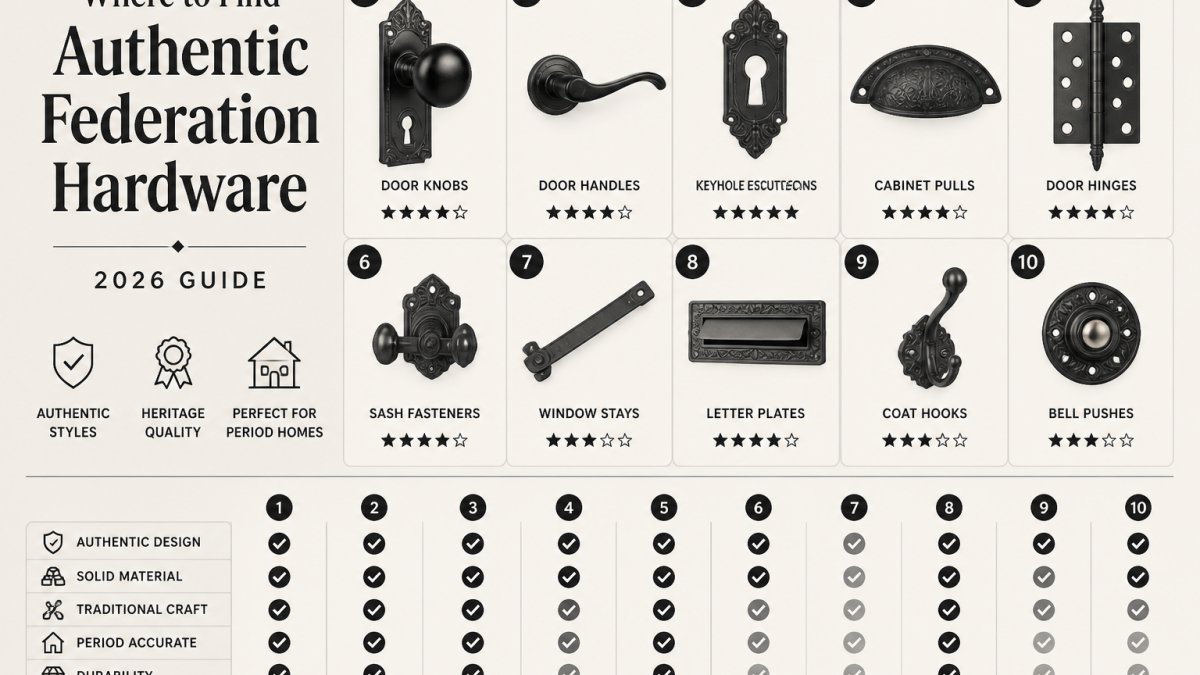
- Federation Door Hardware: Knobs, Knockers and Letter Slots
- Federation Brassware and Traditional Metal Finishes
- Where to Find Authentic Period Hardware in Practice
- Buying Authentic Federation Hardware Safely Online
- Conclusion
- Frequently Asked Questions
Last Updated: October 21, 2026
What Counts as Authentic Federation Hardware
Authentic Federation hardware is the original fittings made for homes built roughly between 1890 and 1915, or faithful reproductions cast to the same patterns and materials. This guide from Restoration Station covers where to find authentic federation hardware, how to spot the real thing, and how to buy with confidence.
"Federation hardware" is therefore a family of styles and finishes sharing common traits, not one fixed set of products.
Three markers separate genuine period hardware from modern lookalikes:
- Material: solid brass, cast iron, copper and bronze, not plated zinc or plastic
- Casting method: sand-cast or die-cast with visible weight and texture
- Pattern language: floral motifs, scrollwork, reeded edges and geometric bands
Age alone does not prove authenticity; a worn modern reproduction can look older than a well-kept original.
Original Fittings Versus Reproduction Hardware
Original fittings are pieces removed from period homes or held in salvage stock.
Neither is automatically better. Originals carry genuine history but often arrive worn, mismatched or incomplete.
Many reproductions are cast from moulds taken off original fittings, so the pattern is accurate even when the age is not.
If you are restoring a heritage-listed property, check what your local council or state heritage authority requires before swapping original fabric.
Federation Home Features That Shape Your Hardware Choices
Federation home features set the rules for what hardware looks right, and each zone of the house carries different expectations.
Start with the entry. Federation homes typically had a solid timber door, often four-panel and generously wide, needing a knob or lever with enough scale to balance it plus a knocker or letter slot at the right height.
Then work through the house:
- Verandah: cast iron lacework, brackets and turned timber posts
- Windows: brass sash lifts, casement stays and fasteners
- Hallway: picture rails, coat hooks and a hall stand
- Formal rooms: ceiling roses, pendant fittings and fireplace surrounds
Matching hardware to Federation homes means matching the level of ornament. A plain chrome lever on an ornate four-panel door reads as a later renovation, because it is one.
Federation Door Hardware: Knobs, Knockers and Letter Slots
Federation door hardware is where most restoration budgets land first, because the front door is the most visible detail on the house.
Door knobs in this period were usually solid brass, often round or oval, with a decorative rose behind them.
Door knockers ranged from simple ring patterns to elaborate figures and floral designs. Weight matters.
Letter slots were cut directly into the door, usually with a brass plate on each face and an internal flap.
Escutcheons, Hinges and Entry Details
Small fittings do more work than buyers expect. Escutcheons, the plates around a keyhole, tie a knob and lock together visually.
Hinges deserve equal attention. Period doors were heavy and hung on solid butt hinges built to carry that load; modern lightweight hinges can sag under a solid timber door within a few years.
Entry details to source together as a set:
- Knob or lever pair
- Escutcheon to match the lock
- Butt hinges rated for the door weight
- Door knocker
- Letter slot plates
Buy these as a family rather than one at a time. Finish consistency across the set is what reads as authentic from the street.
Federation Brassware and Traditional Metal Finishes
Federation brassware covers knobs, knockers, taps, escutcheons, window furniture and lighting components.
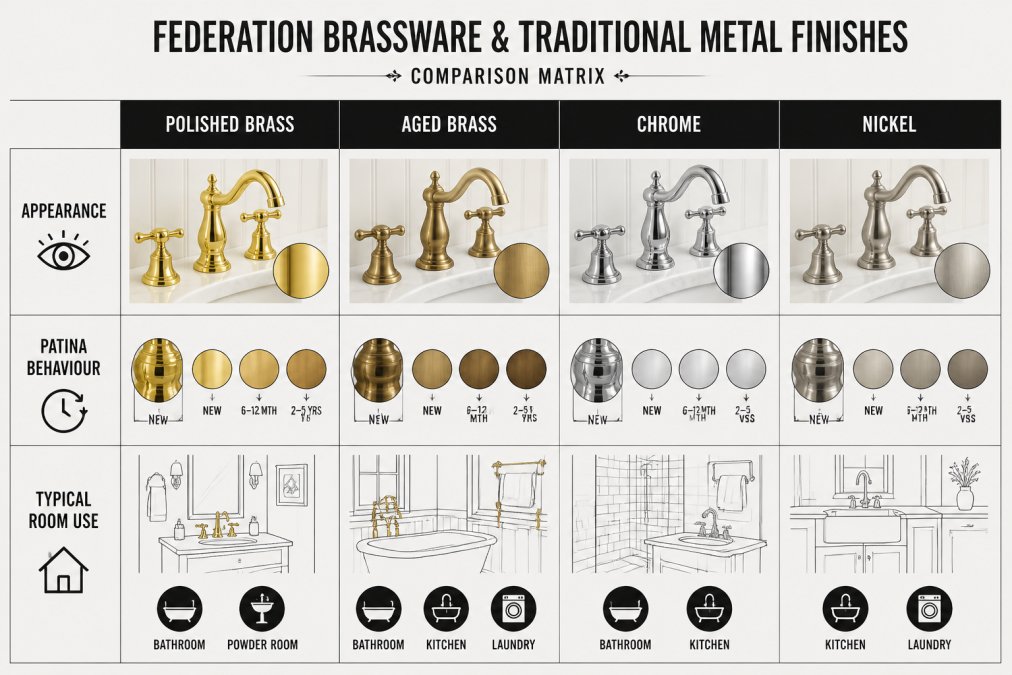
Finish choice changes how a piece ages, and most renovators underestimate that decision.
| Finish | Appearance | How It Ages | Typical Use |
|---|---|---|---|
| Polished brass | Bright gold, reflective | Develops patina unless lacquered | Front doors, formal rooms |
| Aged brass | Muted, darker gold | Stays close to its supplied tone | Renovations matching existing patina |
| Chrome | Cool silver, high shine | Resists tarnish, needs little care | Kitchens, bathrooms |
| Nickel | Soft silver, low shine | Wears gradually, ages evenly | Interior doors, joinery |
Polished brass is the traditional choice and the highest maintenance, needing regular polishing to stay bright.
Chrome and nickel were not unknown in the period, particularly in kitchens and bathrooms, so a mixed finish across a house is not automatically wrong.
Lacquered or Left Raw
- Lacquered brass holds its supplied colour and needs almost no care, but the coating can wear through at high-touch points such as a knob or a knocker, leaving a patchy surface that is hard to blend.
- Raw brass develops a living patina that deepens with handling. It suits restoration work where you want the fitting to age with the house, but it demands that you accept uneven colour early on.
A common pattern among restoration practitioners is to leave entry hardware raw so it patinas naturally, and lacquer interior fittings where consistent appearance matters more than ageing.
Solid Brass Versus Plated and Lacquered Imitations
Not everything sold as brass is brass. Solid cast brass has heft and shows casting texture underneath; plated zinc or pot metal is light and often too smooth. Ask the supplier to confirm the base metal in writing, not just the finish name.
Matching Brassware to the Rest of the House
Brassware should read as one family across a room, even when pieces were sourced separately. Work to these rules:
- Match the rose and escutcheon pattern to the knob, not just the finish.
- Keep projection consistent across doors in the same hallway so handles sit at the same depth.
- Repeat the motif from the front door on interior doors at a smaller scale rather than introducing a new pattern.
- Carry one finish through a room, then allow a deliberate change at the kitchen and bathroom, where chrome and nickel are period-plausible.
Restoration and Compatibility Notes
Before buying brassware for an older door, check three dimensions: the mortice or rim lock body, the spindle size, and the door thickness. Original doors are often thicker than modern ones, and a knob designed for a thin door will not seat correctly. Where an original fitting is worn but sound, re-plating or re-lacquering preserves the original casting; where a thread or spindle is stripped, a specialist can often re-tap or sleeve it.
Where to Find Authentic Period Hardware in Practice
Authentic period hardware turns up through a small number of channels, each with trade-offs.
Architectural salvage yards. The best source for genuine originals.
Specialist restoration suppliers. Businesses that focus on period fittings carry both originals and pattern-accurate reproductions.
Demolition and estate sales. Good for one-off finds. Poor for matching sets, because you rarely get eight of anything.
Online marketplaces and auction sites. Wide reach, variable quality.
A Practical Sourcing Sequence
Work the channels in this order to avoid wasting time:
- Audit what you already have. Photograph and measure every existing fitting before you search, so you know exactly what you are matching.
- Start with specialist suppliers for sets. If you need multiples of the same knob, escutcheon or hinge, a specialist is the only reliable route to consistency.
- Use salvage yards for statement singles. Knockers, letter plates and house numerals are where originals shine and matching matters least.
- Use auctions and marketplaces last. They suit hard-to-find patterns once you know precisely what you need.
Availability is uneven by region: salvage stock concentrates where demolition and renovation activity is highest, so buyers in rural and remote areas often rely more on specialist suppliers who can source and dispatch. When you cannot visit a yard, ask for a video walk-through of the actual piece rather than a stock photo.
How to Verify Authenticity and Date a Fitting
Verification comes down to four checks, and any one of them failing is a reason to slow down.
- Weight and feel. Solid brass is dense. Plated zinc feels light in the hand.
- Back and reverse faces. Originals usually show casting marks, file lines or uneven surfaces. Modern pieces are often too clean underneath.
- Screw holes and fixings. Slot-head screws suit the period. Phillips heads point to a later date.
- Wear patterns. Genuine wear sits where hands actually go. Artificial ageing tends to be uniform.
Dating a fitting needs context. Compare the pattern to known period catalogues and to other fittings in the same house, a piece matching the hallway door furniture is more likely original to the build than one bought separately.
Ask the seller for provenance: which property it came from, when it was removed, and whether it was ever refinished. A supplier who cannot answer those questions is guessing, and so are you.
Buying Authentic Federation Hardware Safely Online
Buying online is now the main way most renovators source period hardware, and it carries real risk. Photos hide weight, scale and casting quality.
Work through this checklist before you pay:
- Confirm the material in writing, not just "brass-look"
- Ask for measurements in millimetres, including projection and rose diameter
- Request a photo of the back and any casting marks
- Confirm whether the finish is lacquered or raw
- Check the return policy covers fit and finish, not just damage
That last point matters more than most buyers realise. A heritage builder ordering across several stages needs the same finish and pattern to arrive each time.
For hard-to-find pieces, ask about lead time before you plan the install date. Specialist suppliers can often source patterns they do not hold in stock, but that takes time, and a door without a knob holds up the whole job.
Our advice is to order one piece first when trying a new supplier. Fit it, live with it for a week, then order the set.
Conclusion
Sourcing authentic federation hardware rewards patience and punishes hurry. Match the material, the pattern and the finish to the house, verify before you buy, and order sets rather than singles. That discipline is what separates a restoration that reads as original from one that reads as a renovation. If you want help identifying the right fittings for your property, contact Restoration Station.
Frequently Asked Questions
How can I tell whether period hardware is authentic?
Look for tool marks, hand-cut threads, uneven patina and wear in the places a hand or key would touch. Original fittings usually show casting seams and slight dimensional variation, while reproductions are uniform. Check screw slots for signs of hand tools rather than machine cuts. Ask the seller for provenance such as the building the item came from. If a piece looks flawless and identical to a catalogue photo, treat it as reproduction until proven otherwise.
What finishes suit a Federation-style home?
Federation brassware commonly used polished brass, which develops a warm patina over time. Aged brass and nickel were also used, and chrome appeared later in the period. Match the finish to the room and the existing fittings rather than mixing metals on the same door. If you are restoring original pieces, keep the existing finish where possible and only re-polish selectively, because heavy polishing removes metal and detail.
Can reproduction hardware work in a Federation home?
Yes, reproduction hardware is a practical option when originals are unavailable or too fragile for daily use. Choose reproductions that copy the proportions, plate shapes and finish of the period rather than modern streamlined designs. Use originals on visible feature doors and reproductions on high-traffic or secondary openings. Keep a record of what is original and what is reproduction for future owners and heritage approvals.
Where can I find Federation-style door handles and hinges?
Specialist restoration suppliers, architectural salvage yards and secondhand building material dealers are the main sources. Online marketplaces can work if you ask for clear photos of the backplates, spindle and screw holes before buying. For hinges, confirm the size and screw spacing match your door and jamb. If you need a consistent set across several doors, order from one supplier at the same time so the finish and pattern match.