Last Updated: October 23, 2026
Quick Summary
Buying authentic Victorian architectural details online is realistic if you verify provenance, condition and measurements in writing before you pay. Ask sellers for the source building, photographs of the reverse side, and exact dimensions, since photos alone cannot show weight, fixing holes or hidden rot.
- Original pieces show hand-planed tool marks, uneven patina and old square fixing holes.
- Request the source building, removal receipts and photographs of any repairs in writing.
- Measure openings at top, middle and bottom, plus recess depth for wall-set pieces.
- Match the Victorian substyle, such as Early, Mid or High Victorian, before matching profiles.
- Confirm council heritage approval before ordering, as refused pieces may be non-returnable.
Table of Contents
- Why Buying Victorian Architectural Details Online Rewards Careful Buyers
- Original or Reproduction Architectural Details: Telling Them Apart
- Authentic Period Features: Provenance, Condition and Measurements
- Architectural Salvage Online: What Specialist Sources Offer
- Victorian Ceiling Roses and Other Decorative Elements to Match
- Doors, Windows, Staircases and Fireplaces: A Buyer's Checklist
- Installation and Compliance: What to Check Before You Order
- Conclusion
- Frequently Asked Questions
Why Buying Victorian Architectural Details Online Rewards Careful Buyers
Buying authentic Victorian architectural details online is now a realistic option for heritage homeowners, provided you know what to check before you click buy. At Restoration Station, we have spent 35 years helping owners of heritage-listed, Colonial and Federation-style homes source period-accurate fixtures, and the difference between a good and a bad purchase almost always comes down to preparation.
The appeal is obvious. Original doors, windows, staircases, moldings, cornices, mantels and porches carry a depth of detail that modern reproductions rarely match. Yet the online marketplace is uneven. Some listings are genuine salvage with documented history; others are modern castings dressed up with distressed paint.
Original or Reproduction Architectural Details: Telling Them Apart
The quickest test is to look at how the piece was made, not how old it looks. Original Victorian joinery and castings carry tool marks, uneven patina and hand-finished edges.
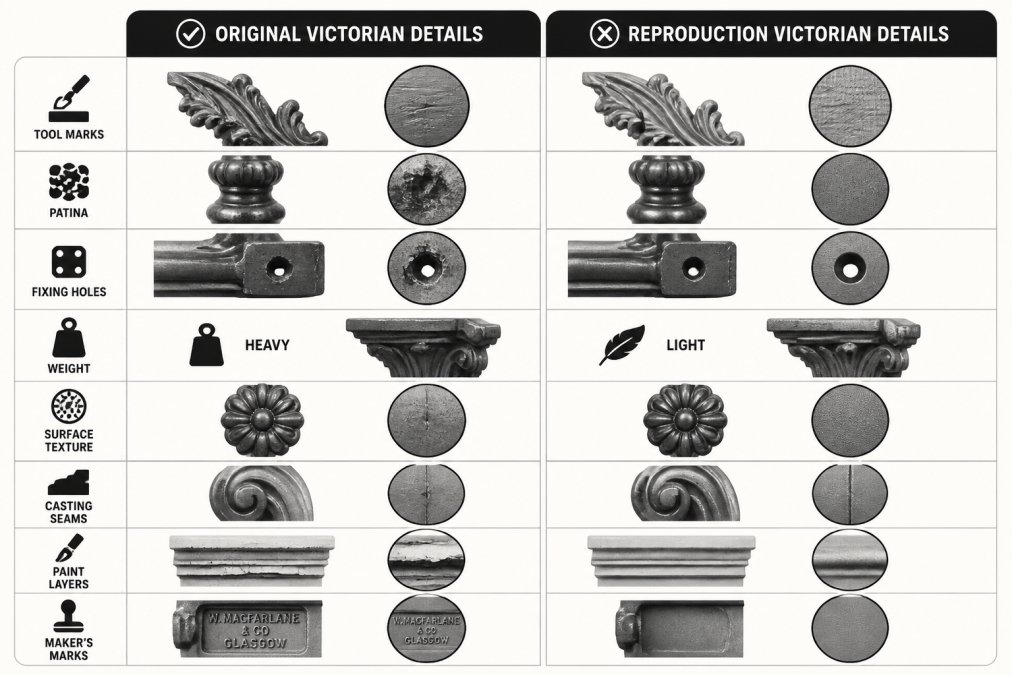
A common mistake is judging age from paint alone. Layers of paint can be faked in an afternoon. Look instead at the back of a piece, the fixing holes and the weight.
| Cue | Original Period Piece | Modern Reproduction |
|---|---|---|
| Tool marks | Hand-planed, irregular | Uniform, machine-cut |
| Fixing holes | Old square or hand-drilled | Pre-drilled, evenly spaced |
| Weight | Heavy, dense timber or cast iron | Lighter composite or softwood |
| Casting seams | Hand-filed, slightly uneven | Sharp, consistent seams |
| Paint layers | Multiple historic coats | Single distressed finish |
Authentic Period Features: Provenance, Condition and Measurements
Authentic period features are only worth the premium if the seller can document where they came from and what condition they are in. Provenance matters because it confirms the piece belongs to the era and style you are restoring, and because it protects you if you later need to justify the work to a heritage adviser or insurer.
Ask for the following in writing before you commit:
- The building or source the piece was removed from, where known, including the suburb and the approximate date of the building
- Any documentary trail, removal receipts, salvage-yard tags, auction catalogues, or photographs of the piece in situ
- Clear photographs of the front, back, edges and any damage, cracks, repairs or missing sections
- Measured dimensions, including the recess depth for anything that sits into a wall
- The material and finish, stated explicitly rather than implied by the photo
Reading condition like a salvage buyer
Condition is not a single yes-or-no question. Most practitioners assess a piece across four axes:
- Structural integrity, is the timber sound, or is there rot, borer activity or delamination? Tap cast iron gently; a dull thud can indicate a hidden crack.
- Completeness, are all sections present, or is a cornice run missing a return, or a mantel missing a shelf? Missing sections are the most common reason a bargain piece becomes expensive.
- Original fabric versus repair, sympathetic repairs (a spliced timber section, a re-cast bracket) are normal in salvage and often acceptable; undisclosed repairs are not.
- Reversible finishes, historic paint layers can usually be conserved or removed; modern two-pack finishes and epoxy fills are harder to undo and may signal a reproduction.
Documenting repairs
Ask the seller to describe any repair in writing, with a photograph of the repair itself. A repair that is disclosed and photographed is a known quantity; a repair discovered after delivery is a dispute. Keep the seller's written description with your records, it is useful evidence if you later sell the piece or need to demonstrate due diligence to a council heritage adviser.
Measurements that actually decide fit
Measurements decide whether a piece is usable. A cornice that is 20mm too deep will not sit flush, and a door frame that is slightly narrow will need costly alteration. Record the following for each item:
- Overall width, height and depth
- The recess or reveal depth for anything set into a wall
- For doors and windows: the opening size at top, middle and bottom, and the thickness of the existing wall
- For staircases: baluster spacing, newel height and the pitch of the existing flight
- For fireplaces: opening width and height, surround width, and hearth depth
Get the numbers before you fall in love with the look. A piece that is 10mm out is a joinery problem; a piece that is 100mm out is a different project.
Architectural Salvage Online: What Specialist Sources Offer
Architectural salvage online works best when you buy from a specialist who handles period stock regularly. General marketplaces list whatever sellers upload; specialists know which pieces suit a Federation hallway versus a high Victorian parlour.
Restoration Station stocks a comprehensive range of traditional restoration products and architectural hardware in one place, from period lighting to cast iron fireplaces and decorative details.
Victorian Ceiling Roses and Other Decorative Elements to Match
Victorian ceiling roses should match the room's ceiling height and the scale of the cornice, not simply the style you like most. An oversized rose in a low-ceilinged room looks heavy; an undersized one disappears. As a working rule, the rose diameter should sit roughly in proportion to the cornice projection, a deep, heavily modelled cornice suits a larger rose, while a shallow cornice in a smaller room suits a modest one.
Match the substyle before you match the profile
"Victorian" covers several distinct phases, and details that suit one phase look wrong in another. Before you buy, identify which phase your building belongs to:
- Early Victorian, simpler, classical profiles; restrained cornices; smaller roses; symmetrical facades.
- Mid Victorian, heavier mouldings, more elaborate brackets and corbels, larger roses, and a greater use of cast iron.
- High Victorian, dense ornament, deep cornices, prominent gables and dormers, and richly modelled mantels.
- Late Victorian and Edwardian transition, lighter ornament, taller windows, and a return to simpler profiles; many Federation homes share these details.
If you are unsure, look at the cornice profile in the principal rooms and the window head details, these are usually the least altered original features and the most reliable guide to the phase.
Matching decorative elements as a set
Decorative elements work as a set. Cornices, roses, brackets, finials and rosettes were designed to relate to one another, so match profiles where you can. If you cannot find an exact profile, choose a complementary one from the same phase rather than mixing eras. A high Victorian bracket next to an early Victorian cornice reads as a mismatch even to an untrained eye.
Elements to consider when matching a scheme:
- Moldings and cornices, matched by profile depth, projection and the number of steps in the profile
- Ceiling roses, matched by diameter, depth of modelling and the style of the centre boss
- Mantels and fireplaces, matched by surround width, opening size and the style of the corbels or brackets
- Porches, gables and dormers, matched by bracket and rafter style, and by the pitch of the roof
- Staircases, matched by baluster and newel proportions, and by the spacing between balusters
Proportion rules that survive side-by-side comparison
When you cannot find an exact match, proportion is the fallback. A cornice that projects too far for the ceiling height will look heavy regardless of its profile; a baluster that is too slender for the newel will look weak. Compare the depth of the existing moulding to the ceiling height, and the width of the newel to the width of the handrail, before ordering.
Doors, Windows, Staircases and Fireplaces: A Buyer's Checklist
Doors, windows, staircases and fireplaces are the four elements most likely to go wrong in an online order, because each has to fit an existing opening. Run this checklist before you buy:
- Measured the opening in three places (top, middle, bottom) for width and height
- Confirmed the recess or reveal depth for anything set into a wall
- Asked for photographs of hinges, locks, sash cords and any moving parts
- Checked whether the piece is complete or missing sections
- Confirmed the material and finish so you can match adjacent joinery
For staircases, baluster spacing and newel height are the details that decide whether a section will fit safely. For fireplaces, confirm the opening size and whether the surround is complete before ordering.
Installation and Compliance: What to Check Before You Order
Compliance checks belong before the order, not after delivery. Heritage-listed properties may require approval for changes to significant fabric, and local councils administer those rules. Check with your council's heritage adviser before altering original features.
Structural work, including fireplace installation and stair alterations, may need a licensed tradesperson and building approval. For guidance on heritage obligations, see the Heritage Council of Victoria guidance on permits and approvals and the Australian Building Codes Board on building compliance.
Conclusion
Sourcing period features online is rewarding when you slow down and verify before you buy. The buyers who get it right ask for provenance, measure carefully and confirm approval first.
If you would like help matching fixtures to your property's era, Restoration Station offers 35 years of experience, a comprehensive range of period lighting, cast iron fireplaces and architectural details in one place, and shipping across Australia and internationally.
Frequently Asked Questions
Where can I buy authentic Victorian architectural details online?
Specialist salvage dealers and restoration suppliers are the most reliable route. Look for sellers who list provenance, provide measured dimensions and clear condition notes, and photograph faults rather than hiding them. Restoration Station stocks period-appropriate fixtures and fittings and can advise on matching pieces to your property. Always confirm the returns process and ask for additional photos of joints, fixing points and surface wear before committing, especially on high-value items like mantels or stair components.
How can I tell whether a Victorian architectural detail is original or a reproduction?
Originals usually show irregular tool marks, layered paint, worn fixing holes and consistent patina in recesses. Reproductions tend to be uniform, sharply cast and evenly finished. Check weight: solid cast iron feels heavier than resin or hollow substitutes. Ask the seller for close-ups of edges, backs and joints, and request provenance such as the building the piece came from. Reproduction architectural details are perfectly valid for many projects, but the price should reflect what you are actually buying.
What should I check before buying salvaged architectural details online?
Confirm measurements in millimetres, including fixing centres and projection, then compare them against your opening or wall. Ask about cracks, repairs, missing sections and lead paint, which requires careful handling under Australian work health and safety guidance. Check the seller's returns policy and how fragile items are packed. For heritage-listed properties, confirm any proposed change with your local council before ordering, since approvals can affect what you can install.
Are reproduction Victorian details suitable for heritage restoration?
Often yes, particularly for hidden fittings, damaged components or pieces where originals are unobtainable. The key is honesty about what is original and what is not, and matching profile, scale and finish closely to the surviving fabric. Many heritage advisers accept well-made reproductions where they preserve the appearance and function of the original. Discuss the approach with your council's heritage officer early, and keep records of what was replaced so future owners understand the building's history.