Last Updated: October 26, 2026
Quick Summary
Ship ornate ceiling roses internationally by building a rigid double-wall cradle with at least 50mm of cushioning on every side, then booking a tracked service tier that matches the piece's size and weight. Accurate customs paperwork and pre-dispatch photos protect your shipment if a claim is needed.
- Measure diameter, depth, weight and centre hole size before you order the piece.
- Pack each ceiling rose separately and never nest multiple pieces together.
- Volumetric weight often decides the service tier more than actual weight does.
- Keep pre-dispatch photos of the double-wall cradle to support any damage claim.
- Request a formal trace only after the carrier's stated delivery window has passed.
Table of Contents
- Before You Ship: Matching the Ceiling Rose to the Destination
- How to Pack a Plaster Ceiling Rose for a Long Journey
- International Shipping Packaging for Fragile Items Like Ornate Rosettes
- Customs Documentation for Decorative Homeware
- Choosing a Carrier and Delivery Service for Ceiling Roses
- What to Do If a Ceiling Rose Is Delayed, Lost or Damaged
- Send Us Your Project Details Before You Order
- Frequently Asked Questions
Before You Ship: Matching the Ceiling Rose to the Destination
Shipping ornate ceiling roses to international locations starts long before you reach for the bubble wrap. It starts with choosing the right piece for the room it will hang in. A ceiling rose is a decorative plaster or resin medallion fixed to the ceiling around a light fitting or cord. Get the style and size wrong and no amount of careful packing will save the project.
So before anything goes in a box, answer three questions: what style suits the building, what are the exact dimensions, and will it fit the existing wiring and ceiling height?
Materials, Dimensions and Weight That Affect Transit
Plaster ceiling roses are heavy and brittle. Resin versions are lighter but still fragile at the edges. Both facts change how you pack and which carrier you choose.
Measure the piece before you order, not after:
- Diameter at the widest point, including any protruding leaves or scrolls
- Depth from the flat back to the highest relief detail
- Weight of the piece itself
- Centre hole size for the light fitting or cord
Write these down. You'll need them for packaging, for the carrier's dimensional limits, and for the customs paperwork later.
Checking Installation Compatibility Before It Leaves
Nothing stings like a rose that arrives intact and won't fit. Confirm the ceiling rose suits the destination before dispatch:
- Does the centre opening clear the existing light fitting or pendant cord?
- Is the ceiling height in the destination room enough for the rose's depth?
- Will the fixing method suit the ceiling material there, whether plasterboard, lath and plaster, or concrete?
How to Pack a Plaster Ceiling Rose for a Long Journey
Pack a plaster ceiling rose by building a rigid, double-walled box, cushioning the face and edges with foam, and suspending the piece so it never touches the outer wall. The goal is simple: the rose should survive a drop without the box touching it.
Start with the right materials:
- Double-wall corrugated cardboard
- Closed-cell foam or bubble wrap
- Foam offcuts or packing peanuts for void fill
- Heavy-duty packing tape
- Fragile labels on every face
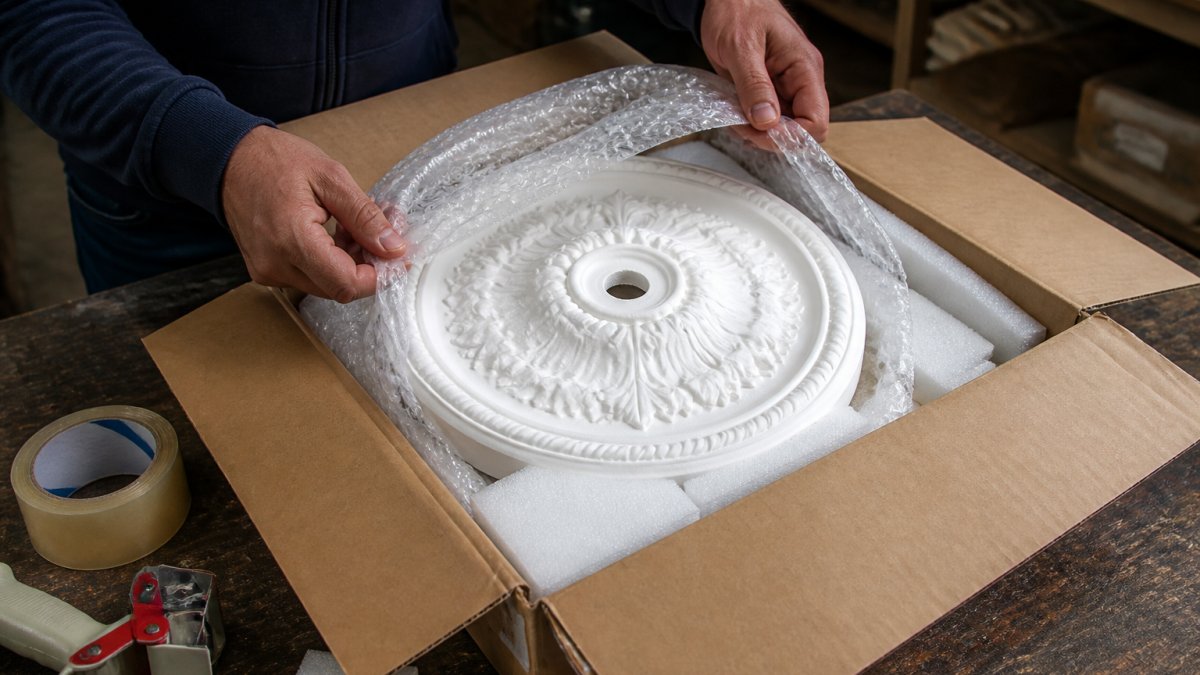
Wrap the face first, then the edges. The relief detail is the most fragile part, so give it extra padding.
Building a Double-Wall Cradle
A cradle keeps the rose floating inside the box instead of resting on a hard surface.
- Cut an inner box slightly larger than the rose.
- Line the base with 30-50mm of foam.
- Sit the wrapped rose on the foam and fill the sides so it can't shift.
- Cap the top with more foam, then close the inner box.
- Place the inner box inside a larger outer box, with foam or void fill on all six sides.
- Tape every seam and label all faces "Fragile".
Watch out: skipping the inner box is the most common mistake. A single-wall carton with loose bubble wrap will crush under stacking pressure in a shipping container.
International Shipping Packaging for Fragile Items Like Ornate Rosettes
International shipping packaging for fragile items has to do more than survive a courier van. It has to survive stacking, humidity and repeated handling across borders. Ornate rosettes with fine foliage detail are especially vulnerable at the tips of leaves and scrolls.
- Use double-wall cardboard as the minimum, never single-wall
- Keep at least 50mm of cushioning on every side
- Never let two hard surfaces touch
- Seal the box so moisture can't creep in during transit
- Photograph the packed box before it leaves, for insurance and claims
If you're shipping more than one rose, pack each separately. Don't nest them.
Customs Documentation for Decorative Homeware
Customs documentation for decorative homeware needs to be accurate, complete and consistent with what's actually in the box. A vague description like "home decoration" invites delays and inspections. A clear description like "ornate plaster ceiling rose, decorative architectural fitting, 600mm diameter" moves through faster. Precision in these declarations remains the most effective strategy for handling customs delays when shipments encounter unexpected scrutiny at the border.
Include on every shipment:
- A commercial invoice with an itemised description
- The country of origin for each item
- The declared value in the shipment currency
- The HS code for the goods
- A packing list matching the box contents
Import duties and taxes are set by the destination country, not by us, and they vary widely. Check the destination's customs authority for current rates before you order. The Australian Border Force guidance on exporting goods is a useful starting point for what exporters must declare, and the destination country's own customs site will tell you what the buyer will pay on arrival.
Choosing a Carrier and Delivery Service for Ceiling Roses
Choosing a carrier comes down to four trade-offs: speed, tracking granularity, fragile-freight handling, and the dimensional limits that apply to bulky plaster pieces. For ceiling roses, a tracked service is non-negotiable, the piece is too easy to damage and too hard to replace to send blind.
Match the Service Tier to the Piece
Most international carriers offer three broad tiers. The right choice depends on the rose's size, weight and how urgently the restoration is progressing:
- Express tracked (air): fastest transit, end-to-end scanning, and the highest priority for fragile handling. Best for high-value or time-critical pieces, and for roses small enough to stay within air-freight dimensional limits.
- Standard tracked (air or road/sea combination): a middle option with full tracking but longer transit. Usually the best balance for most orders, especially mid-size plaster roses.
- Economy tracked (sea or consolidated road): slowest, but still trackable. Fine for non-urgent restorations and for large or heavy pieces where air freight dimensional limits would push the shipment into oversize handling.
Dimensional and Weight Constraints That Decide the Service
Ceiling roses are bulky relative to their weight, so volumetric (dimensional) weight often governs the service tier more than actual weight. Carriers calculate dimensional weight by multiplying length × width × height (in centimetres) and dividing by a volumetric divisor, commonly 5,000 or 6,000 for air services. A 600mm rose in a double-walled cradle can easily exceed the volumetric threshold for standard parcel rates even when it weighs only a few kilograms.
Before booking, confirm with the carrier:
- The maximum length, girth and weight for the chosen service
- Whether the packed dimensions push the shipment into oversize or freight-forwarder handling
- Whether plaster or resin decorative fittings are accepted on the service (some exclude brittle materials from standard parcel cover)
- The declared-value limit for insurance on that service
Insurance and Claims Handling
Ask two questions of every carrier before booking: what is the maximum declared value for cover on this service, and what evidence is required to lodge a breakage claim? A carrier that cannot answer both clearly is not the right choice for an ornate rose. Where the carrier's standard cover is below the piece's value, consider top-up transit insurance, but confirm the policy covers brittle plaster or resin, since many generic policies exclude fragile architectural fittings unless packed to a specified standard.
At Restoration Station, we ship high-quality period pieces across Australia and internationally.
Most international carriers offer three broad tiers, and the right one depends on the rose's size, weight and how urgently the restoration is progressing.
| Service tier | Transit speed | Best for |
|---|---|---|
| Express tracked (air) | Fastest transit, end-to-end scanning | High-value or time-critical pieces; roses within air-freight limits |
| Standard tracked (air or road/sea) | Middle option, full tracking, longer transit | Most orders, especially mid-size plaster roses |
| Economy tracked (sea or consolidated road) | Slowest, still trackable | Non-urgent restorations; large or heavy pieces |
What to Do If a Ceiling Rose Is Delayed, Lost or Damaged
If a ceiling rose is delayed, check the tracking status first, then contact the carrier. If it is lost or damaged, lodge a claim with the carrier and keep every photo and document from the packing stage.
Delays: What to Check and When to Escalate
Most international delays fall into three categories: customs holds, missed connecting scans, and weather or industrial action. Work through them in order:
- Check the last scan location. If the parcel is sitting at a customs facility, the delay is usually a documentation query, confirm the commercial invoice and HS code match what is in the box.
- Wait out the carrier's stated delivery window before escalating. Most carriers will not open a trace until the estimated delivery date has passed.
- Request a trace. Ask the carrier to open a formal trace on the tracking number. This triggers internal scanning checks and is the prerequisite for a lost-item claim.
Damage: Evidence Standards That Decide the Claim
A complete claims file includes:
-
Tracking number and last scan location
-
Photos of the outer box on arrival, including all faces and any crush or puncture marks
-
Photos of the inner packaging and cradle as opened
-
Close-up photos of the damage to the rose itself
-
Copy of the commercial invoice and packing list
-
Written record of when you first reported the issue and to whom
Who Is Responsible for What
Carrier liability is usually capped by the service's declared-value limit or by the carrier's standard terms, and brittle plaster or resin fittings are sometimes excluded unless packed to a specified standard. That is why the packing standard in this guide matters: a claim can be refused if the carrier judges the packaging inadequate. Keep the double-wall cradle and foam documented in your pre-dispatch photos.
Send Us Your Project Details Before You Order
The best way to avoid shipping problems is to plan the piece around the destination before you order.
Restoration Station has spent 35 years supplying traditional home restoration products and architectural hardware for heritage-listed, Colonial and Federation-style homes. We offer an extensive range of period-appropriate fixtures, expert advice for complex restoration projects, and shipping to destinations across Australia and overseas. Our friendly team can guide you through product selection.
Get started with Restoration Station and send us your project details today. We'll help you choose the right ceiling rose.
Frequently Asked Questions
How should an ornate ceiling rose be packed for international shipping?
Wrap the face in acid-free tissue, then bubble wrap, and suspend it inside a double-wall box using foam or scrunched paper so it cannot move. Never let the decorative edges rest directly on the box base. Label the outside as fragile, keep the box upright, and photograph the packed item before sealing. Restoration Station packs ceiling roses this way because plaster and resin edges chip easily under transit vibration.
Can a ceiling rose be shipped internationally?
Confirm the destination's import rules first, keep the parcel under carrier weight and size limits, and choose a tracked service.
What information should be included on a parcel containing a ceiling rose?
Include a commercial invoice, a packing list, and a accurate description of the goods with the material stated (plaster or resin). Add the recipient's full address and phone number, mark the box fragile and this way up, and keep a copy of every document.
What should you check before sending a ceiling rose to another country?
Check the destination's import rules for plaster and resin goods, measure the rose and its packed box against the carrier's limits, and ask the recipient to inspect the parcel on arrival.