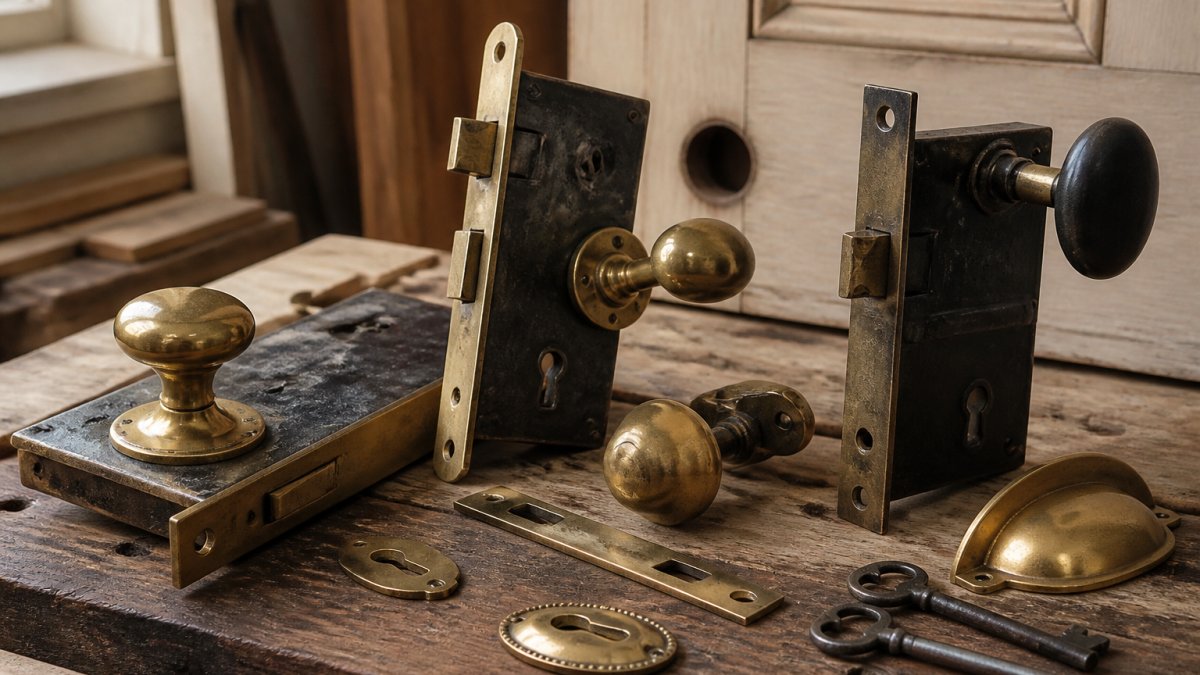
Last Updated: October 28, 2026
Quick Summary
The best period door locks for restoration depend on the door's use: specify a mortice lock with a deadbolt, or a rim lock plus a supplemental deadbolt, for a main external entry. Match the era and finish first, then confirm the mechanism suits the door's function.
- Antique rim locks are surface-mounted, with the lock body visible on the inside face of the door.
- Mortice locks sit inside a cavity cut into the door edge, leaving only the faceplate and handles visible.
- Measure backset, door thickness, keyhole height, strike position and handing before ordering any lock.
- Use a privacy set with an emergency release for internal bathroom and bedroom doors.
- A surface-mounted rim lock suits thin, hollow or fragile doors better than a cut mortice cavity.
Table of Contents
- Choosing the Best Period Door Locks for Restoration
- Antique Rim Locks: Authentic Security for Heritage Doors
- Mortice Locks for Heritage Doors: The Concealed Classic
- How to Identify Antique Door Hardware Before You Buy
- Door Lock Backset and Measurements: Getting the Fit Right
- Matching Locks to Period Style and Door Use
- Authentic Antique vs Reproduction: What to Choose
- Choosing Your Period Door Locks with Restoration Station
- Frequently Asked Questions
Choosing the Best Period Door Locks for Restoration
Finding the best period door locks for restoration starts with one question: does the door need to look right, work right, or both? At Restoration Station, we've spent over 35 years in the house restoration industry. The lock you choose shapes how the door feels in the hand, how secure the entry is, and whether a heritage assessor nods or frowns. Below, we explain how to measure before you buy.
Most guides jump straight to product lists. That's backwards. Get the lock type and the measurements right first, and the buying decision almost makes itself.
Antique Rim Locks: Authentic Security for Heritage Doors
Antique rim locks are surface-mounted locks fixed to the inside face of a door, with the lock body visible rather than hidden in the timber.
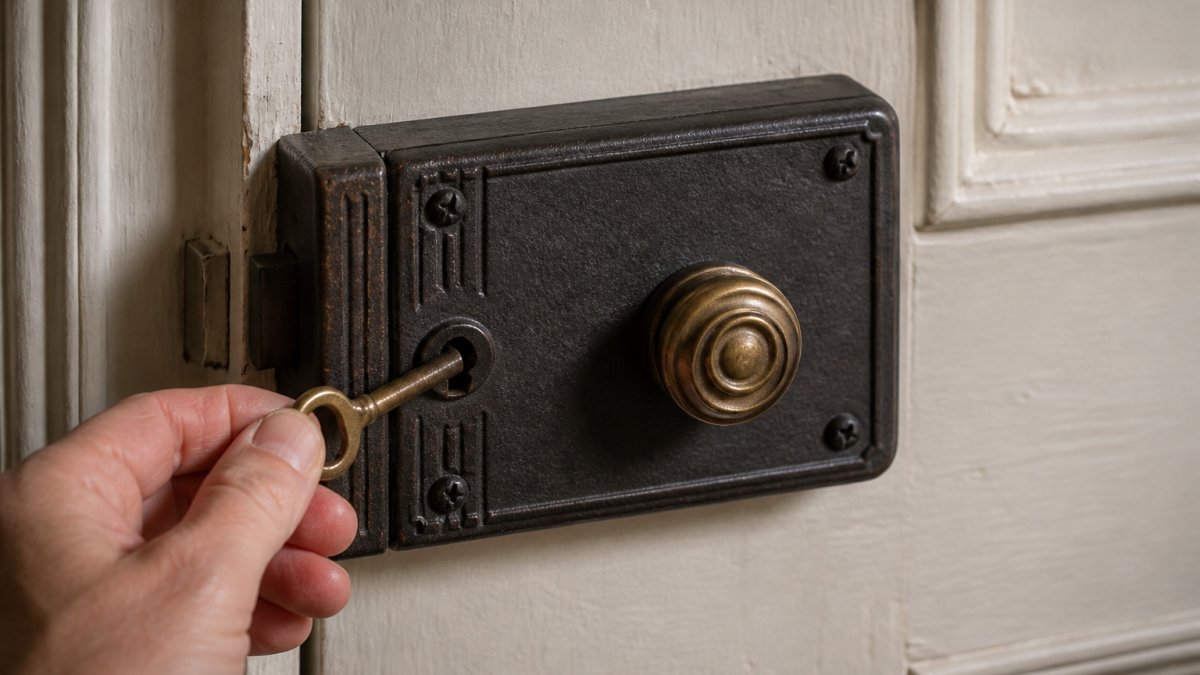
How a rim lock is put together
Understanding the parts tells you what to inspect before you buy:
- Lock case, the cast iron or brass box holding the mechanism.
- Bolt and latch, the deadbolt throws into a keep (also called a staple) fixed to the door frame; the spring latch is withdrawn by the knob or lever.
- Keep/staple, the frame-mounted receiver. If it is missing or worn, the bolt will rattle or fail to seat.
- Spindle and knob, the square bar passing through the door that operates the latch. Spindle size and length must match the knob and the door thickness.
- Rebate, the stepped edge on the frame side that lets the door close past the keep.
Fitting and compatibility checks
Still, check these before ordering:
- Door thickness and face width, the case must sit flat without overhanging the stile.
- Existing keyhole and knob drillings, a salvaged lock rarely lines up with old holes; expect to plug and redrill.
- Handing, rim locks are handed; a right-hand lock will not work on a left-hand door without reworking.
- Frame clearance, the keep needs a solid fixing and enough frame depth to receive the bolt.
Pros: visible period character, straightforward fitting on solid doors, easy to service and repaint, and the mechanism is accessible for repair without removing the door. Cons: lower security than a modern deadbolt, the box sits proud of the door face, and the exposed bolt can be slipped on poorly fitted examples.
Mortice Locks for Heritage Doors: The Concealed Classic
Mortice locks for heritage doors sit inside a cavity cut into the door edge, leaving only the faceplate and handles visible.
How to Identify Antique Door Hardware Before You Buy
Identifying antique door hardware means checking four things: the material, the finish, the fixing pattern, and the mechanism's condition.
- Cast iron: heavy, magnetic, often pitted under old paint.
- Brass: non-magnetic, warm in tone, develops a patina rather than rust.
- Steel: magnetic, prone to corrosion, common in twentieth-century fits.
Door Lock Backset and Measurements: Getting the Fit Right
Door lock backset is the distance from the door's edge to the centre of the keyhole or spindle.
Measure these before ordering:
| Measurement | What to Check | Why It Matters |
|---|---|---|
| Backset | Edge to spindle centre | Determines lock case fit |
| Door thickness | Face to face | Rim vs mortice compatibility |
| Keyhole height | Floor to centre | Matches existing drillings |
| Strike position | Frame alignment | Prevents latch misalignment |
| Handing | Left or right swing | Wrong handing won't latch |
Matching Locks to Period Style and Door Use
Most guides treat period style as a single aesthetic choice. It is really two decisions made together: which era the hardware should read as, and what job the door has to do.
Match the era first
- Victorian, ornate brass and black cast iron with decorative backplates, keyhole escutcheons and sometimes a thumb latch. Heavier, more embellished forms suit formal front doors.
- Edwardian, similar to Victorian but lighter and less fussy; brass with simpler backplates and cleaner lines.
- Federation, Australian-influenced, often brass with a warmer, less ornate feel; good for both entry and internal doors.
- Craftsman, simpler, heavier forms in distressed or antique finishes; straight lines and visible fixings rather than ornament.
- Colonial Revival, brass with a polished or enamel top coat, often paired with a matching knob and escutcheon set.
Match the function second
| Door use | Suitable lock type | Function to specify |
|---|---|---|
| Main external entry | Mortice lock with deadbolt, or rim lock plus supplemental deadbolt | Keyed entry with a positive deadbolt |
| Secondary external door | Rim lock or mortice latch | Keyed entry; consider a supplemental bolt |
| Internal passage (hall, living) | Mortice latch or rim latch | Passage, latch only, no locking |
| Internal privacy (bathroom, bedroom) | Mortice privacy set | Privacy, thumb-turn or snib, emergency release outside |
| Cupboard or wardrobe | Small rim or surface latch | Non-locking latch |
The decision framework
Work through these in order:
- Is the door external and the only entry? Specify a mortice lock with a deadbolt, or a rim lock plus a supplemental deadbolt. Do not rely on a latch alone.
- Is the door internal but needs privacy? Use a privacy set with an emergency release so the door can be opened from outside in an emergency.
- Is the door internal and passage only? A simple latch and knob is correct; adding a lock adds cost and complexity for no benefit.
- Does the era demand a specific look? Choose the finish and form to match the era, then confirm the mechanism suits the function above.
- Is the door thin, hollow or fragile? A surface-mounted rim lock is safer than cutting a mortice cavity into timber that cannot take it.
Authentic Antique vs Reproduction: What to Choose
One locksmith argument worth noting is that antique door hardware need not automatically be replaced where the original still functions. We agree, provided the mechanism is sound and the security is adequate for the entry.
Choosing Your Period Door Locks with Restoration Station
The right lock balances authenticity, fit, and security.
That's where we come in. Restoration Station offers an extensive range of traditional home restoration products and architectural hardware, backed by over 35 years of experience in the house restoration industry. We provide professional guidance for restoration, renovation, and remodelling projects. We ship across Australia and internationally.
Get started with Restoration Station.
Frequently Asked Questions
What is the difference between a rim lock and a mortice lock?
A rim lock sits on the surface of the door, with the lock case visible on the inside face. A mortice lock is set into a cut cavity within the door edge, so only the faceplate and handles show.
Can an antique door lock be restored and reused?
Often, yes. Many antique locks have protected homes for decades and can be cleaned, repaired and refinished rather than replaced. A seized mechanism may free up with careful cleaning and lubrication, and worn springs or latches can sometimes be replaced. Check the lock case for cracks and confirm the key still operates the bolt before committing. If the body is sound, restoration keeps the original character and is usually preferable to a modern substitute.
How do I measure the backset for a replacement lock?
Measure from the edge of the door to the centre of the keyhole or spindle, following the door's face. This distance is the backset, and it must match the new lock or the existing holes won't line up. Also measure door thickness, the distance between the keyhole and handle centres, and the strike plate position. Write these figures down before you shop. Getting the backset right is the single most important step to avoid a lock that won't fit.
Will a modern replacement lock fit an old door?
It can, but only if the measurements match. Old doors are often thicker or thinner than modern standard, and existing holes may not align with a new lock's backset. A modern concealed lock may need extra morticing, which changes the door's appearance. For heritage doors, a reproduction rim or mortice lock in a matching style is often the better fit. Always compare backset, door thickness and faceplate size against the door before buying.