Last Updated: November 2, 2026
Quick Summary
Authentic federation style home interior details are the original or faithfully reproduced fixtures, finishes and joinery installed in Australian homes built roughly between 1890 and 1915. Authenticity is a consistency test rather than a checklist, so the details must relate to one another. Look for high ceilings, deep cornices, ceiling roses, timber arches, leadlight windows and narrow hardwood floors.
- Federation interiors favour high ceilings, decorative plasterwork, timber joinery and coloured glass arranged to draw light deep into the plan.
- Ceiling roses reinforced the plaster around the pendant point and hid the ceiling joint, so match surviving profiles rather than picking a shape in isolation.
- Federation colour schemes used soft stone, cream, sage and dusty green on walls, with deeper reds and greens in the leadlight and front door.
- Original cornices and roses were run in situ or cast in plaster, giving a density and crispness that fibrous plaster reproductions rarely match.
- Specify a lime-based repair rather than a gypsum-only patch on cornices, because lime moves with the older substrate and gypsum does not.
Table of Contents
- What Makes a Federation Home Interior Authentic
- Federation Home Interior Features That Define the Era
- Leadlight Windows, Timber Floors and Other Original Details
- Federation Home Colour Schemes That Stay True to the Period
- Federation-Style Lighting for Period Interiors
- Federation Home Fireplaces and Mantel Choices
- Telling Original Federation Fabric From Later Additions
- Restoring and Maintaining Authentic Federation Details
- Frequently Asked Questions
What Makes a Federation Home Interior Authentic
Authentic Federation style home interior details are the original or faithfully reproduced fixtures, finishes and joinery installed in Australian homes built roughly between 1890 and 1915.
Most guides hand you a list of features and leave it there. That approach fails because Federation interiors were not uniform.
Below, we break down what to look for room by room, how to separate original fabric from later additions, and how to restore each element without erasing the evidence.
Federation Home Interior Features That Define the Era
Federation interiors favour high ceilings, decorative plasterwork, timber joinery and coloured glass, arranged to draw light deep into the plan.
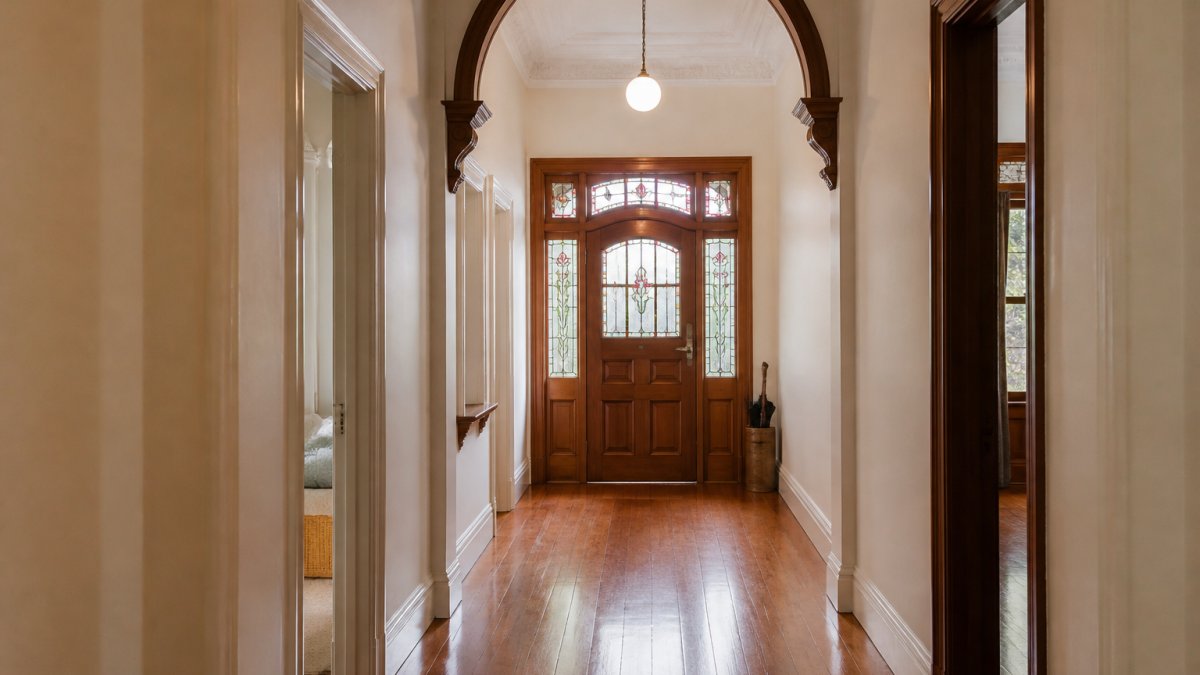
Walk into an intact Federation hall and the sequence is predictable. Ceiling height rises, cornices deepen, and a timber arch marks the transition from passage to living space.
Ceilings, Cornices and Ceiling Roses
Ceilings in Federation homes were generally high, a legacy of the Victorian era. Deep cornices ran the perimeter, and a ceiling rose sat centred above each light fitting.
The rose was not purely decorative; it reinforced the plaster around the pendant point and hid the ceiling joint. Reproduction roses are widely available, but match the profile of surviving roses elsewhere in the house rather than picking a shape in isolation.
Timber Arches, Fretwork and Picture Rails
Timber arches spanned the wide openings created when load-bearing walls were removed, and their profile usually echoed the cornice above. Fretwork served a second purpose entirely: the ventilated panels above doors and in fanlights allowed air to move between rooms before mechanical cooling existed.
Picture rails sit below the cornice line and let you hang artwork without driving nails into plaster.
Leadlight Windows, Timber Floors and Other Original Details
Leadlight windows, hardwood timber floors and coloured glass panels are the details buyers notice first, and the ones most often replaced with modern substitutes.
Look for small window panes in sash windows, often arranged in a grid, with coloured glass concentrated in the upper sash or in sidelights flanking a bay window.
Hardwood floors in these homes were usually narrow boards, laid tongue and groove and finished with wax or shellac rather than modern polyurethane.
Federation Home Colour Schemes That Stay True to the Period
Federation colour schemes were restrained on walls and confident on trim, using a palette drawn from natural materials rather than the heavy jewel tones of the preceding Victorian era.
Interior walls were frequently finished in distemper or flat oil paint, both of which read as chalky rather than glossy. Modern low-sheen finishes are the closest practical match.
The throughline is landscape integration: Federation design pulled the garden inside through colour, and a scheme that ignores the garden will always feel slightly staged.
A Room-by-Room Colour Logic
Most guides stop at the palette. The practical question is where each colour belongs, because Federation interiors used colour to signal hierarchy and function rather than to decorate evenly.
- Hallway: the darkest and most formal scheme in the house. Deep green, oxblood or a warm stone on walls, with the timber arch and picture rail picked out in a deeper tone than the wall. The hall was the first impression and was treated accordingly.
- Living and dining rooms: soft sage, cream or pale stone on walls, with the cornice and ceiling rose in a lighter tone than the wall so the plasterwork reads as light-catching rather than heavy. Ceilings were often a pale tint rather than pure white.
- Bedrooms: the lightest schemes, often cream or pale blue, because these rooms received less artificial light and relied on daylight through leadlight.
Finish Specifications That Read as Period-Correct
A colour is only half the decision; the sheen and binder determine whether it looks right. Distemper and flat oil paint were the original wall finishes, and both dry to a chalky, low-reflectance surface.
Gloss belongs on joinery, handrails and the front door, where the original spec called for durability. The plasterwork is generally best kept flat so the profile reads through shadow rather than shine.
For timber, a hard wax oil or shellac gives the soft sheen of the period, while a high-build polyurethane reads as a later addition. Achieving this balance between historical integrity and contemporary comfort remains the primary challenge when renovating period properties to suit the rhythms of modern living.
Federation-Style Lighting for Period Interiors
Federation-style lighting generally means pendant fittings with a shade or bowl, brass or darkened copper hardware, and a warm, low output.
Batten-fixed pendants with opal glass bowls are the safest choice for a hall or bedroom.
Modern high-output LED globes can generate heat that stresses old glass bowls, so a low-heat globe rated for enclosed fittings is the safer choice.
Federation Home Fireplaces and Mantel Choices
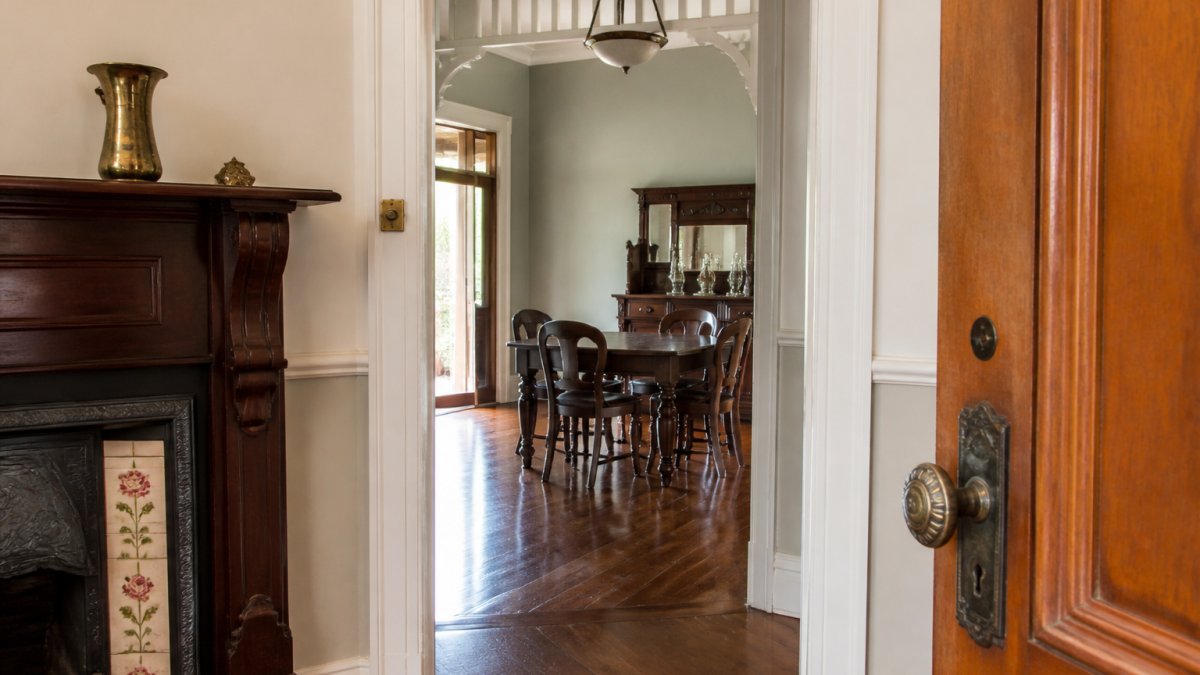
Federation fireplaces paired a timber or marble mantel with a cast iron insert and often a tiled hearth surround. The mantel was the room's focal point, and its scale matched the ceiling height rather than the fireplace opening.
Cast iron fireplaces from the period typically feature arched openings and decorative spandrels.
If the original mantel survives, keep it. Timber mantels can be repaired and re-polished far more often than they can be convincingly replaced.
Telling Original Federation Fabric From Later Additions
Telling original fabric from later additions comes down to three checks: consistency of profile, consistency of material, and evidence of how the element was fixed. Original elements in a Federation home share a design language, and a later addition almost always breaks it somewhere.
Start with the plaster. Original cornices and roses were run in situ or cast in plaster, so they have a density and crispness that fibrous plaster reproductions rarely match.
Then check the fixings. Original picture rails and architraves were fixed with cut nails or screwed and plugged. Modern Phillips-head screws are a clear signal of later work.
- Do the cornice and arch profiles match across adjoining rooms?
- Are fixings cut nails or slotted screws rather than Phillips head?
- Does the timber species match the floor and joinery elsewhere?
| Element | Original Sign | Later Addition Sign | Practical Impact |
|---|---|---|---|
| Cornice | Cast or run plaster, crisp arris | Fibrous plaster, soft edges | Match profile before repair |
| Picture rail | Cut nails, deep paint build-up | Phillips screws, fresh timber | Retain and repaint |
| Leadlight | Hand-cut glass, lead came | Machine-cut, copper foil | Repair, do not replace |
| Flooring | Narrow boards, wax finish | Wide boards, polyurethane | Sand and oil, not coat |
| Fireplace | Cast iron insert, tiled hearth | Reproduction steel insert | Match opening and mantel scale |
Restoring and Maintaining Authentic Federation Details
Restoring Federation details is mostly a matter of doing less, more carefully. Replacing worn elements with new ones is a common cause of lost period character, and it is often avoidable.
Plaster Cornices and Ceiling Roses
Original cornices were run in situ in lime plaster or cast in plaster, and both can be repaired rather than replaced. For a cracked or chipped section, a plasterer can cut back to sound material, fix a matching profile with a running mould, and fill with plaster of Paris.
Ceiling roses are usually cast plaster and can be re-fixed with plaster washers and a lime slurry where they have sagged.
Leadlight and Coloured Glass
Leadlight is repairable, and the original glass should be retained wherever possible. A specialist can re-lead a panel, replacing the lead came while keeping the hand-cut glass, and re-cement it to restore rigidity.
Where a single pane is broken, a glass match is the challenge. The palette of amber, ruby, emerald and pale blue is still made, but modern glass differs in texture and thickness from period glass.
Timber Floors
Hardwood floors can almost always be sanded and refinished rather than replaced. The specification that matters is the finish: a hard wax oil or shellac gives the soft sheen of the period, while a thick polyurethane coating traps moisture and reads as a later addition. Where boards are cupped or gapped, a floor sander can take back the high edges and a joiner can splice in matching narrow boards rather than replacing a whole run.
Fretwork, Arches and Picture Rails
Timber fretwork and arches are repairable where damage is localised: a joiner can splice in matching timber and finish the repair to match the surrounding patina rather than looking new. Picture rails are the most commonly removed original element and the easiest to reinstate; a matching profile can be run or sourced, and the rail should be fixed with cut nails or slotted screws to match the original pattern.
Fireplaces and Cast Iron
Cast iron inserts can be restored by stripping back paint, repairing cracks with a metal-appropriate filler, and re-blackening with stove polish. Where an insert is missing, match the opening dimensions and the mantel's proportions before considering the decorative pattern, because a correctly sized plain insert reads better than an ornate one that is out of scale.
Approvals and Maintenance
For anything touching the building's significant fabric, check whether your property is heritage-listed and what approvals apply before work starts. The Heritage Council of Victoria's permits and approvals guidance sets out how the process works for listed places, and equivalent state bodies publish their own requirements.
Maintenance is unglamorous but decisive. Keep gutters clear, address rising damp early, and avoid sealing original timber floors with impermeable coatings that trap moisture. Details survive when maintained, and fail when ignored until replacement seems the only option.
Frequently Asked Questions
What are the key features of a Federation-style home interior?
The defining interior details are high ceilings with ornate cornices and ceiling roses, decorative fretwork and ventilation panels, timber arches, picture rails, leadlight and stained-glass windows, and polished hardwood floors. Fireplaces with timber mantels and tiled surrounds are common, as are bay windows and sash windows with small panes. Together these features separate Federation interiors from Victorian homes, which tend to be darker and more heavily ornamented.
How can you tell if Federation interior details are original?
Check the back of timber mouldings for aged patina and hand-tooled profiles rather than uniform machine cuts. Original leadlight uses coloured glass panels set in lead cames that show even oxidisation. Look for paint build-up in the recesses of cornices and ceiling roses, and compare fixing holes with the surrounding timber. Later additions usually sit slightly proud of the original surface or use modern screws. A heritage consultant can confirm anything uncertain before you remove or replace it.
What colours are typical of Federation-style interiors?
Federation home colour schemes drew on soft, earthy tones: creams and off-whites for ceilings and cornices, muted greens, dusky pinks and terracottas for walls, and deep reds or bottle greens for feature timberwork. These palettes were lighter than the preceding Victorian schemes. Modern restorations often match heritage paint ranges to original samples found under later coats, which keeps the interior faithful to the period while still feeling fresh.
What lighting suits a Federation-style interior?
Federation-style lighting tends to feature pendant fixtures with opal glass shades, brass or copper fittings, and decorative ceiling roses at the mounting point. Wall sconces and hall lanterns work well in entryways. Choose fittings that suit the scale of high ceilings rather than small modern pendants, and match the metal finish to other hardware in the room. Restoration Station stocks period-appropriate fittings and can advise on what suits your home's era.
How do you restore original features in a Federation home?
Start by documenting what survives before removing anything. Strip paint from cornices and fretwork with gentle methods rather than harsh sanding, and repair timber with matching species where possible. Source period-accurate hardware such as ceiling roses, cast iron fireplaces and door furniture from a specialist supplier. For heritage-listed properties, check local council requirements before making changes, and keep records of everything removed or replaced.
Which timber features suit a Federation home?
Federation interiors commonly used Australian hardwoods such as blackwood, cedar and kauri for archways, mantels, skirting and picture rails. Flooring was typically tallowwood, jarrah or blackbutt, polished rather than carpeted. When replacing damaged sections, match the original species and profile where you can. A specialist supplier can help identify the right timber and hardware so new work blends with the existing fabric instead of standing out.