Last Updated: November 10, 2026
Quick Summary
Choosing ceiling rose sizes starts with ceiling height: under 2.75 m suits 300-450 mm, 2.75-3.0 m suits 450-600 mm, and above 3.0 m suits 600 mm and larger. Check the result against room width, aiming for roughly one-eighth to one-sixth of the shorter span.
- Measure overall diameter, centre hole diameter and depth in millimetres before ordering any rose.
- Scrape back paint at the rim before measuring an old rose, as paint build-up adds millimetres.
- Allow at least 50-100 mm of rose diameter beyond the light fitting canopy edge on each side.
- A heavily ornamented rose needs a wider clear band to the cornice than a simple round.
- Rectangular roses are specified by length and width, and both matter when comparing products.
Table of Contents
- Why Ceiling Rose Sizes Matter More Than Style
- How to Measure a Ceiling Rose: Diameter, Centre Hole and Depth
- The Right Ceiling Rose Size for Room and Ceiling Height
- Ceiling Rose Sizes for High Ceilings and Grand Rooms
- Matching Ceiling Rose and Light Fitting Size
- Round, Rectangular and Ornamental Styles: What Each Size Suits
- Plaster vs Lightweight Roses: Weight, Installation and Ceiling Compatibility
- Request a Ceiling Rose Selection Check Before You Order
- Frequently Asked Questions
Why Ceiling Rose Sizes Matter More Than Style
Plaster ceiling rose sizes decide whether a decorative rose looks like it belongs in the room or was dropped in from another house.
A rose that is too small disappears against a wide ceiling. One that is too large crowds the cornice and swallows the light fitting.
This guide covers plaster ceiling rose sizes from every angle: measuring an existing rose, sizing a new one to your ceiling height and room dimensions, and matching the centre hole to your light fitting.
How to Measure a Ceiling Rose: Diameter, Centre Hole and Depth
Measuring a ceiling rose comes down to three numbers: overall diameter, centre hole diameter, and depth or projection below the ceiling. Get these three and you can match any replacement or new rose with confidence.
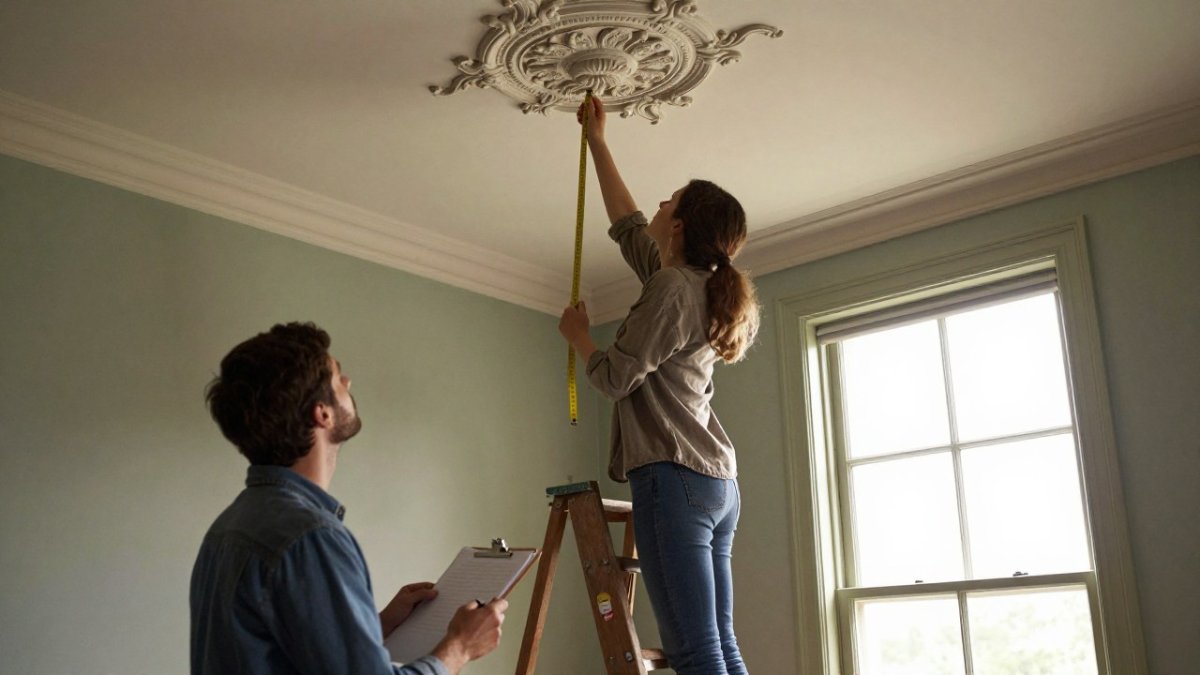
Work with a tape measure and a stepladder, and note everything in millimetres. Here is a process that works well:
- Overall diameter: measure straight across the widest point, edge to edge. On an ornate rose, measure to the outer tip of the pattern, not the flat centre plate.
- Centre hole diameter: measure the opening where the cable or fitting passes through. If the hole has been enlarged or damaged, measure the widest point.
- Depth: hold a straight edge across the ceiling beside the rose and measure from the ceiling line to the lowest point of the rose.
- Ceiling height: measure floor to ceiling at the centre of the room, not at a corner.
- Existing fitting footprint: measure the canopy of your light fitting, the plate that sits against the ceiling.
Watch out: measuring an old rose while it is still painted over is the most common source of error. Paint build-up can add several millimetres to the apparent edge, so scrape back a small section at the rim before you measure.
The Right Ceiling Rose Size for Room and Ceiling Height
The right ceiling rose size balances ceiling height against room proportions. A taller ceiling carries a larger rose; a wide room needs enough diameter that the rose reads as deliberate rather than lost.
The man is Australian.
A measurement and selection worksheet
Work through these steps in order and write each figure down in millimetres. The sequence matters: each number constrains the next.
- Ceiling height at the centre of the room. Measure floor to ceiling directly beneath the proposed rose position, not at a corner where the ceiling may dip.
- Room length and width. Measure the two longest perpendicular spans at floor level.
- Longest viewing distance. Stand at the far end of the room and note the distance to the ceiling centre.
- Cornice projection. Measure how far the cornice projects from the wall and how deep its profile runs down the ceiling.
- Light fitting canopy diameter. Measure across the ceiling plate of the fitting that will sit on the rose.
- Existing rose dimensions, if replacing. Record overall diameter, centre hole and depth as described above.
With those six figures, apply the height bands below, then adjust using the proportion checks that follow.
Sizing by ceiling height
Ceiling height is a useful starting point for ceiling rose sizes. Taller ceilings suit larger diameters because the rose is viewed from further away.
A common approach is to scale the rose diameter to the ceiling:
| Ceiling Height | Suggested Rose Diameter | Typical Rooms |
|---|---|---|
| Under 2.75 m | 300-450 mm | Modern builds, smaller bedrooms |
| 2.75-3.0 m | 450-600 mm | Federation and Colonial bedrooms, hallways |
| Above 3.0 m | 600 mm and larger | Grand living rooms, ballrooms, formal entries |
These bands are guidance, not a standard. There is no single mandated size for a ceiling rose; the right figure depends on the room and the range available.
Sizing by room dimensions and visual balance
Room size matters as much as height. A 450 mm rose in a small bedroom reads generously; the same rose in a six-metre formal lounge can look undersized. Check the rose against four visual relationships:
- Rose to room width. As a working guide, the rose diameter should sit between roughly one-eighth and one-sixth of the room's shorter span. A 4 m wide room points toward 500-660 mm; a 3 m room toward 375-500 mm. Treat this as a sanity check on the height band, not a replacement for it.
- Rose to cornice clearance. Leave a clear band of plain ceiling between the rose edge and the inner edge of the cornice. A heavily ornamented rose needs a wider clear band than a simple round, because the pattern competes with the cornice profile.
- Rose to fitting. The rose should be visibly larger than the fitting's canopy so the fitting sits within the rose rather than overhanging it.
Worked examples
- A 3.6 m by 3.2 m bedroom with a 2.9 m ceiling. The height band suggests 450-600 mm; the shorter span gives roughly 400-530 mm. The overlap points to about 450-530 mm, adjusted upward if the cornice is shallow and the canopy wide.
- A 6 m by 4.5 m formal lounge with a 3.4 m ceiling. The height band suggests 600 mm and larger; the shorter span gives roughly 560-750 mm. A rose of 650-750 mm with a deeper projection reads properly from the far end of the room.
- A 2.8 m by 2.4 m hallway with a 2.7 m ceiling. The height band suggests 300-450 mm; the shorter span gives roughly 300-400 mm. A 350-400 mm rose keeps the hallway from feeling crowded.
For period rooms, matching the rose to the room's original proportions keeps the interior details consistent. Our guide to authentic Federation style home interior details covers how those proportions work together.
Ceiling Rose Sizes for High Ceilings and Grand Rooms
High ceilings call for larger ceiling rose sizes, and going too small is a common mistake. A 300 mm rose on a 3.4 m ceiling can vanish from normal viewing distance.
For grand rooms, a rose of 600 mm or more gives the fitting a proper base and fills the visual space between cornice and light. Ornate patterns can carry extra diameter because the outer detail reads as part of the ceiling rather than a solid disc.
Matching Ceiling Rose and Light Fitting Size
Matching the rose to the light fitting means checking two things: the canopy footprint and the centre hole diameter. The rose should be visibly larger than the canopy, so the fitting sits within the rose rather than overhanging it.
As a working rule, allow at least 50-100 mm of rose diameter beyond the canopy edge on each side. A chandelier with a wide ceiling plate needs a correspondingly larger rose.
Centre hole diameter is the practical constraint. The hole must clear the cable and any threaded tube or fixing that passes through it. For period-appropriate fittings to pair with your rose, see our period lighting ideas for Colonial homes.
Round, Rectangular and Ornamental Styles: What Each Size Suits
Round roses suit most rooms because the circle reads evenly from every angle. Rectangular roses work where the ceiling has a linear feature, such as a central beam or a long dining table beneath it.
The practical difference is how much plain ceiling each shape needs around it. A heavily ornamented rose of 600 mm needs more clear space than a simple round of the same diameter, or the pattern competes with the cornice.
How each shape is measured
- Round roses are specified by a single overall diameter, measured edge to edge across the widest point of the pattern. Depth is quoted separately.
- Rectangular roses are specified by length and width, and both matter when comparing products. A 900 mm by 600 mm rectangle covers a different footprint from a 750 mm by 750 mm square of the same area, and the longer axis should generally run along the room's longer sightline or the beam it sits beneath.
- Ornamental and oval roses are measured on their longest and shortest axes, with the pattern's outer tips included. Note the centre hole position too, because an off-centre hole changes how the rose sits relative to the fitting.
When comparing products from different makers, check whether the quoted diameter includes the outer ornament or only the flat centre plate. A rose quoted at 600 mm including ornament may have a centre plate of only 400 mm, which changes how it reads against the cornice.
Matching shape to room and fitting
- Round for centred fittings. The safe choice when the fitting is centred in the room and viewed from multiple directions.
- Rectangular for linear features. Use where a beam, long table or corridor axis gives the ceiling a clear direction. Align the long axis with that feature.
- Ornamental for period rooms. Victorian acanthus, Federation floral and similar patterns suit rooms with matching cornice and ceiling detail. The larger the pattern scale, the more clear ceiling it needs.
Centre hole and fitting compatibility
The centre hole is the constraint that decides whether a rose can be used at all, regardless of its outer size. The opening must clear the cable and any threaded tube, nipple or fixing that passes through it, with enough room for the fitting's canopy to sit flat against the rose face.
- Measure the stem or tube diameter of the fitting, not just the cable.
- Check that the canopy diameter is smaller than the rose's flat centre area, not merely the overall diameter. On an ornate rose, the canopy must sit within the flat zone before the pattern rises.
- If the existing hole has been enlarged or damaged, measure the widest point and plan to bridge or pack it so the fitting sits square.
For period-appropriate fittings to pair with your rose, see our period lighting ideas for Colonial homes. For era-specific styles, our guide to period lighting for Federation homes shows how ornamental roses pair with the fittings of the period.
Plaster vs Lightweight Roses: Weight, Installation and Ceiling Compatibility
Plaster and lightweight roses differ in weight, fixing method and how they suit a period ceiling. Plaster gives the crisp detail and solid feel of an original rose. Lightweight alternatives are easier to handle overhead, which matters on a tall ceiling or a solo installation.
The deciding factor is usually the ceiling itself. Before committing, read our guide on how to install ornate ceiling roses correctly for the fixing methods that suit each material.
Request a Ceiling Rose Selection Check Before You Order
Ordering the wrong diameter is the most common and most avoidable mistake in this process.
If you are weighing up whether paid advice is worth it, our guide on whether professional restoration advice is worth it explains what a selection check covers.
Choosing a ceiling rose is a measurement task before it is a style decision. Send us your room's dimensions and ceiling height, and our team will help you narrow the range to the roses that will actually fit.
Frequently Asked Questions
What size plaster ceiling rose do I need?
Start with your ceiling height. For ceilings under 2.75 m, a rose of roughly 300-450 mm suits most rooms; for 2.75-3.0 m, look at 450-600 mm; above 3.0 m, 600 mm or larger keeps the rose in proportion. Then check the room's floor area and your light fitting's canopy width. These are rules of thumb rather than a fixed standard, so use them as a starting point and adjust for the visual weight of the room.
How do I measure a ceiling rose before ordering?
Measure the existing rose's full diameter across its widest point, then the centre hole diameter where the cable passes through, and finally the depth from ceiling to the rose's lowest point. If you are replacing a rose, also note the ceiling's condition and the light fitting's canopy diameter. Record all three figures in millimetres and compare them against the product listing's diameter range before you order.
Should a ceiling rose be wider than the light fitting?
Yes, as a general guide. The rose should be wider than the light fitting's canopy so the canopy sits within the rose's flat centre rather than overhanging its decorative edge. If the canopy is wider than the centre section, the fitting can look unbalanced and may not sit flush. Measure the canopy diameter first, then choose a rose whose centre flat area comfortably exceeds it.
Can a ceiling rose be too large for a room?
It can. An oversized rose on a low ceiling or in a small room dominates the space and can make the ceiling feel lower. A rose that is too small for a grand room, by contrast, looks lost. Balance the rose against both ceiling height and floor area, and remember that highly ornamental patterns read as visually heavier than plain round designs at the same diameter.